
The Anthropic Institute published Economic Scenarios for Transformative AI, a 2026-2030 framework that maps assumptions about AI capability, adoption, productivity, and job search into U.S. GDP, wages, labor share, and unemployment. The authors say the scenarios are not predictions and attach no probabilities.
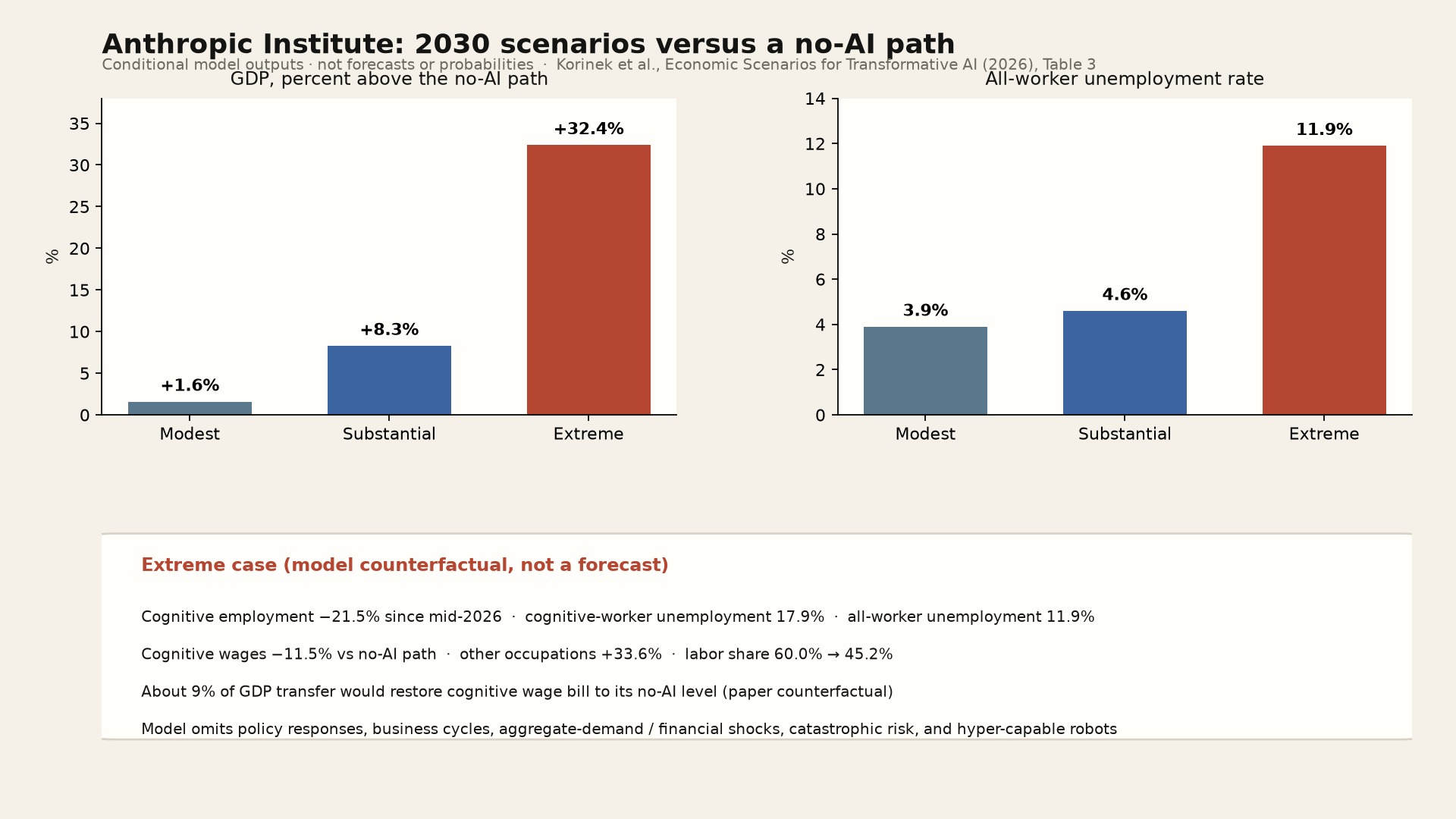
In the model's three highlighted 2030 paths, GDP finishes 1.6%, 8.3%, and 32.4% above a no-AI baseline in the modest, substantial, and extreme cases, with annual GDP growth of 2.4%, 5.4%, and 15.4%. Those figures are Anthropic Institute model outputs conditional on the paper's inputs, not a single forecast.
Labor outcomes diverge by occupation group and by metric. In the substantial case, cognitive employment is 3.9% below its mid-2026 level while all-worker unemployment is 4.6%. In the extreme case, cognitive employment is 21.5% lower, cognitive-worker unemployment reaches 17.9%, and all-worker unemployment reaches 11.9%. Employment decline and unemployment rates are different measures.
Wage and income shares also split. In the extreme case, average wages are 9.7% above the no-AI path, but cognitive wages are 11.5% below it while other-occupation wages are 33.6% above it. Labor's share falls from 60.0% to 45.2% even as total labor income stays near its no-AI level. A model counterfactual in the paper says restoring the cognitive wage bill would require about 9% of GDP in transfers, not a current fiscal proposal.
Independent desks treated the release as scenario analysis. University of Virginia Darden summarized the same unemployment range. Euronews on Sept. 11, 2026, stressed that the authors reject forecast framing while reporting the extreme case's 15.4% annual growth and 11.9% economy-wide unemployment. Marginal Revolution relayed the roughly 9% of GDP transfer counterfactual and noted that a falling labor share need not cut aggregate labor income.
An August Anthropic survey of 10,980 U.S. adults maps at the median near the substantial path when run through the model: GDP about 8.6% above the no-AI baseline and all-worker unemployment around 4.6% by 2030. The model omits policy responses, business cycles, aggregate-demand or financial-market disruptions, catastrophic risks, and hyper-capable robots. What remains open is which capability and adoption path the U.S. follows, and which institutions would share gains if knowledge-work displacement rises.