
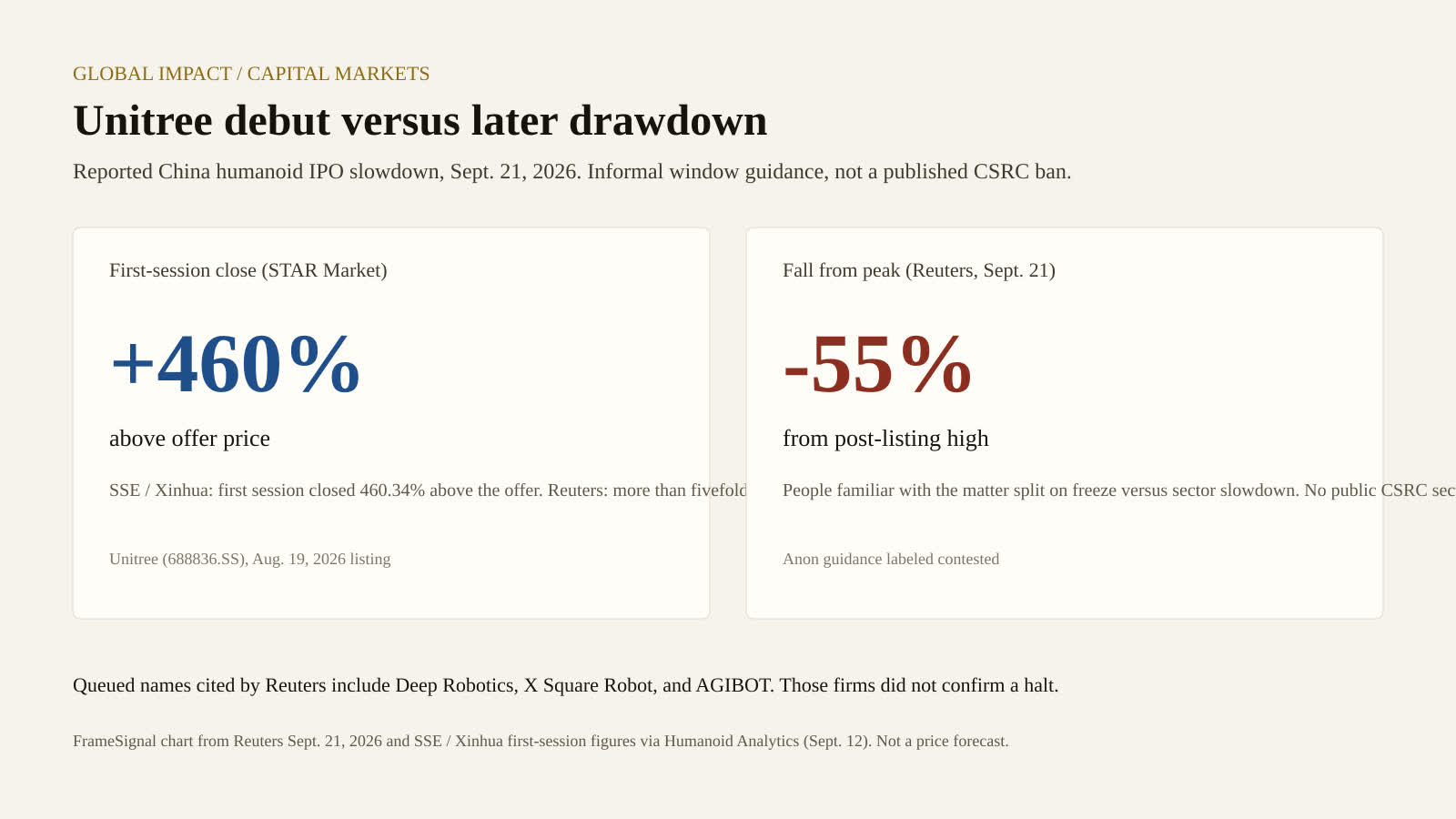
Reuters reported on Sept. 21, 2026, that Chinese regulators are slowing a rush of humanoid-robot listings while they test whether high valuations and revenue tied to state-backed projects reflect commercial demand. The report matters because queued Chinese humanoid listings and the private-market prices behind them now sit behind a higher, still unpublished bar for public-market access, even as Beijing keeps embodied intelligence as a national priority.
People familiar with the matter, speaking anonymously, said regulators had used informal window guidance to hold back some listings. One said humanoid IPOs had effectively been frozen. Another said there was no formal ban and described a sector-specific slowdown. That freeze-versus-slowdown split is contested. The China Securities Regulatory Commission did not respond to Reuters, and this pack found no public CSRC filing that enacts a humanoid-sector ban.
The people said the slowdown was triggered mainly by Unitree Robotics, whose shares rose more than fivefold in a Shanghai STAR Market debut about a month earlier and have since fallen 55 percent from their peak. Humanoid Analytics, writing Sept. 12 from Shanghai Stock Exchange records, put Unitree's first-session close at 460.34 percent above the offer price and said that volatility makes a regulatory response commercially plausible without verifying a new listing standard.
The Information first reported on Sept. 9 that the CSRC had given informal guidance to some banks and investment firms, raising the bar so applicants would need recurring revenue, progress toward narrower losses, or meaningful technological innovation. Reuters on Sept. 21 independently reported the slowdown from people familiar with the matter. At least half a dozen firms, including Deep Robotics, X Square Robot, and AGIBOT, are preparing to list, Reuters said. Those three companies did not respond on whether their plans had slowed.
Regulators are focusing on whether revenue from local-government-backed projects can be sustained, one person close to humanoid-robot investors told Reuters. Data-collection centers and joint ventures in which local governments could supply 80 to 90 percent of initial investment had generated significant revenue for some companies, and the same person estimated some valuations could fall 60 to 70 percent if that revenue were stripped away. Mech-Mind Robotics chief executive Shao Tianlan alleged in a WeChat post this month that some highly valued embodied-AI firms were generating revenue through data-collection centers, related-party deals, and other unsustainable arrangements as they raced toward IPOs. Shao declined to comment beyond the post.
Executives and investors said the tighter stance is not a retreat from humanoid robotics. Ruiying Zhao, a senior research analyst at S&P Global Market Intelligence, said investor sentiment was shifting from blanket euphoria to selective rationality. A senior banker involved in Asian equity offerings told Reuters that investors still want to finance robotics companies but asked whether the use case is factory work or robots dancing around, saying the volume has not caught up with the hype. What remains open is whether the CSRC publishes a sector rule, whether delayed or rejected applications confirm a freeze, and how much of the queued pipeline clears a higher commercial bar.