
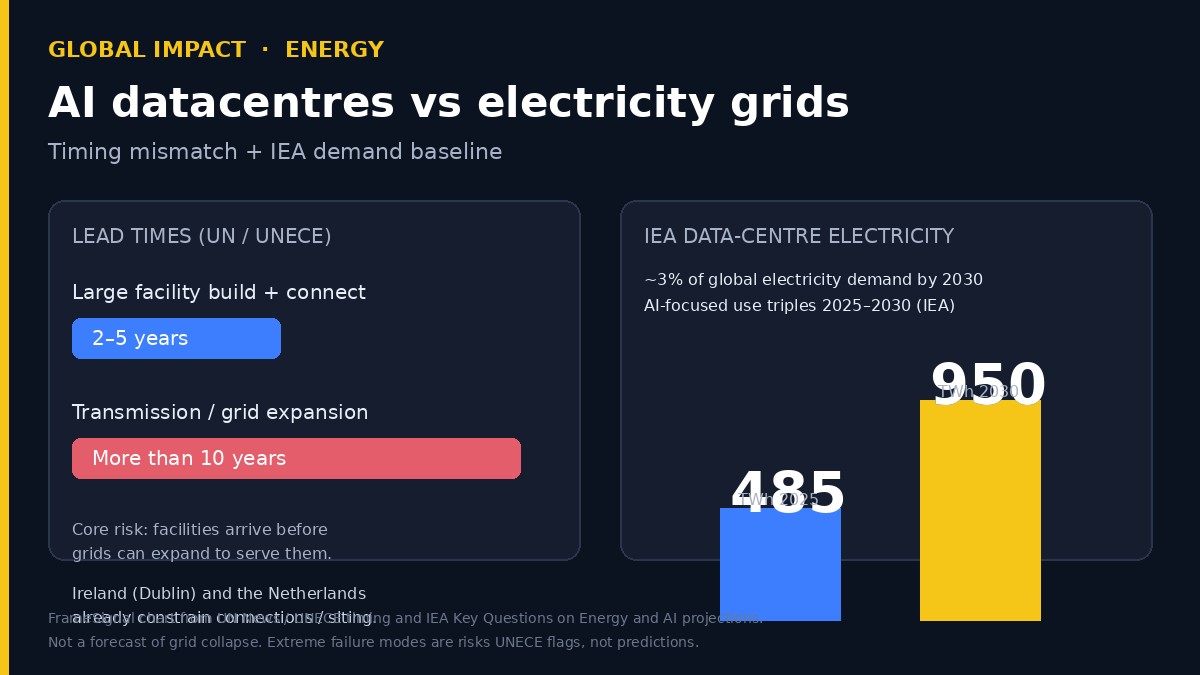
The United Nations Economic Commission for Europe warned that AI data centres and other energy-intensive facilities are being built faster than the power grids needed to supply them, putting electricity-system reliability and resilience under pressure worldwide. UN News carried the warning on Sept. 8, 2026.
The global scale is material but still bounded. The International Energy Agency projects data-centre electricity consumption will nearly double from 485 terawatt-hours in 2025 to 950 TWh in 2030, or around 3% of global electricity demand by that date. The IEA separately says AI-focused data-centre consumption grew 50% in 2025 and is expected to triple between 2025 and 2030, while overall data-centre demand grew 17% in 2025.
The timing mismatch is the core systems risk. UN News says a large facility can often be built and connected in two to five years, while transmission and other grid expansion can take more than 10 years because of planning, approval and construction processes.
UNECE frames a technical failure mode rather than an inevitable collapse. UN News reports worries that volatile AI loads can be hard for renewable-heavy grids to balance in real time, and that overloading can contribute to voltage oscillations, unintended disconnections and cascading failures in extreme cases. Ireland has introduced connection restrictions in Dublin, and the Netherlands has constrained where data centres may be built.
The policy problem is also distributive. UN News reports no consistent framework for dividing grid-upgrade costs among data-centre developers, electricity companies and consumers. The IEA adds that uncertain peak load and the mismatch between fast-moving projects and slower energy investment can misalign system spending and raise local electricity-price risks if unmitigated.
UNECE is calling for greater regulation, information-sharing and coordination, including better visibility into real-time electricity use and more strategic siting. The IEA's response framework is broader than a demand warning: manage project pipelines and grid investment proactively, use flexibility such as non-firm connections, demand response and storage, and remove policy barriers so AI can also improve energy-system security and sustainability. What remains open is how quickly jurisdictions close the lead-time gap and who pays when concentrated data-centre demand lands on constrained grids.