
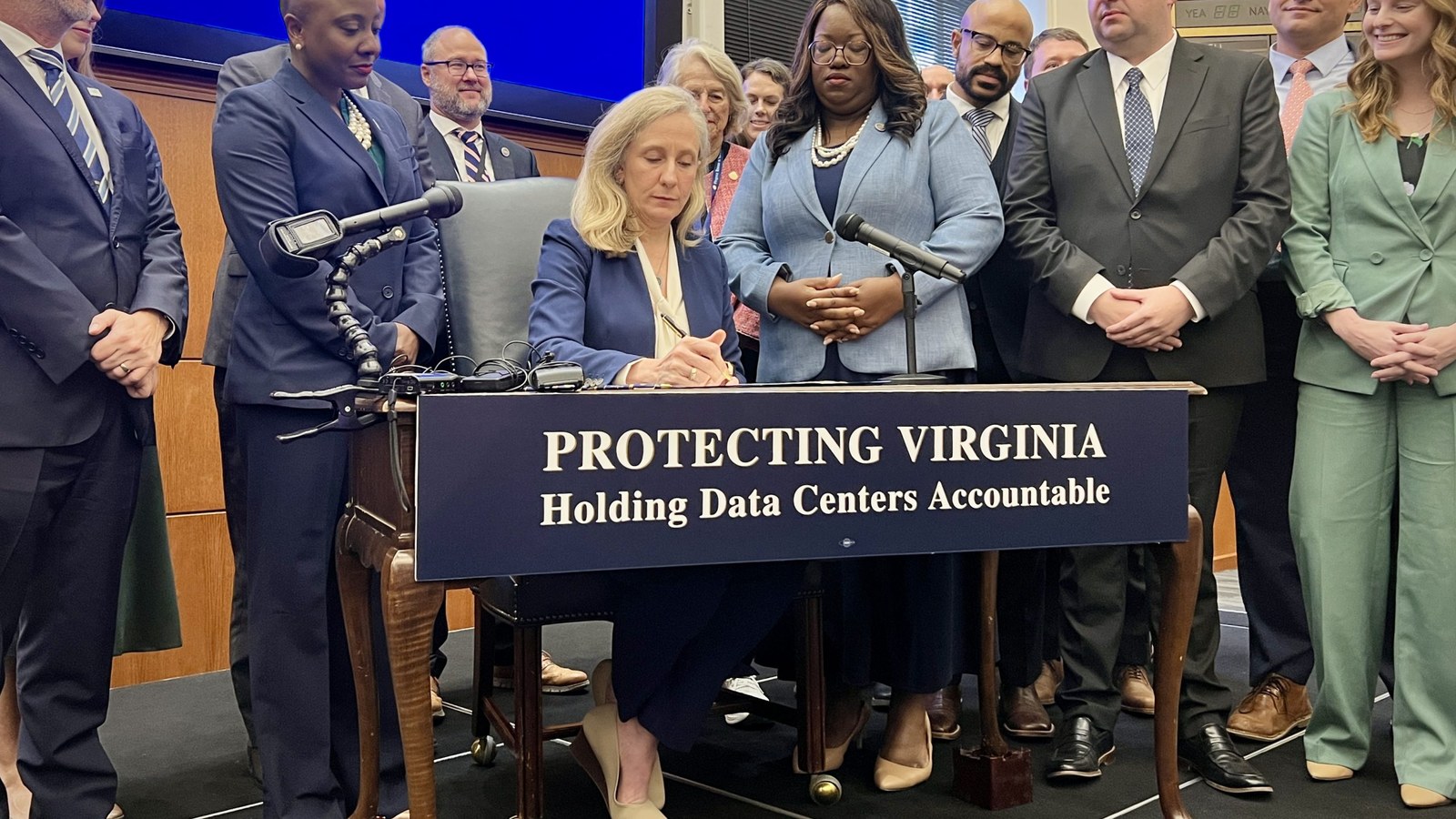
Virginia Gov. Abigail Spanberger on Sept. 18, 2026, signed Executive Order 22, barring supervised executive-branch agencies from nondisclosure agreements that hide material data-center project information, cutting new projects at or above 25 megawatts of peak demand out of VEDP expedited site programs, and creating a rapid-response AI Task Force. The order matters because Virginia hosts the densest U.S. data-center corridor, so immediate state secrecy limits, incentive gates, and a standing AI labor-and-risk task force change near-term permitting and ratepayer stakes even though ending by-right local approval still needs 2027 legislation.
Unlike a statewide development moratorium or a statute that would end sales-tax exemptions, EO 22 is a state executive order aimed at agencies under the governor. It does not pause new applications and does not repeal data-center tax breaks. The companion Data Center Accountability Framework and agency press mix EO-now directives with 2027 General Assembly priorities. Cardinal News reported that the NDA ban covers state entities and employees, not local officials, and that eliminating by-right approval for projects above 25 MW is framed as legislation, not present EO force.
Effective on signing, executive-branch agencies, boards, commissions, authorities, and other employees under the governor's supervision may not enter into, enforce, or require nondisclosure agreements that prevent public disclosure of material information about a proposed commercial data-center development, its incentives, resource demands, or community impacts. Existing NDAs are to be honored absent extraordinary or national-security circumstances. The same order bars VEDP from assisting new data-center projects with anticipated peak demand of 25 MW or greater through the Virginia Business Ready Sites Program, any expedited permitting program, or similar discretionary state site-readiness or expedited-review programs.
Within 120 days, the Office of the Chief Energy Officer must publish an initial Data Center Planning and Community Engagement Toolkit for local governments. Within 180 days, DEQ must deliver accelerated workplans for data-center noise rulemaking and for cooling-water scarcity rules, with the Eastern Virginia Groundwater Management Area designated a cooling-water scarcity area, and submit findings from a cumulative-impact review of diesel and other backup generation. Virginia Works, with the Secretary of Labor, must develop project-level workforce data-collection criteria within 180 days. The Chief Energy Officer is also directed to advocate with utilities, the State Corporation Commission, and PJM for cost allocation that shields households from large-load infrastructure costs.
EO 22 creates a rapid-response AI Task Force co-led by the Chief Transformation Officer, Counsel to the Governor, and the Secretary of Administration, supported by a new AI Policy Planning Unit. Its remit includes workforce displacement, data privacy, cybersecurity risks from AI agents and bots, coordination with frontier developers including Anthropic, OpenAI, xAI, Meta, Amazon, and Microsoft, and continuous reporting to the governor. The order rescinds Youngkin Executive Order 30 (2024) and Executive Directive 5 (2023). GovTech corroborated that some Framework items begin immediately through EO 22 while others, including ending by-right approval and broader utility mandates, still need General Assembly action.
What remains open is how localities use the Toolkit, how high DEQ sets noise and cooling-water rules, whether the 2027 session writes by-right limits and a statewide commercial NDA ban into law, and how the AI Task Force turns continuous reporting into concrete executive or legislative proposals. Industry and developer responses were not independently verified in this pack.