
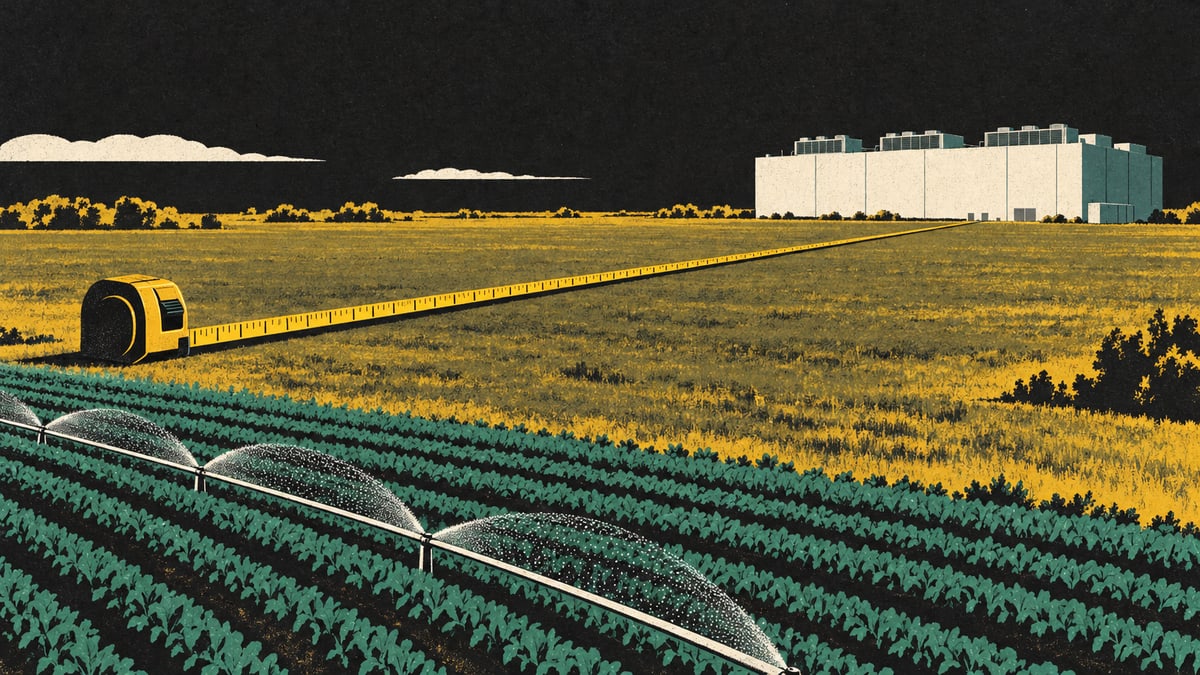
Alberta's government introduced a bill on Nov. 18 meant to set where large data centers can be built in the Canadian province. Data centers are buildings full of computers that run online services, and the bill's definition names artificial intelligence, cloud computing and cryptocurrency mining among their uses. The government says the bill and the rules that would follow it would keep data centers that draw 10 megawatts or more at least 600 meters (about 2,000 feet) from the nearest home. Megawatts measure how much electricity a site uses at any moment. They also would be kept off the province's highest-quality farmland, about 14 million acres, and off land that is watered by irrigation.
The government says the rules answer what people told it at four town halls in August and September and in a survey. "Albertans told us what matters most: their communities, farmland and water," said Nate Glubish, the minister of technology and innovation. According to a news report, the province said about 30 percent of current data center proposals would likely be affected, though it could not give an exact figure.
Beyond location, the government says data center builders would pay for the power lines inside their own sites, so those costs are not passed on to other electricity customers. The government says this builds on rules already in place, which make data centers show they won't put the power grid at risk and cut their own power use first in an emergency. Existing noise rules would still apply. The government also plans a provincewide standard to bring the water data centers use for cooling close to zero, and says they would have to be designed and run so their waste heat can go to greenhouses, industry or homes. The Alberta Utilities Commission, the province's utility regulator, would become the main overseer of data centers of 10 megawatts or more. Under the bill, data centers above a size the regulations set (10 megawatts, the government says) could not be built or run without its approval. Projects the regulations count as far enough along when the law takes effect would be spared that step. The bill also says that when a data center is judged on whether it serves the public interest, what its computers do and how its data is used are not to be considered.
The plan has exceptions. Glubish said data centers in designated industrial zones and on old industrial sites could be exempt from the distance rule, according to a news report. The government says industrial zones, old industrial sites and existing power plant sites would be recognized as places for data centers, and local governments could ask the regulator for a different distance from homes where local planning supports it. Until Sept. 20, 2027, building on protected farmland would need a special order from the provincial cabinet, which the bill lets the cabinet grant. After that date the bill drops the cabinet step, and any limits on farmland would come from the regulations. Under the bill, data centers already being built or running when the law takes effect would be treated as already approved by the regulator, though they would still have to follow the act's other rules.
Nathan Ip, who speaks for the opposition New Democrats on technology, called the bill too little and too late, a news report says. He said it would apply only to new proposals, "so all of the projects that have been approved will not be impacted in any way."
The same bill raises the top fine for a company that knowingly causes serious environmental contamination from $1 million to $6 million, and the government says the higher fines would apply across industries, data centers included. It also requires energy companies to set aside money to close and clean up new oil and gas wells, changes forestry rules, raises fines for illegal dumping, and repeals a 2016 cap on oil sands emissions that was never put into effect.
The bill itself does not contain the 600-meter distance, the 10-megawatt cutoff, the irrigated land ban or which farmland is protected, and it leaves them to regulations the cabinet would write. If the bill passes, the government says detailed rules would be set in regulations worked out with towns, industry, Indigenous communities and Albertans, and it has not said when they would take effect. The bill's data center rules would start on a date the cabinet sets.