
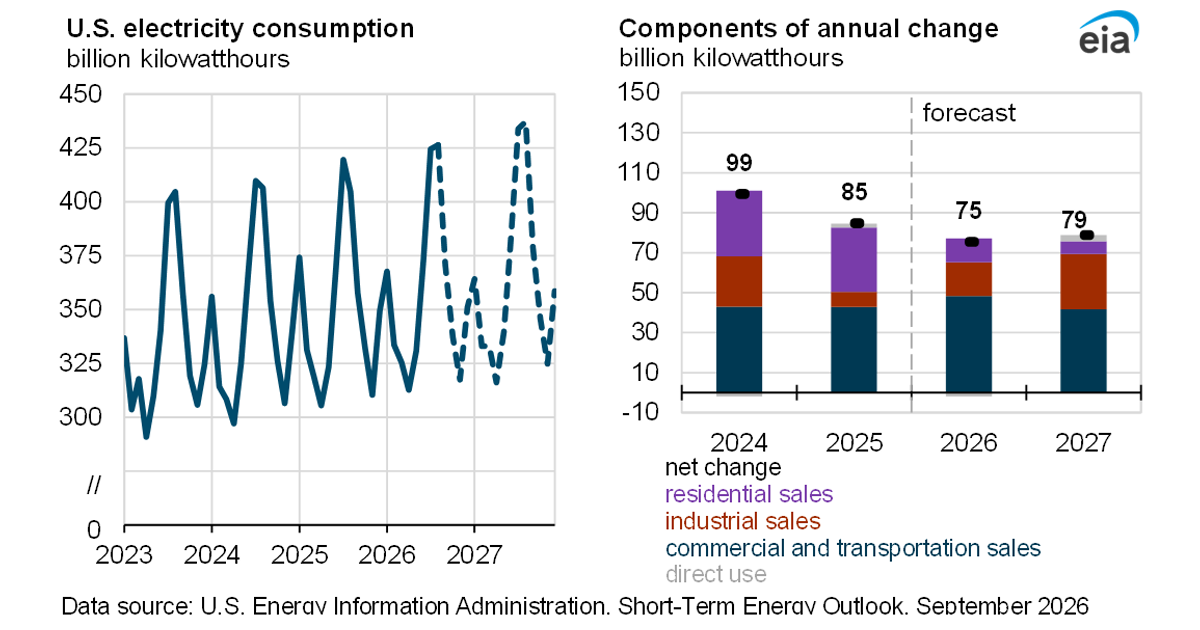
The U.S. Energy Information Administration said on Sept. 9, 2026, that U.S. electricity sales will hit record levels of 4,135 billion kilowatthours in 2026 and 4,211 BkWh in 2027, according to its September Short-Term Energy Outlook.
EIA attributes the climb to data-center development and increased manufacturing activity in the commercial and industrial sectors. Commercial sales are forecast to rise 3.3% in 2026 and 2.7% in 2027, accounting for most of the incremental load those years, with industrial sales adding further growth.
A companion EIA press release says U.S. electricity generation will grow 2.2% to a record 4,368 BkWh in 2026, with an additional 1.7% increase in 2027, as generators chase the same demand surge. Those generation figures are distinct from the sales totals in the STEO overview.
Despite a pause in connecting new data-center projects in Texas to the grid, EIA still expects the West South Central region to account for the largest share of national electricity-sales growth, nearly 20% in 2026 and nearly 40% in 2027. Governor Greg Abbott on Aug. 3, 2026, directed the Public Utility Commission of Texas and ERCOT to audit data-center interconnection requests before projects move forward, citing more than 474 GW of connection requests, about 90% of them data centers.
Independent coverage framed the STEO as an AI-and-electrification demand story and highlighted commercial load overtaking residential sales in EIA's 2026 path. Reuters published a parallel set of demand figures that do not match EIA's sales totals line for line, so the agency's STEO text remains the controlling primary for FrameSignal numerals.
What remains open is how long the Texas audit freezes new load, whether West South Central growth holds once delayed projects clear or die, and how much of the commercial surge EIA attributes to data centers will show up as firm metered load rather than interconnection-queue aspiration.