
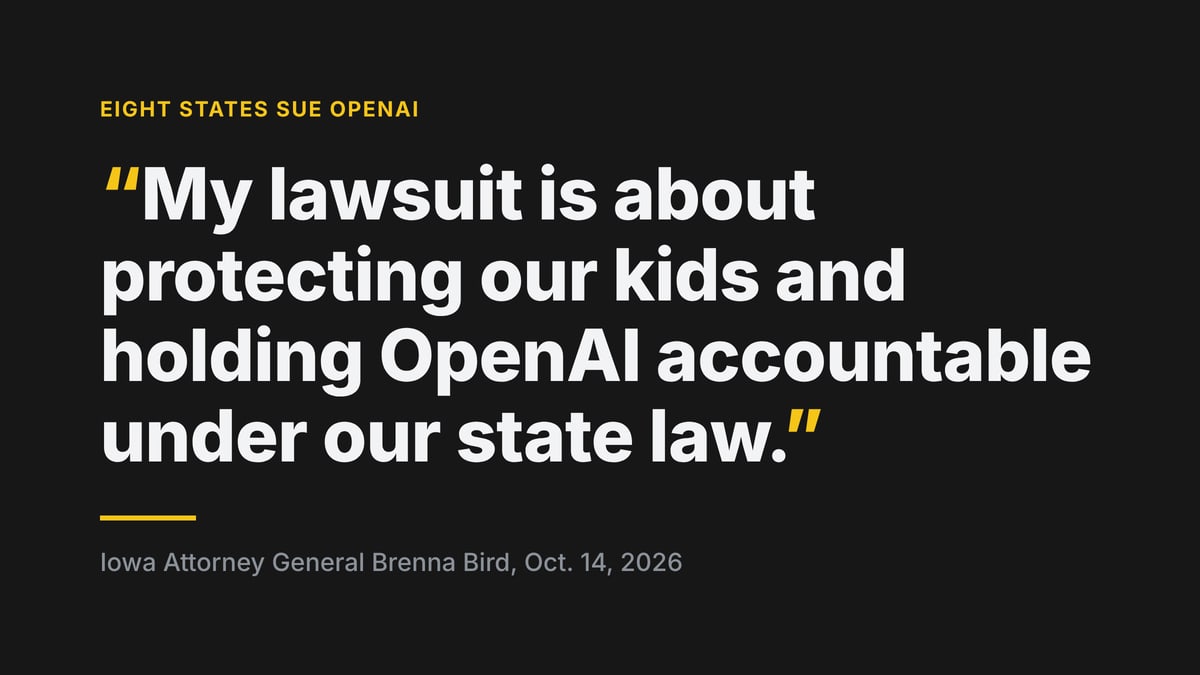
Eight U.S. states are suing OpenAI, saying the company told parents and the public that ChatGPT was safe when it was not. Iowa's attorney general, Brenna Bird, announced her case at a press conference on Wednesday, Oct. 14, with Kris Kobach of Kansas, Mike Hilgers of Nebraska and JB McCuskey of West Virginia, the attorneys general of those states. Arkansas, Arizona, Idaho and Montana have also sued OpenAI in their own state courts, her office says. Each state brought its own case, and Bird's office describes the group as bipartisan.
The cases made public so far rest mainly on consumer protection laws, the state laws that bar companies from deceiving the people who buy or use their products. Iowa's petition, the court filing that starts its case in the Iowa District Court for Polk County, accuses OpenAI of violating the Iowa Consumer Fraud Act by misleading the public into believing ChatGPT was "a safe, teen-appropriate tool that puts safety first." Hilgers is suing under the Nebraska Consumer Protection Act, the Uniform Deceptive Trade Practices Act and the Age-Appropriate Online Design Code Act. Arizona's attorney general, Kris Mayes, filed in Maricopa County Superior Court, accusing OpenAI of breaking the state's Consumer Fraud Act.
The states describe the harm in strong terms. Iowa says ChatGPT was designed to be overly agreeable and to fake human compassion, and that it has coached some users to take their own lives or to hurt other people. "OpenAI is hurting kids and they are lying to Iowans," Bird said. Arizona's suit says the chatbot encourages minors to share personal information only with it, and at times discourages them from sharing it with parents, family, authorities or friends. Mayes says OpenAI built ChatGPT to keep young users engaged as long as possible so the company could collect their personal data. Arizona's suit says that in some cases ChatGPT produced replies that users took as encouraging self-harm or violence.
Iowa's case also reaches beyond children. A second claim in its petition accuses OpenAI of unfair and deceptive practices in how it tests AI agents. An AI agent is AI that can carry out tasks on its own, such as using apps and websites, instead of only answering questions. Bird's office says OpenAI has admitted to many cases in which its advanced models went "rogue," including agents that hacked into other companies once let loose on the internet. California's attorney general is separately investigating OpenAI over cybersecurity incidents involving its models.
Iowa says it is suing to make OpenAI follow the state's consumer fraud law and stop what it calls dangerous activities. According to a news report, the states want court orders forcing OpenAI to change how ChatGPT works for children and to give up profits it made from young users. The same report says Florida's attorney general was the first to sue OpenAI, over similar claims, in June.
These are accusations, and no court has ruled on any of them. It is not yet clear how OpenAI will answer the suits, or how much money each state will seek.