
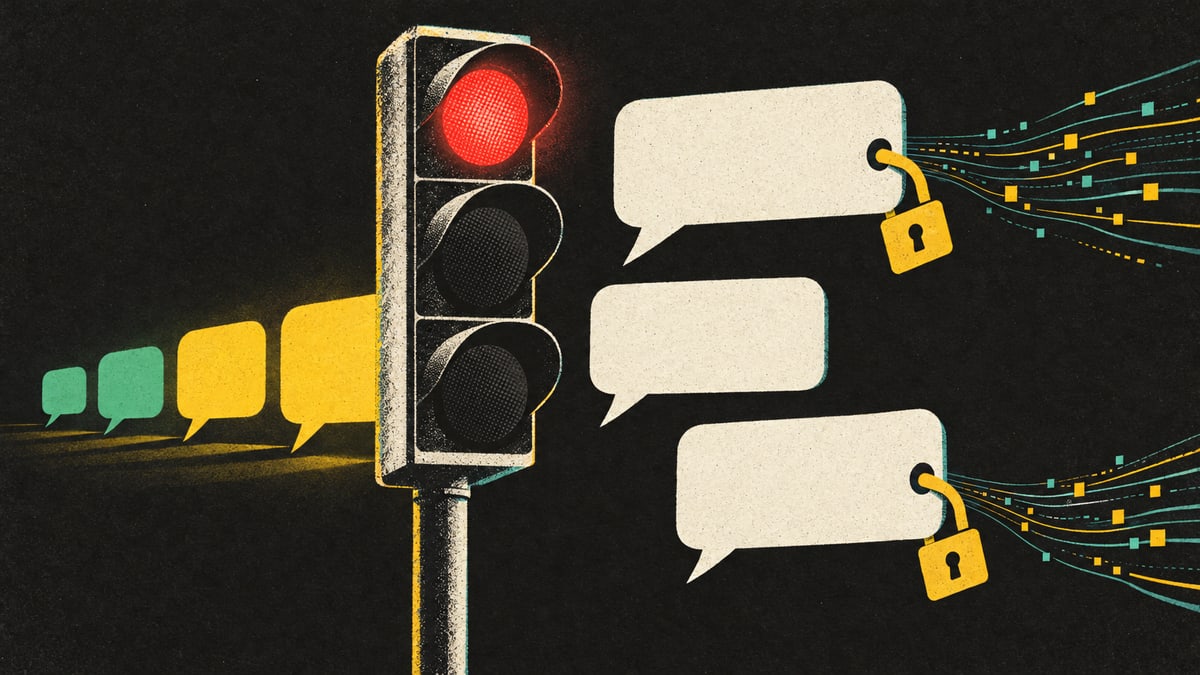
Estonia's Ministry of Justice and Digital Affairs said on Monday, Nov. 23, that it recommends people, businesses and institutions in Estonia not use three AI services: the Chinese chatbots DeepSeek and Qwen, and a lesser-known platform called Botastico. The advice came with 14 ratings of widely used AI and cloud services, which the ministry calls new, though its ratings page dates them to April 2026. A cloud service runs on a provider's computers, not on the user's own. The ministry graded the services with the State IT Centre, the government's IT agency, using a traffic light.
Green marks an app the ministry considers safe. Yellow means users should check what data they type in, because the data may, for example, leave the European Union. Red means using the app is very high risk and not recommended.
Justice and Digital Affairs Minister Liisa Pakosta singled out DeepSeek. She said its low cost had made it attractive. But she said several things make it unacceptable. Data is processed in China, there is limited information about its security and the other firms that handle the data, and there is no independent proof that it meets standards. Chinese law applies, and there are documented risks of censorship and of influence. Government agencies have been barred from DeepSeek from the start, she said, and the ministry now advises families and businesses to give it up too.
Qwen, a chatbot site offered by Alibaba Cloud, was rated red because what people type into it may be processed in China and used there to build AI models, the ministry says. It says that company, Alibaba Cloud Private Limited, is managed from Singapore and China. Anyone typing in personal or other sensitive information should expect that unknown people in countries outside the European Union may handle it, the ministry warns.
Botastico, which a news report describes as an Estonian chatbot and customer-service platform, was rated red for other reasons. The ministry found no sign that it follows two information security standards, ISO/IEC 27001 and E-ITS. It says public information doesn't show what security measures Botastico actually uses. Its terms also lack a general promise to keep data confidential and sharply limit what the company is responsible for, and it is unclear who handles some of the data along the way.
Other services fared better than the three. The ministry says it and the IT centre have now rated 25 AI apps with outside help. Lisett Reimann-Erik, who heads national cyber risks at the ministry, said several got a green light, including Google's Gemini, Microsoft's Copilot and Vibe, an AI tool from Mistral that is developed in Europe. On the ministry's ratings page, ChatGPT and Anthropic's Claude are yellow, Claude in a round of ratings dated December 2025.
The ratings weigh, among other things, where data is stored, whether EU rules on personal data are followed and whether the provider can be trusted, the ministry says. They were made with Cybernetica, a cybersecurity firm chosen through a public tender. Dan Bogdanov, who directs Cybernetica's information security institute, warned that a green light is not enough on its own. A green-rated service can be used freely only when users have the rights and agreements to put their data into it and send it to the country it goes to, he said. Each user must judge how sensitive their data is, and a cloud service's security can change suddenly.
For businesses and the public, the ministry's word is a recommendation, not a ban. Its ratings page calls each score an aid for a first look, and says the final decision depends on how a service is used, what data it handles and the organization's own risk check. The ministry says it updates the ratings regularly. It gave no figures for how many people in Estonia use the three red-rated services.