
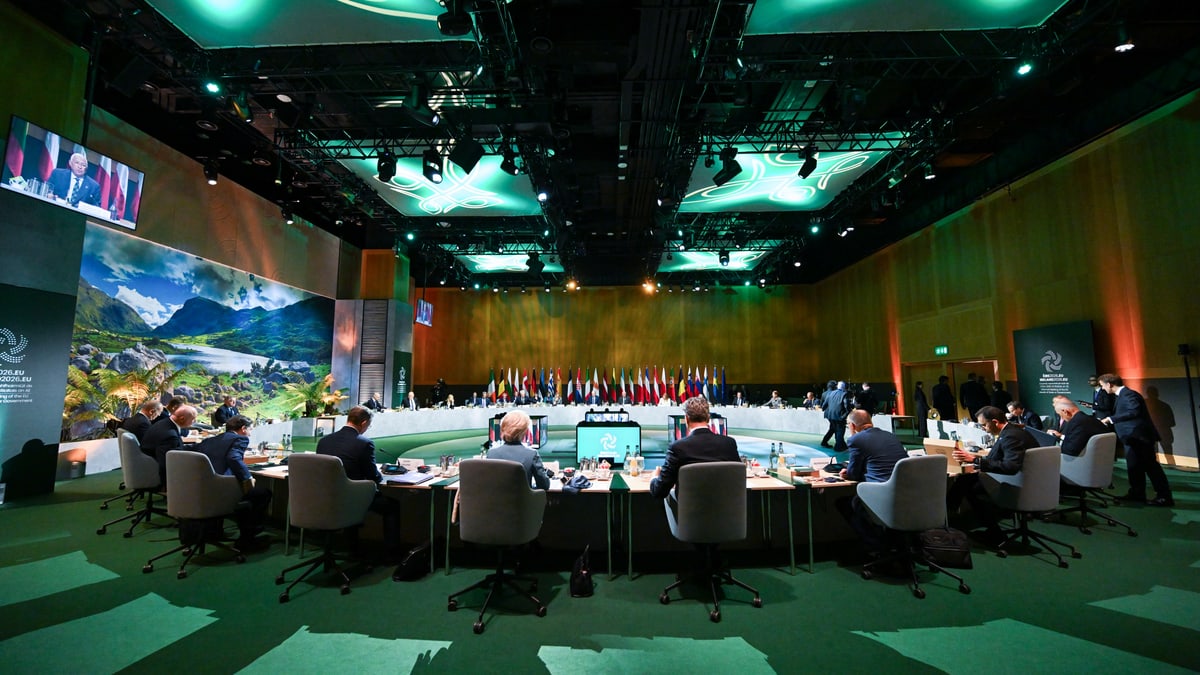
EU leaders met in Dublin on Nov. 13 for their first in-depth discussion on artificial intelligence. The meeting was an informal session of the European Council, the gathering of the EU's presidents and prime ministers, and it covered two questions: how AI can make Europe's economy more competitive, and what it means for society, safety and security.
Two guests joined them. One was Arthur Mensch, chief executive of Mistral AI, a Paris company that builds advanced AI models. The other was Geoffrey Hinton, who shared the 2024 Nobel Prize in Physics for his work on artificial neural networks, the research that paved the way for today's AI systems.
Leaders will come back to the subject. European Council President António Costa, who spoke for the leaders after the meeting, said they will take up AI again at an informal leaders' retreat at Alden Biesen on Feb. 5, 2027. He also said AI and its effects on society will be the central theme of a 2027 summit with unions and employers, marking 10 years of the European Pillar of Social Rights. He gave no date for it.
Both presidents talked about money. European Commission President Ursula von der Leyen said Europe's push to have its own chips, computing and advanced AI will need at least €500 billion in investment, by the Commission's own estimate. She said what is missing are large investments in chips, computing power and the most advanced AI. She said leaders showed "a shared will" to put forward funding ideas, and that she will follow up with "an ambitious proposal". Costa said catching up with Europe's "global peers" will take "significant extra efforts" in funding, and that the EU's next long-term budget, especially a planned European Competitiveness Fund, will play a decisive role. Mensch told the leaders that Europe needs speed, financing and strong coordination between member countries, according to a news report.
A note prepared for the leaders says Europe remains heavily dependent on providers from outside Europe for computing power, advanced AI models, chips, cloud services and AI software. Von der Leyen pointed to what the EU has done so far. She said it has opened its supercomputers to researchers and startups through 19 "AI factories" across Europe, and is now planning seven "AI gigafactories", for which it is lining up about €30 billion. She said the gigafactories will give startups the computing power to build the most advanced AI models.
On the risks, discussed with Hinton, the European Council's summary says leaders covered protecting people's rights, including children's; protecting elections and other democratic processes; AI's effect on jobs; the power of a few large companies over the market; and security threats such as cyberattacks. Costa said the EU is the first region in the world with rules for governing AI, its AI Act, and wants to use that experience to shape global standards at the G7, the G20 and the United Nations.
Neither Costa nor von der Leyen said how big the funding proposal will be or when it will come. Von der Leyen said the money should come from private investors as well as the next EU budget, but did not say in what shares, or over how many years the €500 billion would be spent. The meeting was informal, and the European Council's summary describes discussions on AI, not decisions.