
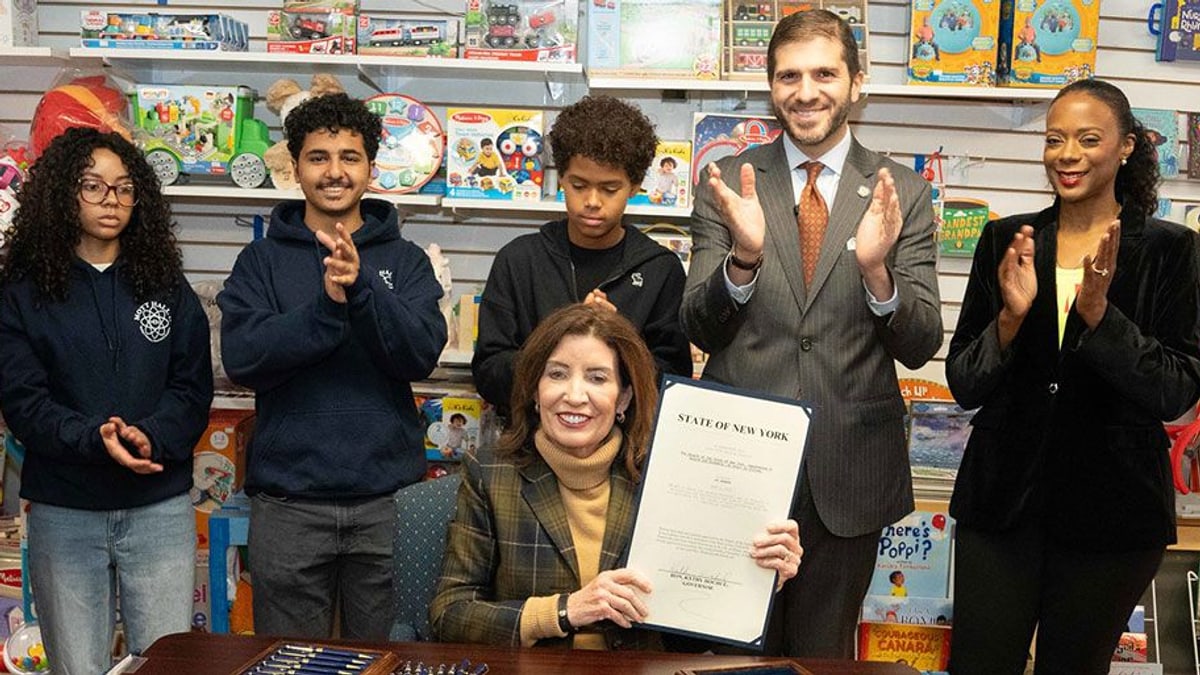
New York Gov. Kathy Hochul signed a law on Tuesday, Nov. 24, that pauses the sale of AI chatbot toys in the state for five years. The law bars any person or business from making, trading, holding for sale, distributing or selling such a toy in New York. The governor's office gives talking stuffed animals, dolls and robots that use the internet to talk with children as examples. New York already requires AI companions to watch for talk of self-harm and to tell users at the start of each chat that they are not human, and an October law bars some unsafe chatbot features for minors.
The ban turns on what counts as a chatbot toy. The law defines it as a children's toy with an AI companion built into it or integrated with it, and borrows the meaning of AI companion from an earlier New York law. Under that law, an AI companion is a system that uses AI to mimic a lasting relationship with a user, such as a friendship. The law lists three things it does, joined by "and": it remembers past chats and the user's preferences, asks emotional questions on its own beyond answering what the user asked, and keeps up a running conversation about the user's personal life.
Systems a business uses only for customer service or internal work, and systems mainly designed and marketed to save time or help with research or technical tasks, are left out. The other half of the test is the toy itself. Under the federal definition the law uses, a children's toy is a product its maker designed or intended for a child 12 or younger to play with.
Enforcement falls to the state. The attorney general can go to court to stop any person or business that runs or provides the AI companion in a children's toy, and can seek fines of up to $15,000 a day for each violation. Once a court is satisfied that the ban was broken, no proof that anyone was harmed is needed. Attorney General Letitia James said her office "will not hesitate to enforce this law."
Hochul's office points to a national consumer watchdog that tested a sample of chatbot toys marketed to children aged 3 to 12. The watchdog found that some talked in depth about sexually explicit topics, told children where they could likely find matches at home, and acted upset when a child had to leave. The toys had few or no parental controls, and their safety limits weakened the longer a conversation went on, the release says. Hochul said parents "should not have to worry that dangerous chatbots disguised as toys could expose their children to inappropriate conversations, manipulate their feelings or put their privacy at risk."
The law takes effect on Feb. 22, 2027, 90 days after signing, so it does not apply to the 2026 holiday season. Until then, Hochul urged parents to check whether a toy includes an AI companion, what information it collects, and whether it allows open-ended conversation with a child. The ban expires five years after it takes effect, when lawmakers can decide whether to renew or lift it, according to the bill's sponsor memo.
An earlier draft of the bill would have had four state officials report on the toys' risks and benefits within four years. The version that passed leaves that study out, though the lawmakers who pushed for it, state Sen. Andrew Gounardes and Assemblymember Rebecca Kassay, say the pause gives the state time to study the toys. The Toy Association, which speaks for toy companies, says it has opposed bans like this one and favors studying the toys instead, and that it will share guidance with its members on complying.
The law names no toys. The sponsor memo points to Miko, a talking robot it says sells for less than $150 at big stores, whose answers to a tester suggested jumping from a roof or a window. Neither the law nor the governor's office says which toys now on sale meet all three parts of the AI companion test.