
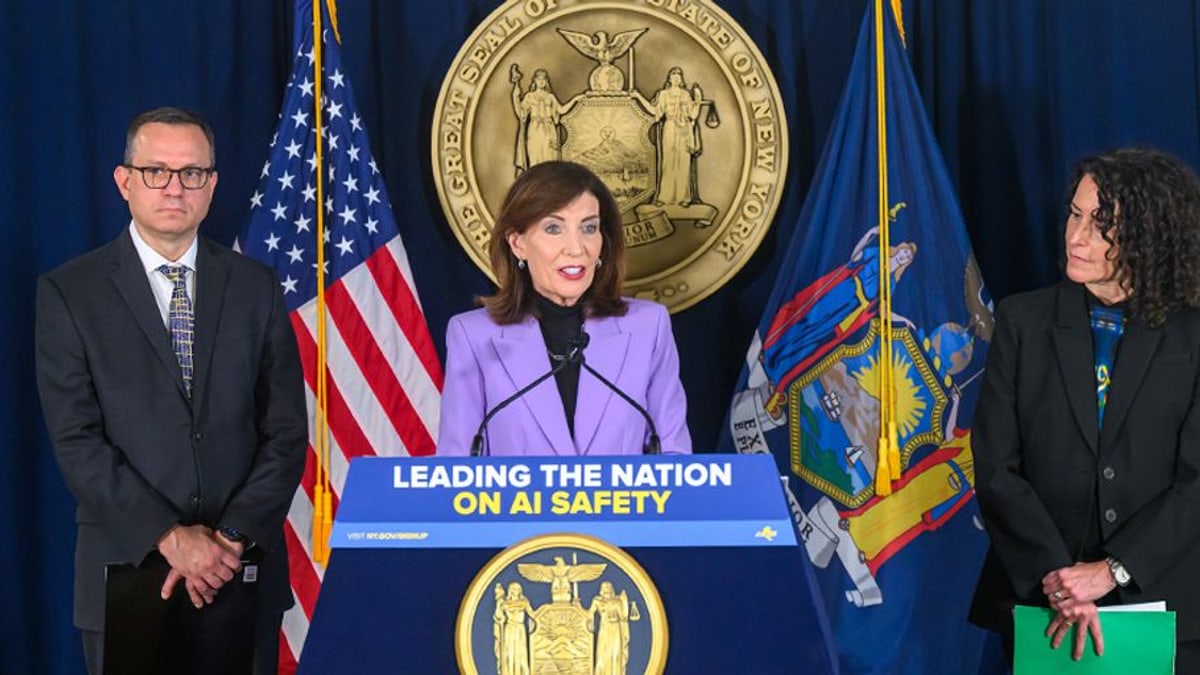
New York opened an online sign-up on Tuesday, Nov. 10, for the biggest makers of the most powerful AI models, which must register with the state by Jan. 1, 2027, under its AI safety law, the RAISE Act. The same day, Gov. Kathy Hochul launched the New York Center for AI Responsibility and Research at the State University of New York's Binghamton University, which she says will independently test advanced AI systems for safety and security. "The stakes are too high to simply take AI companies at their word," Hochul said. The sign-up and the center were both announced earlier, in September and January, and Tuesday's step puts them into practice.
The law is aimed at makers of frontier AI models, the most capable AI models, ones that match or beat the best that exist today. It draws the line by how much computing went into training a model, counting later rounds of adjustment too: more than 10 to the 26th power calculations, a 1 followed by 26 zeros. Any company or person, though not a government body, that has trained such a model, or started training one, counts as a frontier developer, and the law covers those operating in New York. It does not apply to New York colleges doing academic AI research, or to the Empire AI research group. A large frontier developer is one that, together with the companies tied to it, had more than $500 million in revenue in the previous calendar year, and only those must register. According to a news report, that includes Anthropic and OpenAI.
From Jan. 1, 2027, every frontier developer must report any critical safety incident involving its own models to the state through the new portal. The state can later accept an equally strict federal reporting rule in its place. The law builds that idea on what it calls catastrophic risk: a risk that a model could help kill or seriously injure more than 50 people, or cause more than $1 billion in damage, in a single incident. It counts only three kinds of conduct. One is a model giving expert help to build chemical, biological, radiological or nuclear weapons. Another is a model acting with no meaningful human oversight in a cyberattack, or in something that would be murder, assault, extortion or theft if a person did it. The third is a model slipping out of the control of its maker or user. A critical safety incident is harm from one of those risks, or a break-in, theft or loss of control of a model that kills or injures someone, or a model tricking its own maker to get around its controls in a way that clearly raises those risks.
The report is due within 72 hours of concluding that an incident happened, or of learning enough to reasonably believe one did. When an incident puts lives at immediate risk, the developer must also tell an authority such as the police within 24 hours. Each time a frontier developer releases a new or substantially changed model, it must post a report on its website with the release date, the languages the model supports, the kinds of output it gives, what it is meant for and any limits on its use.
The large developers carry more duties. Besides registering, they must renew their filing at least every two years and pay fees to the state. They must publish a safety plan that says how they judge and reduce catastrophic risks, respond to incidents and keep unreleased models secure, and review it at least once a year. Every three months, they must send the state a summary of the catastrophic risks they see in using their own models inside the company. Their release reports must also sum up the checks they ran on the new model under their safety plan, the results and how much outside testers took part. Frontier developers under the $500 million line don't have to register, but the state strongly encourages them to open an account early in case they need to report an incident quickly.
The state attorney general can sue a large developer for a penalty of up to $1 million for a first violation and up to $3 million for each later one, scaled to how serious it is. That applies when the developer fails to publish or file a required document, fails to report an incident, makes a false or misleading statement the law forbids, or doesn't follow its own safety plan. The law does not let private people sue over violations. Separately, the state's AI office can, after notice and a hearing, fine a large developer that builds, offers to others or runs such a model in New York without a current filing $1,000 a day, plus the fees it owes. It must also publish a list of the large developers that have filed.
The law is carried out by DIGIT, the new Office of Digital Innovation, Governance, Integrity and Trust, inside the Department of Financial Services, the state's financial regulator. Members of the public can report suspected incidents from Jan. 1, 2027, and DIGIT will publish its first yearly report on Jan. 2, 2028.
The new center will be led for now by two computer scientists, Greg Morrisett of Cornell Tech and Jeannette Wing of Columbia University. They will bring together more than 80 researchers from colleges and research groups across the state, who will keep working where they are now, using the computing power of Empire AI, Hochul's $500 million public-private AI research project. The center will work with DIGIT to begin reviewing the safety plans companies publish and suggest ways to tighten the rules. Hochul says she will keep looking at ways to build on the law in the coming months. Her announcement does not say how the center will get access to the models it tests, or whether companies must provide it.