
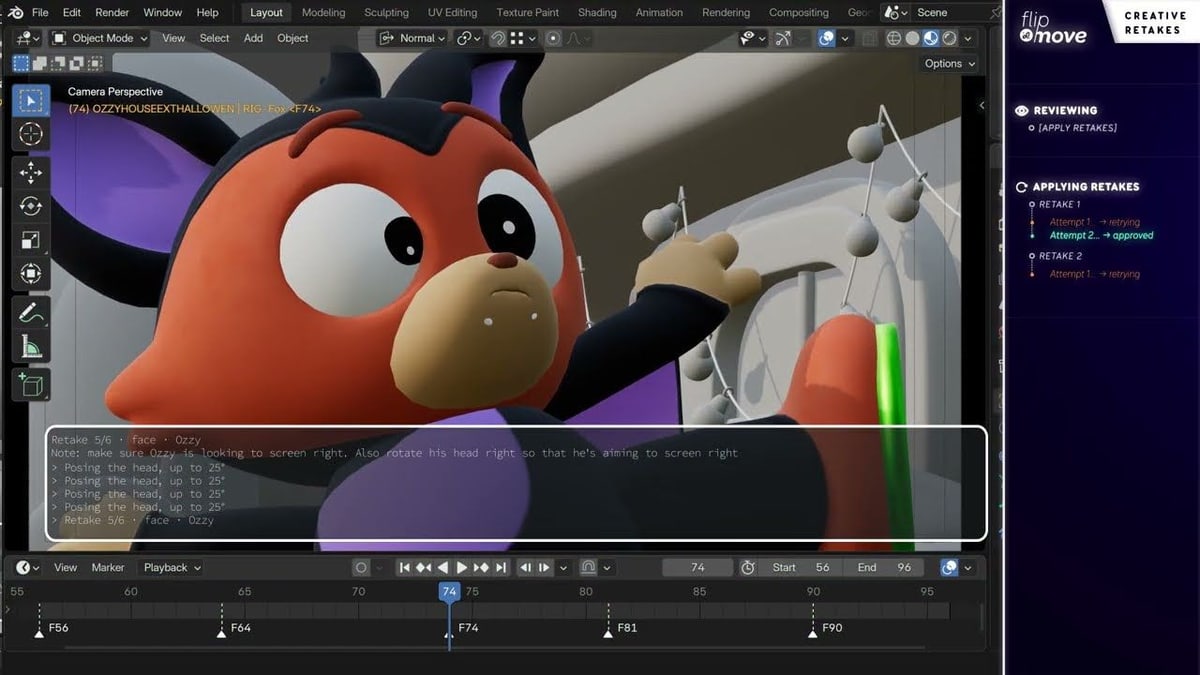
Animaj, the company behind the children's cartoons Pocoyo, Maya the Bee and Ozzy Fox, introduced FlipMove on Nov. 3. It is a set of AI tools that carries a cartoon from an approved rough draft to finished 3D animation. Animaj says the idea is to let AI do the repetitive technical work between creative decisions, while artists direct, refine and approve the results.
The one figure Animaj gives is about revisions. When a director sends a note asking for a change to a shot, Animaj says FlipMove turns it into a revised version of how the shot is staged, meaning where the camera, props and characters sit, or of a character's pose. It says that takes two minutes rather than 20. The revision lands in the artists' scene in Blender, a 3D animation program, so they can inspect it, adjust it and keep animating.
FlipMove joins up tools Animaj built over several months. One turns an artist's drawings into poses for a 3D character. Another fills in the poses between the main ones an animator sets, the repetitive frame-by-frame work that makes a movement look smooth. New parts take the approved rough 2D draft of a scene and set up the cameras, props and characters in a 3D scene, and turn a director's notes into revisions.
Animaj says the tool is already used to make Ozzy Fox, a preschool show it launched on YouTube in July, and the company plans to use FlipMove on Pocoyo and Maya the Bee too. Animaj said it would show FlipMove on Nov. 3 at Disney Accelerator Demo Day in Los Angeles. The tools combine Animaj's own AI models, trained on its characters and production files, with other AI models and standard animation software. Animaj's research on filling in poses was presented at the SIGGRAPH 2026 conference in Los Angeles.
The two-minute figure comes from Animaj, and no outside test of FlipMove has been published. Animaj has talked only about using it on its own shows and has not said whether other studios will get it. Animaj's chief executive, Sixte de Vauplane, says the time saved goes back into storytelling, and that FlipMove "gives artists back the one thing budgets too often take away: another try."