
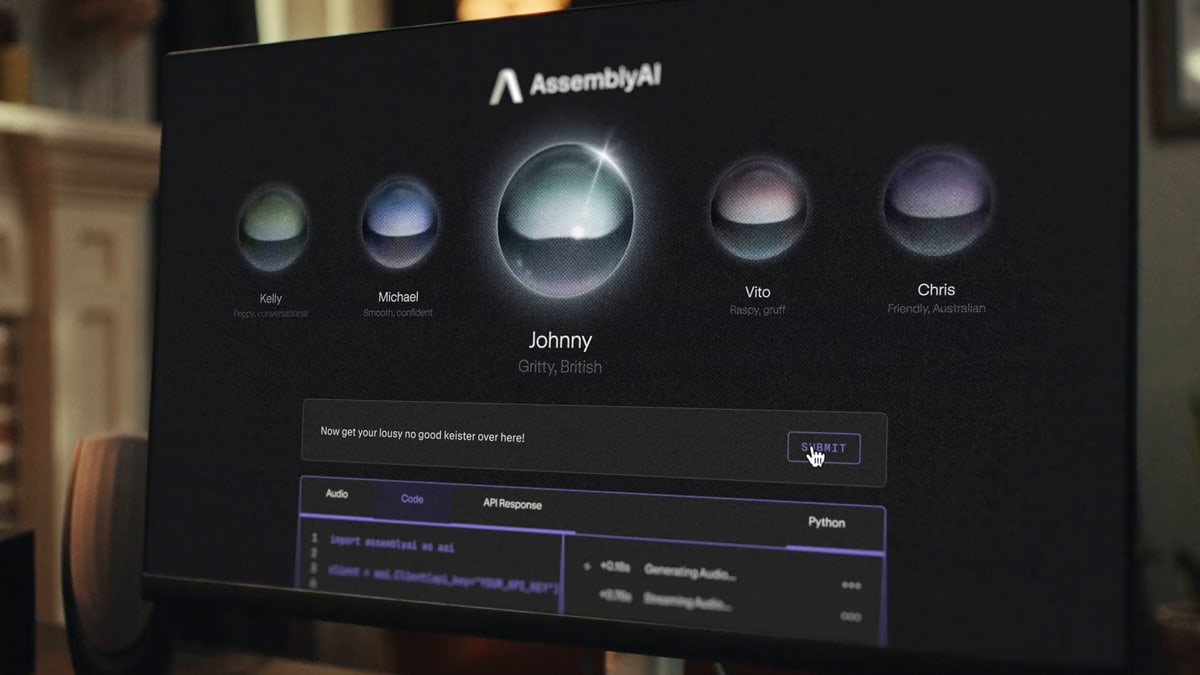
AssemblyAI, a company that sells AI for turning speech into text, has released its first model that does the reverse. AssemblyAI-TTS-1, announced on Oct. 27, turns written text into speech, and it is built for voice agents: AI systems that businesses use to answer phone calls and handle what callers need on their own.
The company says the hard part is keeping people on the line. The moment most callers suspect they are talking to an automated phone menu, AssemblyAI writes, they press 0 and repeat "representative." So AssemblyAI set out to make a voice that sounds like a person and answers without an awkward pause: it says the model starts speaking in under a tenth of a second in real-world use. It was trained on millions of hours of audio, including real conversations, the company says.
In AssemblyAI's launch video, a boy facing a plate of leftovers types a pizza order into a computer, picks a gritty British voice from a row of choices, and lets the AI voice make the call. The pizza shows up at the door.
Developers can try it now in AssemblyAI's online playground and build it into their own products, and the company says it costs about half what businesses pay for this kind of voice today. It comes with thousands of ready-made voices, and it can copy a voice from a short uploaded recording within seconds, once the person uploading confirms they have the speaker's permission. It speaks with a range of accents in English, Spanish, French, German, Italian and Portuguese, with more languages promised in the coming weeks.
The speed and accuracy figures come from AssemblyAI's own tests, in which it says the model read hard items such as phone numbers and confirmation codes correctly about as often as the best rival it reported, an ElevenLabs model. An outside firm that tests voice models every day ranks it at the top so far, level with a Cartesia model, for saying the words it is given correctly, though after only about a week of tests and far fewer measurements than most of its rivals, so the ranking could still move. On that firm's clock, which times the wait until the voice is first heard, it is only in the middle of the pack, and slower than AssemblyAI's own figure. Some controls are still to come, such as lists that tell it how to say particular words and tags that set the emotion, and a second kind of voice copy, made by training the model further on a speaker's recordings, isn't available yet. Whether callers actually prefer it and see their calls through, the test AssemblyAI says matters most, can only be shown on real calls.