
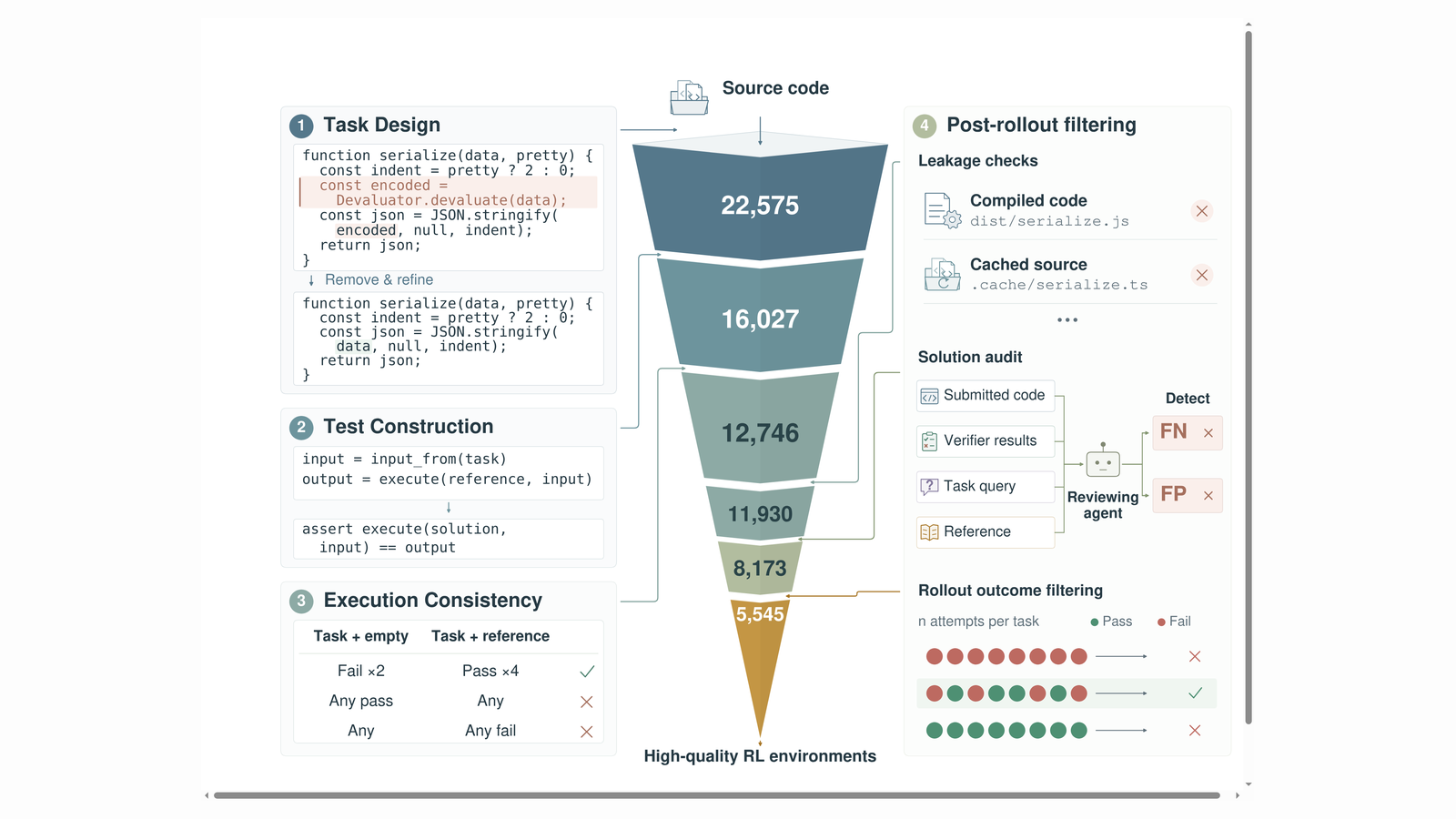
Xiaomi's LLM Core team, with Peking University, the University of Hong Kong, and Renmin University of China, submitted CodeMidas on Sept. 18, 2026. The agentic pipeline turns existing source into coding reinforcement-learning environments without issues, pull requests, or commits, aiming at the task-supply ceiling on coding-agent RL.
In plain terms, CodeMidas is not a chat coding assistant and not another harvest of GitHub issues. It is an environment factory: agents inspect implemented functionality, remove the core code, write a behavioral task statement, build tests from running the original implementation, and keep only tasks that fail when empty and pass with the reference under containerized checks.
The retained training set has 5,545 tasks from 3,185 open-source codebases spanning 23 programming languages and 15 technical domains. Four modules cover task design and codebase adaptation, execution-grounded test construction, a six-container execution-consistency gate (two starting-state failures and four reference passes), and post-rollout filtering for leakage, verifier agreement, and mixed pass/fail outcomes.
Training MiMo-V2.5 with GRPO on those tasks, the authors report gains on all five external benchmarks they evaluated. DeepSWE pass rate rises from 10.0% to 21.7% (+11.7 percentage points), ProgramBench Almost Solved rises from 4.5 to 21.5 (+17 score points), and Terminal-Bench v2.1 rises from 63.7% to 72.2% (+8.5 percentage points). Those figures are author-reported self-comparisons under identical eval settings, not a third-party bake-off.
Ablations they report show a filtered high-quality 3,000-task subset outperforming a vanilla unfiltered roughly 8,000-task sample on SWE-bench Pro, DeepSWE, and CodeMidas Val, while the full 5,545 set leads later checkpoints (CodeMidas Val pass 35.0% to 44.7%). Trajectory analysis they report finds more pre-edit exploration, higher drafting overlap with prior reasoning, and more diverse post-edit verification, with agent-written checks associated with a +4.2 percentage-point pass-rate gap (95% CI 1.8 to 6.6).
Hugging Face Papers listed the preprint on its Sept. 21, 2026 Daily Papers feed under Xiaomi MiMo, alphaXiv indexes the same arXiv record with a third-party methods overview, and AI Weekly published an independent alert the same day restating the task counts and headline deltas. The alert also notes no public dataset license or release plan and no accounting of construction compute; mimo.xiaomi.com/rl/ is a thin MiMo RL hub, not a methods primary. The pipeline is coding-RL environment synthesis from source code, distinct from DeformSmith deformable assets, Dream-RSI exploration policy, IBM Granite time series, the NGU Matthew-effect result, ZGCM-1, and the Hugging Face one-sandbox survey. What remains open is independent replication of the DeepSWE, ProgramBench, and Terminal-Bench gains, plus whether the dataset ships. Author benches and outsider indexes should be weighed separately until those points are settled.