
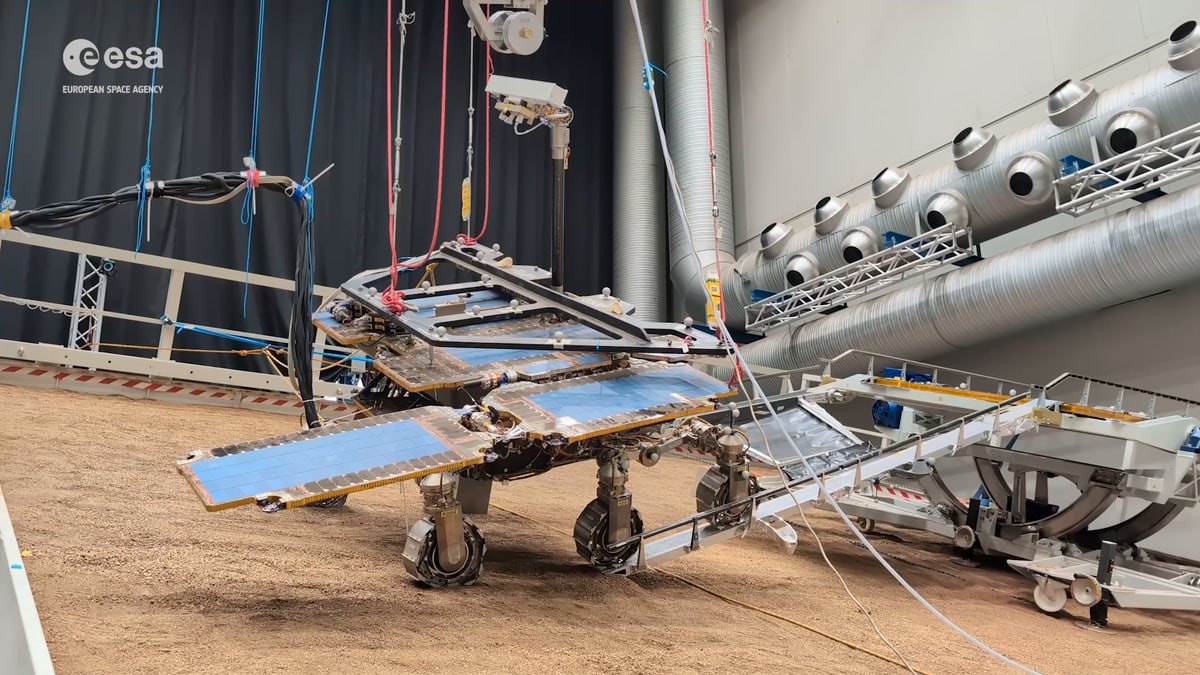
Before Europe's Rosalind Franklin rover can explore Mars, it has to get off the platform that lands it there, and the European Space Agency says that will be one of the most critical moments of the mission. To prepare, engineers tested Amalia, a full-size twin of the rover, on fake Mars ground at a test site in Turin, Italy. Amalia drove off a copy of the landing platform and onto the surface more than 20 times.
Getting off, a step engineers call egress, is more than rolling down a ramp. The platform has two pairs of ramps, one pair at the front and one at the back, and the team on Earth must pick the safer way out using only pictures taken by spacecraft circling Mars. "Depending on where and how we land, one of the exits could be blocked by rocks or slopes," says Eric Zekri, who leads ESA's ExoMars rover team. "On Mars, we will only have one chance. Once we egress, there is no way back, so we have to get it right," he adds.
So engineers added extra challenges. Mars' gravity is only about a third of Earth's, so a device in the ceiling held the rover up like a puppet, taking most of its weight. A hydraulic platform tilted the rover and its lander at a steep angle, and engineers put obstacles under the ramps, as if the lander had come down on a boulder or a slope. The ramps, made of aluminum with a honeycomb pattern for grip, were developed by the Polish space company Astronika.
Thales Alenia Space, the company leading the industrial work on the mission, ran the tests. It says driving off may take only a few minutes, but the whole sequence on Mars will be a much longer, carefully coordinated operation, with a series of checks before the rover starts to move. ESA says the campaign gave engineers practice that will help keep Rosalind Franklin safe.
The real rover's journey on the Martian surface is due to begin in 2030. Thales Alenia Space says the conditions around the rover after it lands can't be fully known in advance, which is why the team practiced leaving by both the front and the back.