
University of Illinois Urbana-Champaign and Cornell University researchers submitted FIRE3D on Sept. 8, 2026, a feed-forward system that turns an unsegmented RGB image or casual video into editable, simulation-ready 3D scene assets in under about a minute. That matters for games, robotics, and interactive apps that need object-level meshes they can move and restage, not only a render that looks right.
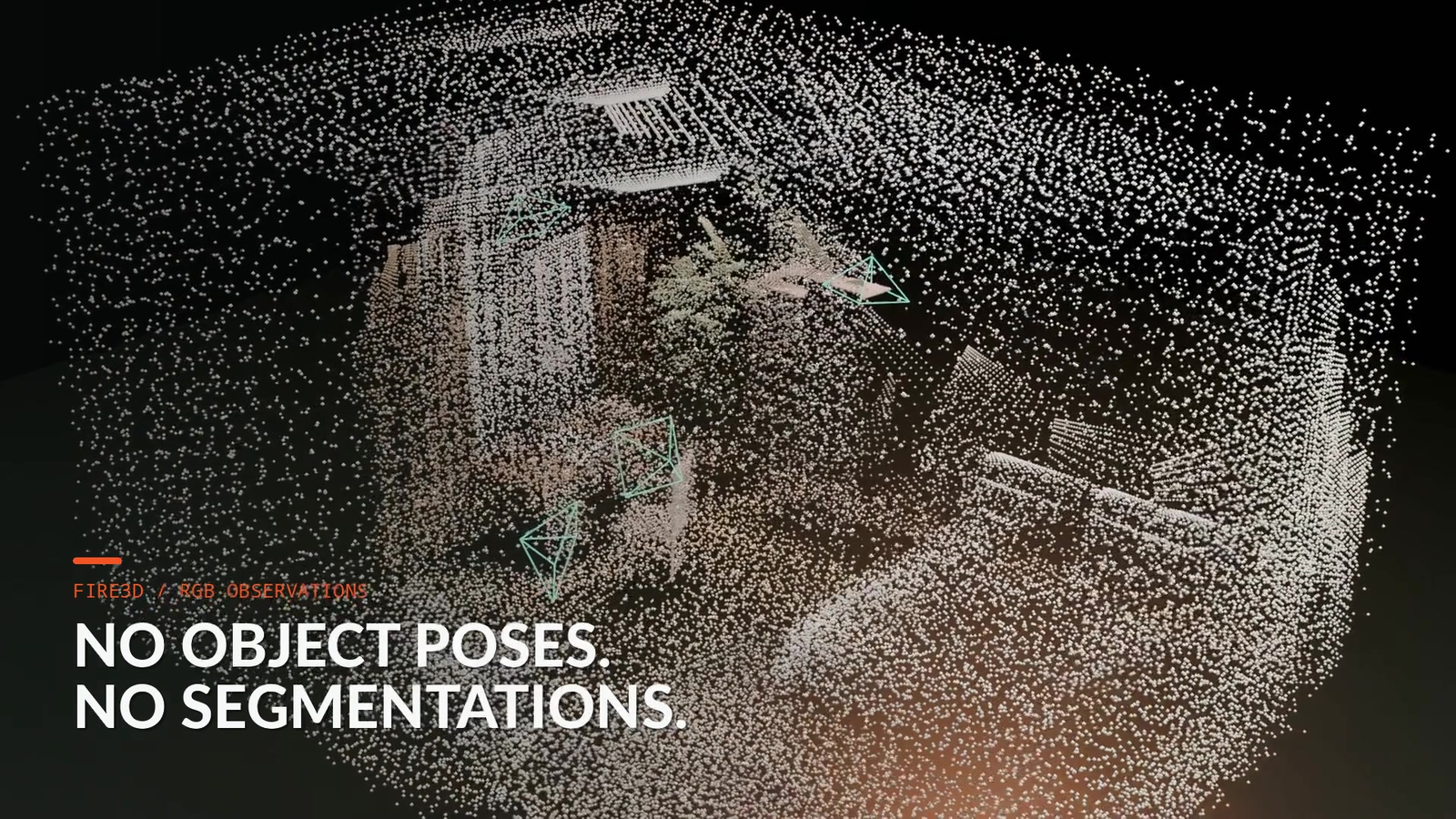
FIRE3D takes casual RGB, uses Pi3 to estimate posed RGB-D, then predicts object count, 3D masks, oriented boxes, 6-DoF poses, meshes, and textures with no supplied masks, boxes, poses, or prompts and no test-time optimization. In plain terms, it is a single forward pass from everyday capture to compositional scene assets, rather than a per-scene optimization loop that refits a reconstruction for every new room.
The paper introduces Hierarchical Compression VAE (HC-VAE), which the authors say compresses TRELLIS.2 SC-VAE latents by 32x (from 32 cubed by 32 channels to 8 cubed by 64), enabling batched generation of up to 16 objects on one 80 GB NVIDIA A100. For posed RGB-D from a 60-frame RGB video with more than 12 instances, the authors report end-to-end inference in under 60 seconds, plus more than a 5x speedup from the compact latent generator with minor quality loss. Treat those speed and compression figures as paper claims.
The authors report competitive or state-of-the-art results on pose accuracy, geometry completeness, and texture quality across their evaluated datasets while being orders of magnitude faster than prior interaction-ready methods. The project page separately contrasts about one minute for FIRE3D with about eight hours for HoloScene; that HoloScene wall-clock is project comparative copy, not an independently re-timed benchmark here. Hugging Face Papers lists the preprint, and the hongchi/Fire3D model card publishes frozen inference protocols for iTHOR, Imaginarium, ScanNet++, and single-image scenes.
Training scale cited in the paper spans five scene datasets and four object datasets totaling about 80,000 scenes, 140,000 video snippets, and an extra 500,000 objects. Code, checkpoints, and example inputs are released on GitHub and Hugging Face under an MIT license for original FIRE3D code, with DINOv3 and TRELLIS.2 components retaining upstream licenses.
Stated limits keep the work scoped to static indoor scenes. The network interface expects posed RGB-D, so RGB-only captures need external geometric preprocessing such as Pi3, and quality depends on depth, poses, and instance parsing. The authors say generated assets are not yet guaranteed to be physically stable, relightable, or articulated. The Hugging Face model card warns performance can degrade under bad poses or depth, severe occlusion, unusual scale, non-room backgrounds, or out-of-distribution objects, and says meshes should be reviewed before safety-critical or physically deployed use.
What remains open is how often the under-a-minute path holds outside the paper's indoor protocols, whether third parties match the reported pose, geometry, and texture scores, and how far the assets go before physics, relighting, or articulation work is added. Paper metrics, project-page timing contrasts, and Hub release notes should be weighed separately until those points are settled.