
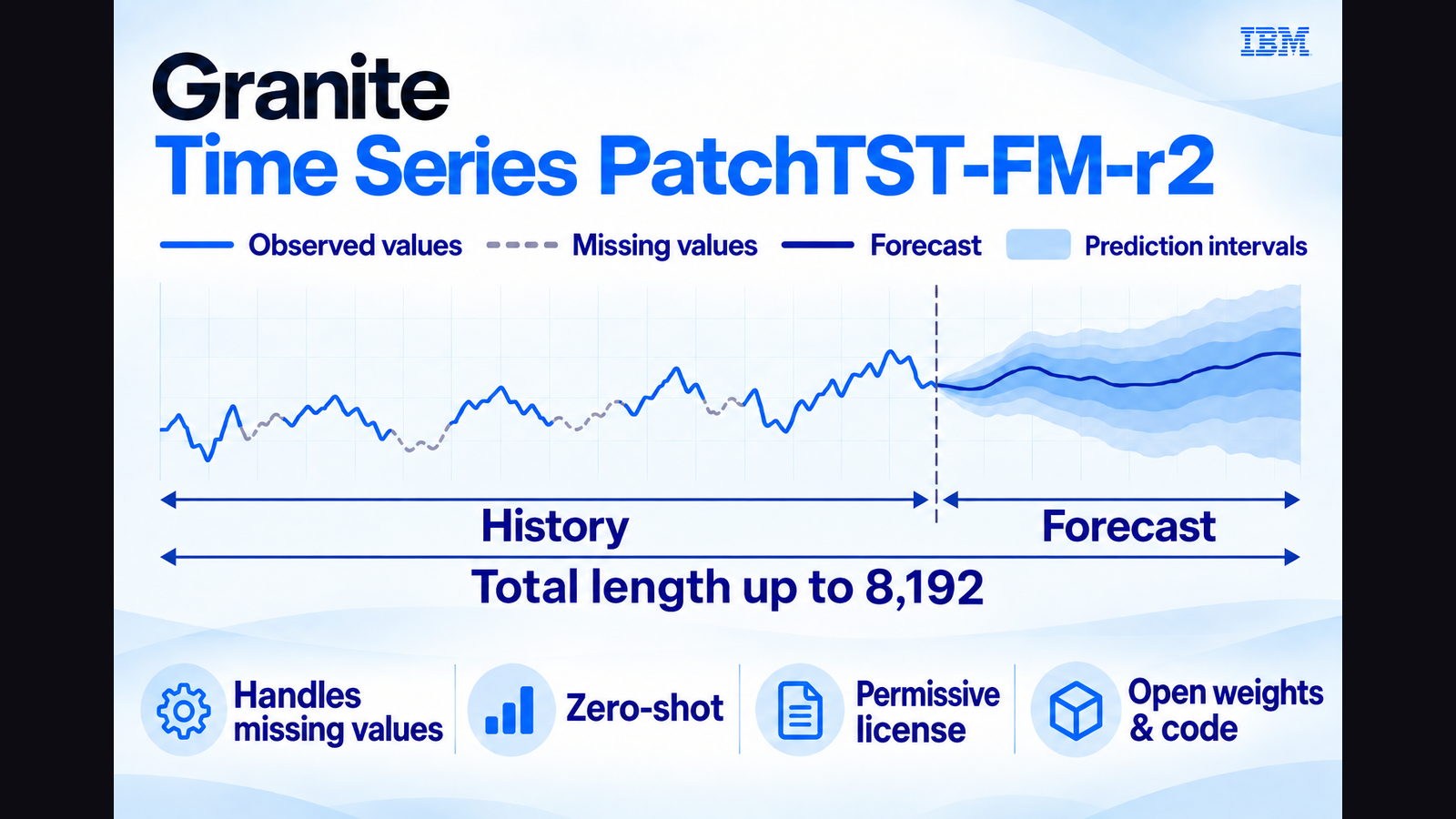
IBM's Granite Time Series PatchTST-FM-r2, released on Sept. 9, 2026, is a free forecasting model built to work on new data straight away, without being trained on each dataset first. It could save teams that need forecasts with a range of likely outcomes, for things like demand, energy, prices, traffic or equipment readings, from training a separate model for every dataset. IBM published the trained model for anyone to download, along with its design, the code to run it and code it says can reproduce its test results.
PatchTST-FM-r2 is not a chatbot. The AI behind chatbots writes free-form text, while this model works with numbers: given a recent history of regularly spaced measurements, it predicts future values along with a range showing how uncertain they are. It can also fill in missing points in the history it is given.
IBM says the model has about 385 million parameters, the numbers a model tunes as it learns, and can look back over as many as 8,192 past readings to make a forecast. It can make forecasts of different lengths. For this second version, r2, IBM says it reworked the model's internal design.
IBM says that, as of Sept. 8, 2026, the model ranked second on two accuracy measures used by GIFT-Eval, among models that had not seen the test data and whose results others can reproduce. Among models in that group with licenses friendly to commercial use, IBM says, it ranked first. The ranking is IBM's own, for one group of models on one date, and does not mean the model is the best choice for every forecasting job.
IBM's page for the model said the GIFT-Eval result was still waiting to be added to the leaderboard. IBM says the model is offered under Apache 2.0, a license that lets anyone use, change and share it free of charge, and also under a second license, OpenMDW 1.0. The release still notes that organizations need their own licensing and model-governance review before using it.
It is not yet clear when the leaderboard's maintainers will add IBM's result. Nor is it known how well the model's ranges of likely outcomes hold up on any one organization's own data, or whether its forecasts beat a simple method that repeats past seasonal patterns when data goes missing or conditions suddenly shift.