
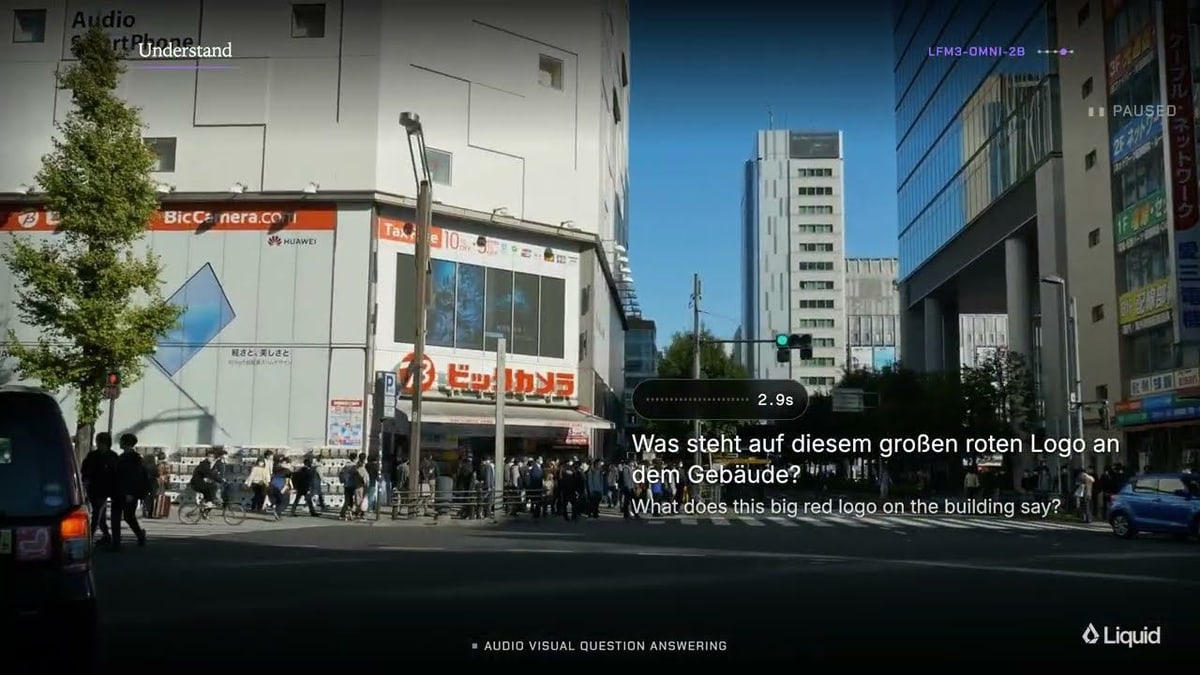
Liquid AI, a company that builds small AI models meant to run on phones, laptops and other devices rather than in distant data centers, released a new family called LFM3 on Oct. 27. There are six models, all built on the same small base. One works with text, one with pictures and video, one with speech, and one, LFM3-Omni, can see, listen and talk back in a single model. The other two are built to make quick decisions, such as sorting a support ticket or pulling the details out of an invoice.
The point of keeping the models small is where they can run. Liquid says they can run on the device itself, so the data doesn't have to leave it and no internet connection is needed. Instead of one big model that tries to do everything, Liquid says, people can pick the small one that fits the job and run it on their own machine.
Liquid gives some examples of what the all-in-one model could do: a tutor that looks at your handwritten math and answers your spoken question, a tablet you carry around and ask about what it sees, and a car assistant that combines what its camera sees with what the driver says. Mercedes-Benz, which tested the models before release, says it is exploring with Liquid how this kind of AI could improve the voice assistant in its cars. The speech model can transcribe and translate speech in many languages. Liquid also trained a version of its picture model to control a robot arm, and tested it in a computer simulation.
The models are free to download now and can also be used through Liquid's own online services. The text model and the all-in-one model come under a Liquid license that lets people use them for free, including for business, but a company that brings in more than $10 million a year in revenue has to buy a license from Liquid to keep using them commercially.
So far, the published results on how well the models work come from Liquid and companies that tested the models with it. The company says bigger models still do better at programming jobs the AI carries out on its own, and at knowing facts, where size matters most. How well the models work on people's own phones and laptops, outside Liquid's demos, will become clearer as others try them.
Correction (Oct. 28): an earlier version said every published result on how well the models work came from Liquid itself, and that bigger models do better at longer programming jobs. Liquid's post also quotes a test by MacPaw, a software company, and does not say longer.