
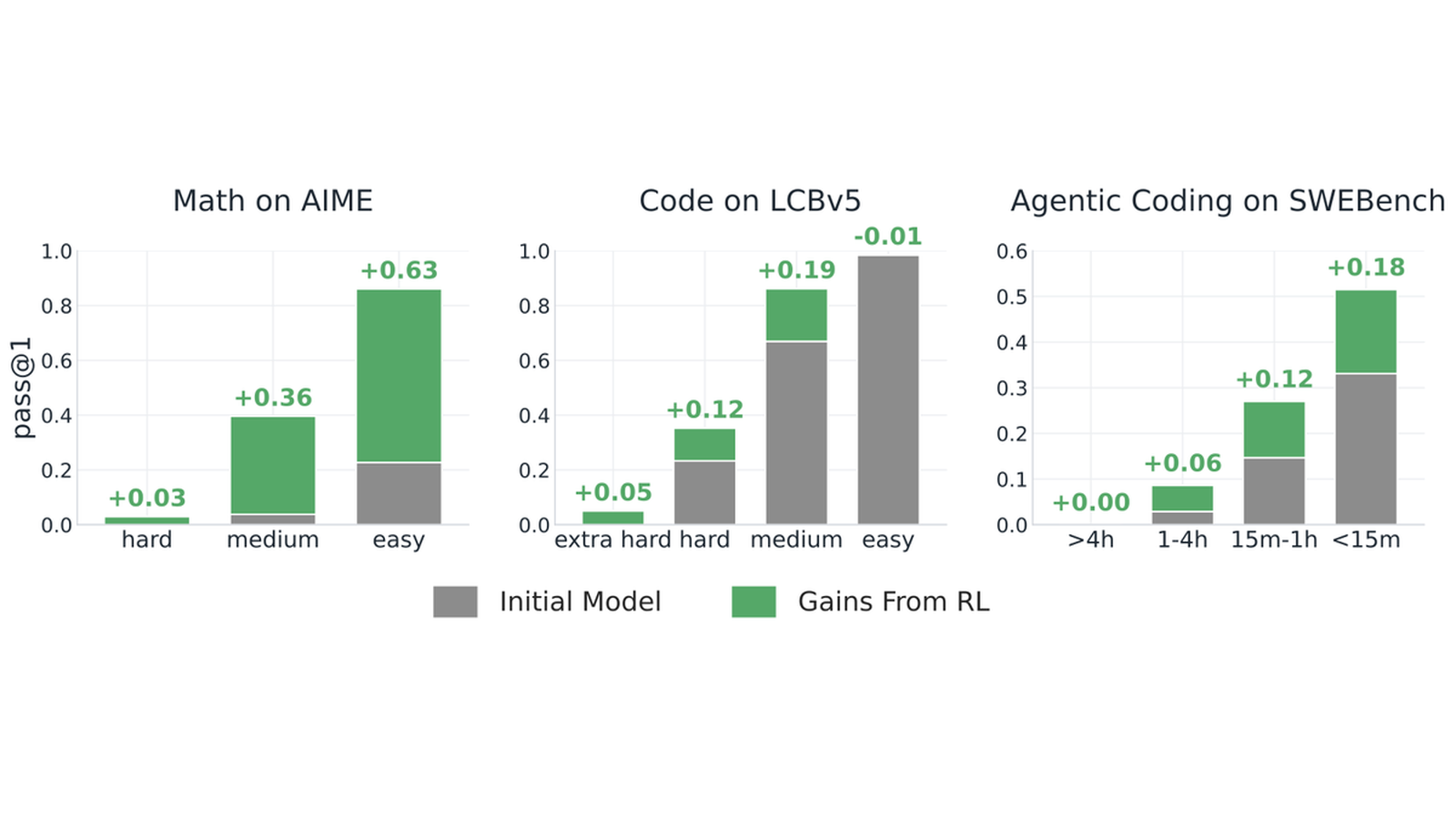
A Mila and Université de Montréal arXiv preprint submitted Sept. 11, 2026, argues that reinforcement learning for large language models improves easy problems far more than hard ones. Michael Noukhovitch, Hamish Ivison, Nathan Lambert, and Aaron Courville call that pattern the Matthew Effect in RL for LLMs and introduce Never Give Up (NGU), which keeps sampling a prompt until a completion is correct.
Using open RL-trained systems in math, code, and agentic coding, the authors report that pass@1 gains track the initial model's competence: easy items improve most, and hard items move little. They argue fixed sampling budgets waste compute on prompts the model already solves and leave too little useful signal on prompts it cannot yet crack.
In plain terms, fixed-k group methods such as GRPO draw a set number of samples for every prompt. Easy prompts burn completions that add little learning signal; hard prompts often yield no correct sample and no useful gradient. NGU keeps sampling a prompt until a correct completion appears, and with asynchronous RL that reallocates effort toward harder prompts. The authors present the work as a method preprint, not a settled training standard.
On Deepscaler math with a Qwen 3 4B base, the authors say NGU improves performance per compute versus fixed-k GRPO baselines matched to about 120 H100 hours, especially on the hardest AIME and BRUMO 2025 subsets. On Manufactoria coding with per-test rewards, they say standard GRPO stagnates short of full solves while NGU climbs harder tests until full solutions. An author blog dated Sept. 15 restates a GSM8k Platinum setting where small-k NGU beats varied fixed-k GRPO on the hardest subset. Treat those Deepscaler, Manufactoria, and GSM8k figures as author claims.
The authors warn NGU is unlikely to help when the training mix is dominated by very hard problems, because multi-round resampling can increase off-policy staleness compared with sampling a larger fixed k up front. Independent Sept. 15 coverage from Beckmann.ai and a Hacker News thread summarize the preprint; neither is experimental replication. A linked GitHub repository for code returned HTTP 404 as of Sept. 16, 2026. What remains open is whether third parties reproduce the reported gains and whether public code appears. Preprint claims and digest coverage should be weighed separately until those points are settled.