
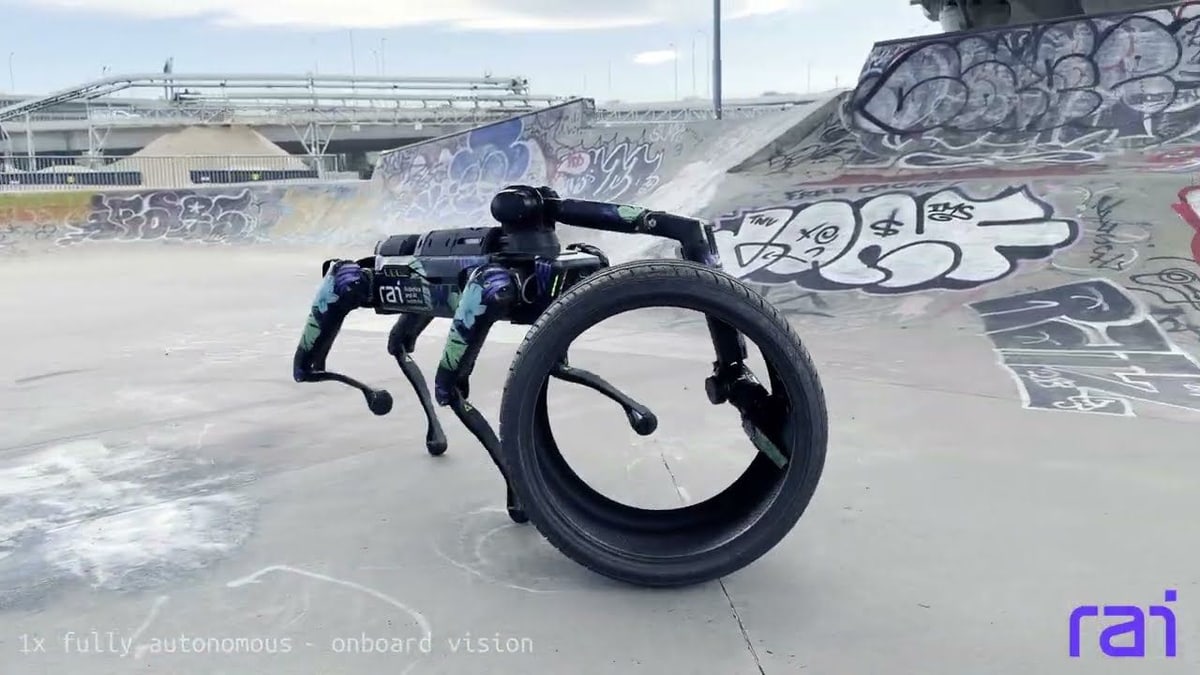
The RAI Institute, a robotics research lab led by Boston Dynamics founder Marc Raibert, has taken a robot trick it first showed in its lab out into the world. In a post on Oct. 27, it showed a Spot robot, a legged robot with an arm, standing a 15-kilogram car tire upright, rolling it and dragging it to a goal on its own, in a skatepark, on a basketball court, in a garage and on the floor of RAI's own building. The robot finds the tire with the depth cameras already built into its body, which measure how far away things are. The earlier version worked only in RAI's lab, where cameras in the ceiling told it where the tire was, a desktop computer ran it and a set of hand-written rules decided what to do next.
The tire is heavier than Spot's arm can lift alone, so the robot uses its legs and body as well. A person sets a goal a few meters away, and the robot walks to the tire, stands it up if it is lying flat, gets behind it, rolls it and drags it the last stretch onto the target. When a person deliberately knocked the tire over with a stick in the middle of a roll on the basketball court, the robot stood it back up and kept going.
Each skill, from standing the tire up to rolling it, was learned by trial and error in a computer simulation, with tens of thousands of simulated robots practicing at once. In the simulation, each skill first practiced knowing exactly where the tire was, and RAI slowly took that away and gave it only camera images instead, roughened up to look like the messier pictures from real cameras. A small extra program watches the camera images and picks which skill to use at each moment, and everything runs on a Mac Mini computer riding on the robot's back.
RAI noticed something it hadn't asked for: the version that learned with cameras became careful about turning the tire, walking around it and making contact from an angle that keeps it in view, though it still rolls fast. A version that was always told where the tire was rolled it aggressively, spinning it toward the goal in one continuous motion. RAI says nothing in how it scored the robots' practice pushed them toward either habit; each learned from what it could see.
The work is far from finished. To the robot, anything that shows up as a blob in its camera view can look like the tire, and in a few runs it left the tire and went after something else. Pulling the tire out of a van and stacking it on a pallet work as separate skills but are not yet joined to the rest, and in one clip RAI shares, the robot got stuck pulling the tire off the van, unable to drag it over the edge.
RAI says one next step is teaching the robot what a tire actually looks like, by adding other objects to its training. So far RAI has tested it with one tire on flat ground, and more objects, rougher ground and obstacles between the robot and the tire are the challenges still ahead. RAI has not said whether, or when, these skills will reach Spot robots beyond its own research.