
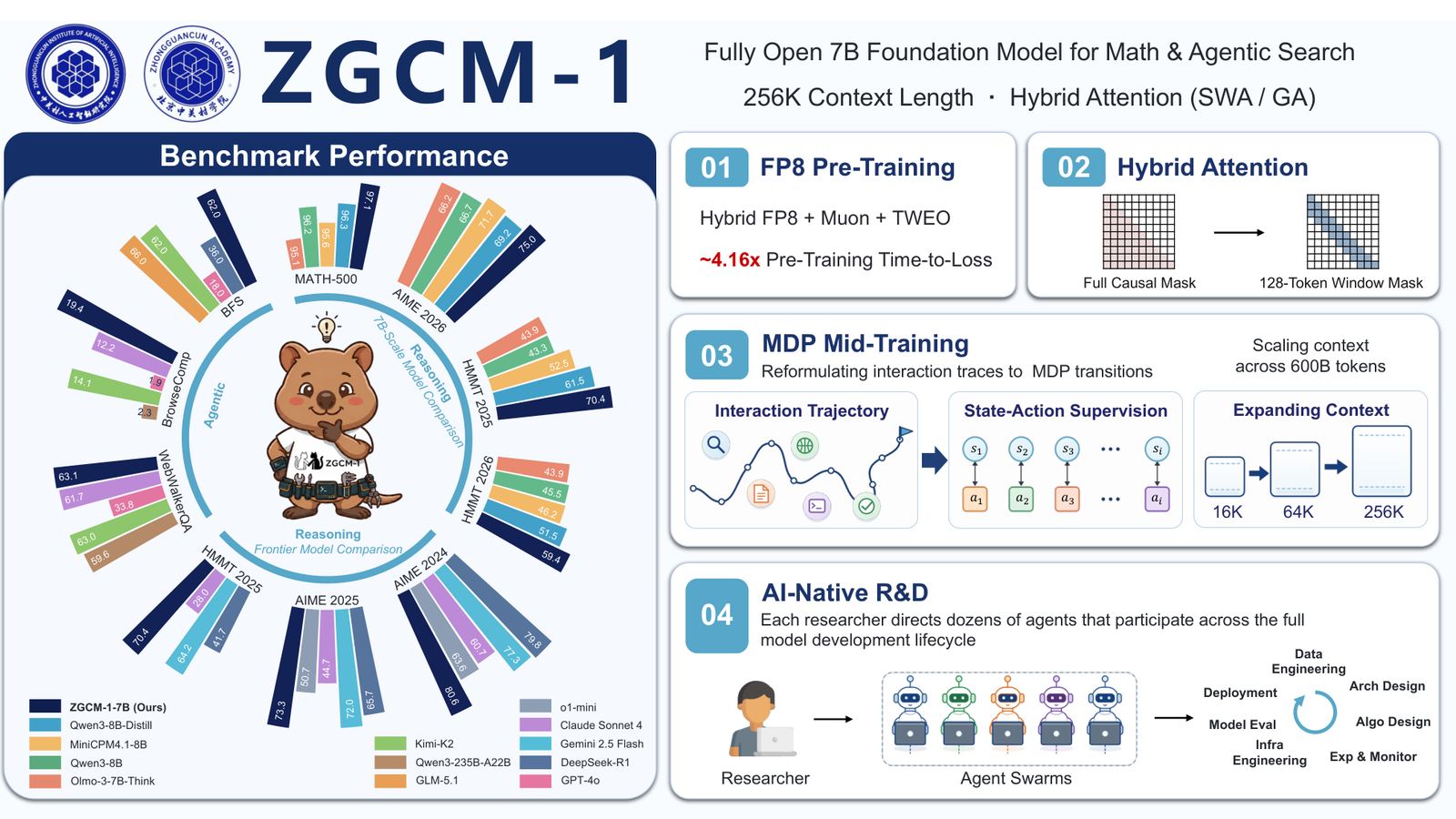
Zhongguancun Academy and the Zhongguancun Institute of Artificial Intelligence released ZGCM-1 on Sept. 11, 2026, as a fully open 7.39B dense foundation model trained from scratch for mathematical reasoning and agentic search. The technical report is arXiv:2609.13356.
Unlike a closed chat API that only returns hosted completions, ZGCM-1 ships open weights plus a public training recipe: stage checkpoints, data cards, code, and logs that researchers can inspect and retrain. The model couples internal thinking with external tool use over up to 256K tokens rather than relying only on memorized web text.
The authors describe a hybrid of gated sliding-window and global attention, a stable FP8 Muon optimizer, progressive mid-training from 16K to 64K to 256K context, and Markov Decision Process reformatting of interaction traces. Pretraining is reported at about 4.19 trillion tokens, with mid-training about 600 billion tokens, before joint general and agentic supervised fine-tuning.
The official Hugging Face model card restates author-eval figures such as 97.13% on MATH-500, 75.00% on AIME 2026, 70.42% on HMMT 2025, and 63.09% on WebWalkerQA. The technical report also says the pretraining design offers about a 4.2x improvement in 16K pretraining time-to-loss and that, on several hard math and agentic-search suites, ZGCM-1 remains competitive with much larger frontier models such as Qwen3-235B-A22B and GLM-5.1. Those scores and comparisons are author and model-card claims.
Artifacts confirmed live as of Sept. 16, 2026, include MIT-licensed weights at zgcagi/ZGCM-1-7B, the ZGCM-1-Data dataset, and training code at github.com/zgcagi/ZGCM-1. Beckmann's Sept. 15 digest highlighted the openness and the reported efficiency figure. CCTest's Sept. 15 write-up stressed the reproducible development trail and cautioned that selected-task results should not be read as a universal advantage over much larger systems.
What remains open is independent third-party replication of the MATH-500, AIME, HMMT, WebWalkerQA, and ~4.2x efficiency figures, plus how the 7B competitive-with-frontier claim holds under shared protocols. Author benches and outsider coverage should be weighed separately until those points are settled.