
Anthropic said on Nov. 25 that it has moved its Messages API from the Python programming language to Rust, another programming language, with help from teams of Claude AI agents. An API is a connection that lets developers plug a service into their own apps, and this one is the main way customers, and Anthropic's own apps such as Claude Code and Cowork, reach Claude. AI agents are AI that can carry out tasks on their own instead of only answering questions. Here, Anthropic says, they tracked down differences between the old and new code and wrote and tested fixes.
Anthropic says requests on its own platform, counting its own use, grew roughly 1,800 times from early 2024 to fall 2026, far beyond what the original Python version was built for. Python added extra work at every step of handling a request, and Rust needs far less processor time, the work a computer's chips do, for each one, the company says. An earlier step that rewrote just one part in Rust cut processor use by about 8% to 10%, Anthropic says, but made the system more complicated than the gain was worth.
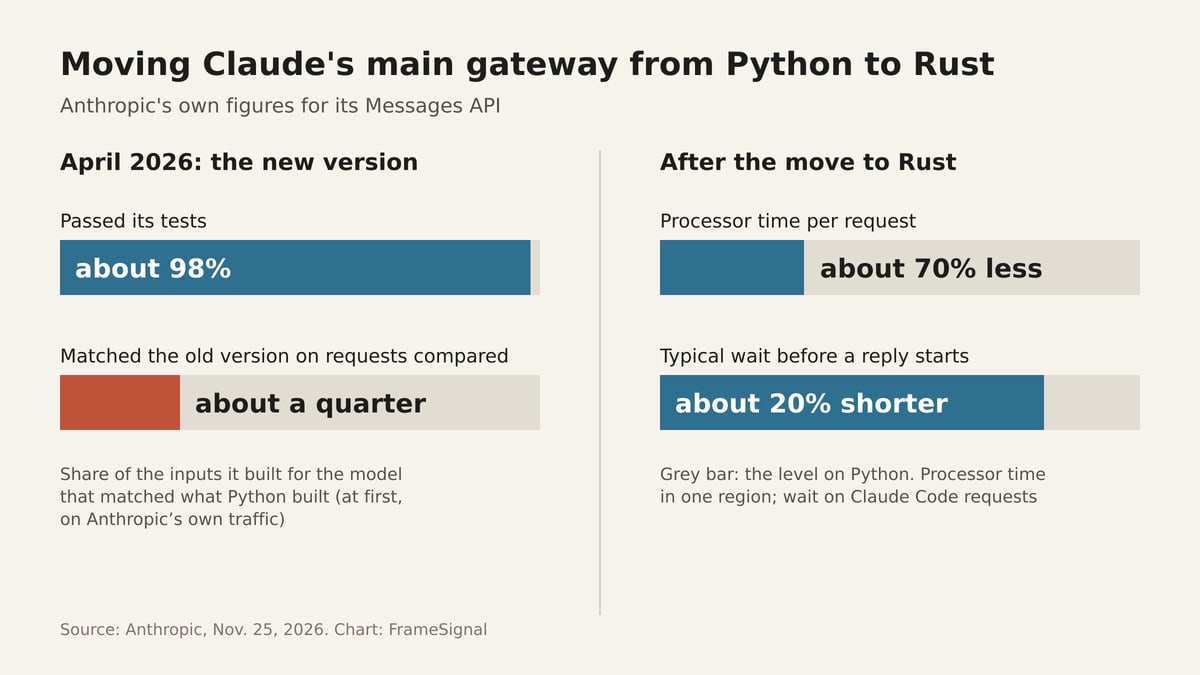
Anthropic's argument is that AI has made writing code fast, so checking it is now the slow part. Claude wrote a first version of the core code that handles each request in about a week, the company says, and by May 2026 Claude was writing more than 80% of the code Anthropic added to its software. Checking a service people already use is harder than writing it, Anthropic says, because users often rely on odd behaviors its tests don't cover. Anthropic says that in April the new version passed about 98% of its tests. Yet on the real requests it compared, at first from Anthropic's own use, only about a quarter of the inputs it prepared for the model matched what the old version prepared.
The tests themselves were also a weak guide. They were built around the old Python code, so they had to change along with it, and Claude helped with both. When the team audited the tests it had moved over, it found more than 100 checks that had been made weaker. A passing test could mean the new code was right, or that the test had been changed so wrong code got through.
So Anthropic sent real requests through both versions and compared what each did, step by step. The model answered each request once, and its answer was fed to both versions, so the natural variety in Claude's wording didn't count as a difference. To protect privacy, Anthropic says, the team didn't read users' requests or Claude's replies. It recorded the shape of each difference instead, such as where it happened and how big it was. A coordinating Claude agent handed each new kind of difference to a worker agent. That agent guessed the cause and wrote and tested a fix in a sandbox, a walled-off workspace with copies of both versions where, Anthropic says, a wrong guess couldn't affect users. Some fixes that worked there didn't clear the difference on real requests, and the agent had to try again.
Engineers reviewed each fix before it was tried on real requests. In one case the new version was leaving out the description of Claude's web search tool, which the old version fetched from another internal system. An agent made the two match by copying that text into files, and an engineer turned it down: the new version would still have to fetch the text properly before launch, so the shortcut would be thrown away. Anthropic writes that the check rewarded matching outputs, "and the agent found the cheapest way to produce them." Engineers' corrections became rules that later agents read.
Customers' requests moved to the new version in September 2026, Anthropic says, without taking the service offline or pausing work on new features. Anthropic says the new version uses about 70% less processor time per request, measured in one region, and that the typical wait before a reply starts fell about 20% on customers' Claude Code requests. That was measured over a shorter stretch, and part of the drop came before most of those requests had moved. These are Anthropic's own figures, and it hasn't said whether the savings will change what customers pay.