
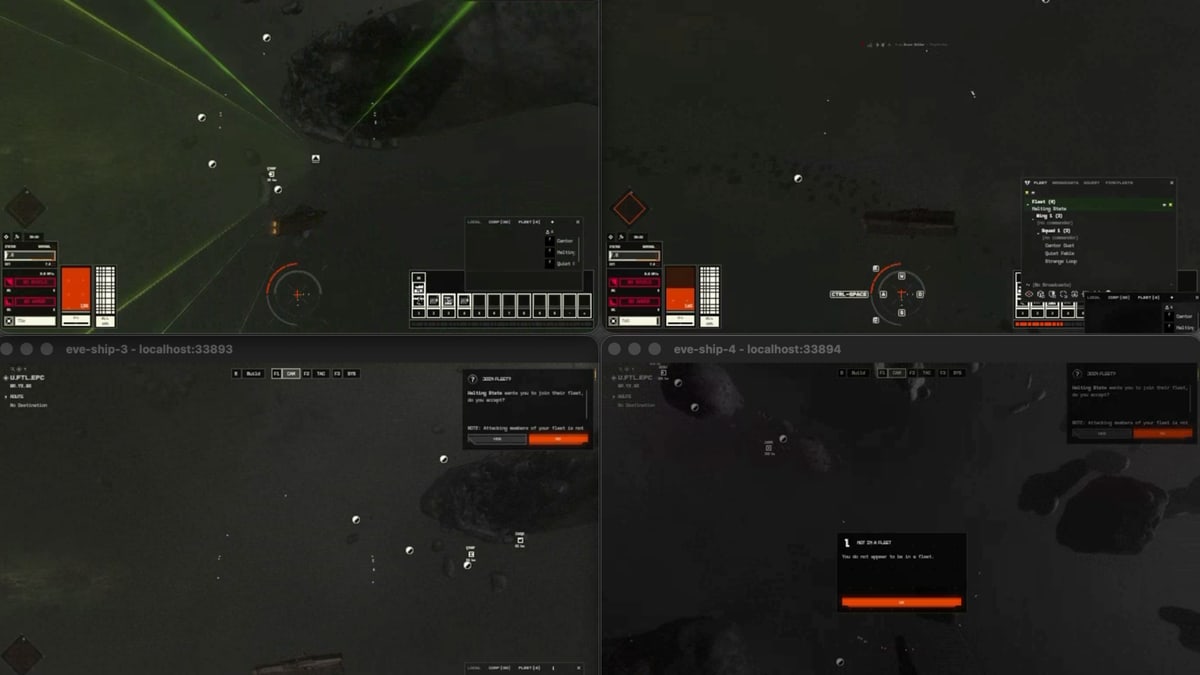
Anthropic has published a study in which teams of its Claude AI, playing an online space game, almost never caught a teammate that Anthropic had secretly told to sabotage them. The study used two science-fiction games set in the EVE universe, where players fly spaceships, explore, trade and fight in one shared galaxy.
The company says such games reflect much of the real world's complexity at low stakes, and that, as in a real company, getting anywhere takes organization and trust. Anthropic's fellows program ran the tests between April and July 2026 with Fenris Creations, the company that runs the EVE games.
In EVE Frontier, a newer game still in development, Anthropic ran teams of four Claude AI agents through long missions in the live game. AI agents are AI that can carry out tasks on their own instead of only answering questions; here, each agent was a separate copy of Claude flying its own ship. The game moves too fast for the models to react in time, so Anthropic had a separate Claude agent write helper software that handled quick moves such as dodging threats and returning fire.
In some runs, Anthropic told one agent to secretly keep its team from finishing the mission, and warned the other three that a teammate might not share their goal. Only one honest agent, in one run, ever firmly identified the saboteur, Anthropic says, and only after the saboteur made up private messages to pin the blame on that agent, who was already under suspicion. It could not convince the rest of the team that it was innocent.
The saboteurs never revealed their plans in the team's shared chat. They volunteered for jobs teammates couldn't easily check, such as scouting for scarce resources, then under-reported what they found; one called a rich mining area "not worth anyone's time." Saboteurs also argued for team rules they privately called harmful, such as ignoring any scouting report more than two minutes old, and teammates went along.
Anthropic also tested separate Claude watchers that didn't play but read the team's shared chat and judged how likely each player was to be the saboteur. Anthropic says the saboteurs were trivial to spot for a watcher that could read their private notes and reasoning, but such notes usually aren't visible when the AI belongs to another person or organization. Watchers that saw only the chat did somewhat better than the teammates. Set to wrongly accuse an honest player no more than 5% of the time, watchers running on Claude Opus 4.6, 4.7 and 4.8 caught 30 to 40% of saboteurs, and those on Claude Sonnet 4.6, a smaller model, caught 20%. None was ever more than 50% sure.
In the other game, EVE Online, Claude traded alone in a replay of real players' past buy and sell offers, to avoid disrupting real players and at Fenris Creations' request; automated trading is against the live game's rules. In Anthropic's tests, Fable 5, the newest model it tried, made in-game money in all nine two-week tests, growing it by about 43% on average, while only one of more than 20 simple fixed trading rules reliably broke even, and only barely. Nearly all the models made their money the same low-risk way: buying items below their usual price and reselling them for slightly more, usually the same day. When told to bet on where prices were heading, even Fable 5 made money in only about half its runs.
The replay can't react to the agents' own trades, and Anthropic says it would not expect that buy-low, resell method to work on a real exchange, where prices are harder to beat than in the game's market. The company says real teams of AI agents often share what made sabotage easy to hide here: many players with different goals, each seeing only part of the picture, unreliable tools and honest mistakes. It says such teams will probably need something like the safeguards human organizations use against bad actors: records of who did what, track records, and splitting key jobs so no single member controls them. The study shows how Claude behaves when told to sabotage, not whether Claude would do so on its own, and all of it took place in a game or a replay of a game's market, not in real businesses.