
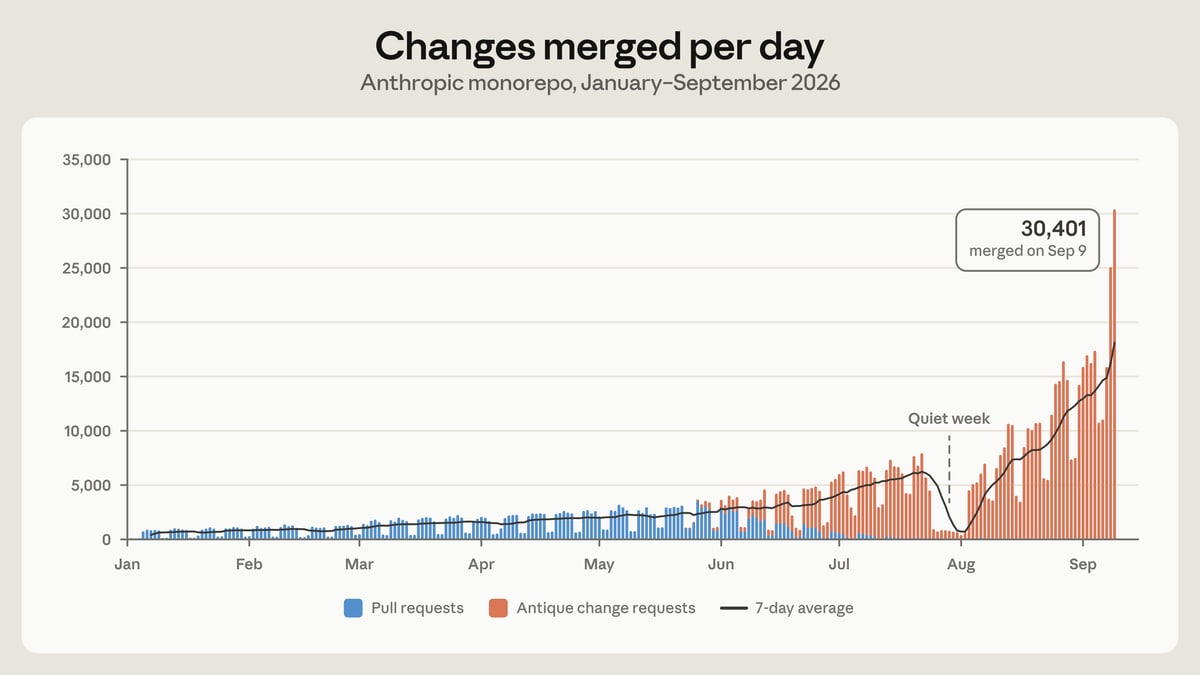
Anthropic says its Claude AI now writes code faster than the company's own systems can manage it. In a post on Tuesday, Oct. 13, the company said it merged, or added to its main body of code, about 2,500 code changes a day on average in May 2026, and more than 30,000 a day as of September. The company's own chart shows that 30,000 mark as a one-day high in early September, with the weekly average still climbing toward it. Anthropic says Claude's ability to write code is what put it in this position, and that at Anthropic, writing code is no longer the slow part. The slow part is the tools built for human-scale work that store, build and test it.
The worst of those bottlenecks, Anthropic says, was version control, a system that records changes to a set of files over time, so earlier versions can be called up later. The standard one is git, which gives every user a full copy of a project's code and history. Anthropic keeps its code in one giant shared project, and the record of past changes to its main version alone is almost 100 gigabytes, the company says. Its automated testing systems pull a copy of that code about 25 million times a day. At the busiest point, Anthropic ran several hundred extra copies of its code store, known as mirrors, to handle the load.
So Anthropic built its own system, called Scion, and moved its main code project fully off git in five months. Instead of handing every user a full copy, Scion keeps the code on central servers and sends each program only the files it asks for, a design Anthropic says suits AI agents and automated jobs, which are always online. Anthropic says a team of seven people built Scion, a new tool for reviewing code and half a dozen related systems in that time. It says the new setup needs 200 times less computing power and memory than the git mirrors it replaced, and that test jobs now get their code in seconds rather than minutes.
Anthropic says Claude's coding is also how it built the new system so quickly. When it asked an early internal version of Claude Mythos Preview, an Anthropic AI model, to rewrite the program that copies code history from git into Scion, which engineers had mostly written by hand, the result used 20 times less memory and ran four times faster, the company says. Every engineer on the team would now rate Claude as better at writing code than they are, Anthropic says, but the engineers still made the design decisions and often had to tell Claude no when it tried to break the system's core rules. They still review every change, though now for what it is meant to do rather than line by line.
Anthropic is not alone in seeing the surge. GitHub, where many developers keep and share their code, said in April that AI tools that work on code by themselves had sped up sharply since late December 2025, that new projects and code changes on its site were growing quickly, and that by February it had to plan for 30 times its size then.
Anthropic says Scion is no replacement for git for most teams. It only makes sense for enormous code projects with tens of thousands of engineers or swarms of AI agents, the company says, and Anthropic spends far more on its own AI use than any other business would want to. It also says Scion would be hard for other companies to adopt, because they would have to replace their code review, code search and testing tools too. Anthropic expects similar problems to become more common over the next six to 12 months and says it wants to work with GitHub, GitLab, a rival code-hosting service, and open-source developers to bring some of Scion's ideas to git. It has not said how many of those changes Claude wrote.