
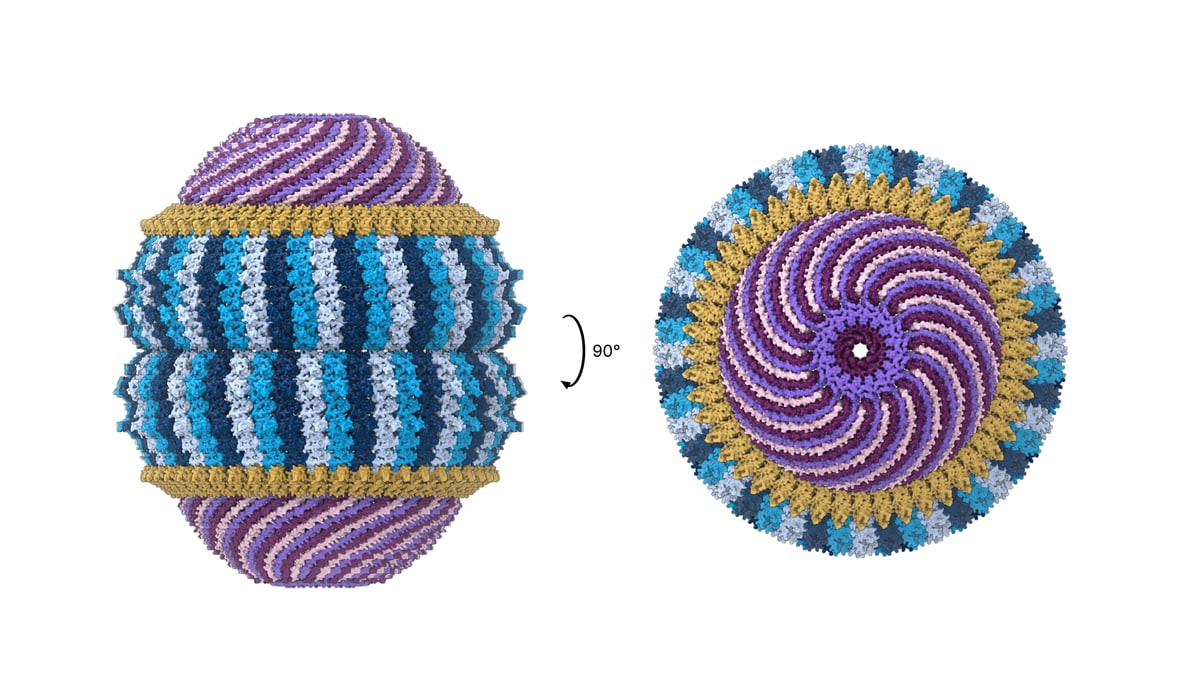
Anthropic's biology research lab says it has shown that proteins from bacteria, and from viruses that infect them, can form vaults, and that Claude helped at each step. Scientists had already found relatives of the vault protein in the genes of bacteria and those viruses, but to Anthropic's knowledge no one had shown that they build vaults. The lab says it has also mapped the first 3D structure of such a vault. Vaults are large hollow shells of protein found in nearly all the cells in the human body. Leonard Rome and Nancy Kedersha discovered them in 1986. Anthropic says a version that bacteria make is easier to study, since bacteria are quick to grow.
The vault the team mapped comes from a bacteriophage, a virus that infects bacteria, so in nature it would be built inside a bacterial cell. In the lab, the team grew it in E. coli, one of the most studied bacteria. It is made of 96 copies of a single protein, against 78 in human vaults, and is shorter and wider. By copying two of the seven repeating pieces in its wall, the team made a bigger vault with about 20% more room inside. The report says a vault whose size can be adjusted this way could serve as a shell for carrying cargo.
Under the team's direction, Claude searched a database of about 15 billion predicted proteins for relatives of the vault protein, designed the DNA to make the ones the team chose, and helped speed up a way to pull the particles out of cells. The team was not the first to use this kind of method, but says its version took about 90 minutes from cells to microscope, against about three days for the usual method. The team tested dozens of candidates, and seven of the 15 that the bacteria actually produced formed vault-like particles, and four of those were confirmed as vaults, two from bacteria and two from these viruses.
Claude also processed the images from an electron microscope, which photographs frozen copies of a particle with a beam of electrons and combines them into one 3D model. A first model was ready 34 hours later, which the team estimates would normally have taken weeks, and the final maps about a week after that processing began. Anthropic says most of the work is within reach of an ordinary lab using Claude, though the 3D analysis needed more computing power than a university might have.
Claude also made mistakes. A recipe it wrote included an ingredient that interferes with getting DNA into cells, which set the project back two weeks. It also skipped a standard step and produced a flawed 3D map blended with its own mirror image. The team says it caught Claude's errors quickly in fields it knew well, but the errors cost time in fields it didn't.
Anthropic released the findings early, in a report it posted itself, and says the structures and data will follow soon. So far the vaults have been made only in E. coli in the lab, not in the bacteria and viruses where they occur naturally. A pocket in each of the 96 protein copies holds a small molecule the team could not identify. Claude found that the molecule's shape resembles coenzyme A, which cells use to move small chemical pieces around. Anthropic says that if it is coenzyme A or something like it, that would be an early hint at what vaults do. "Figuring out the function of vaults is still enormously challenging," says Leonard Rome, who advised on the work as a paid consultant.