
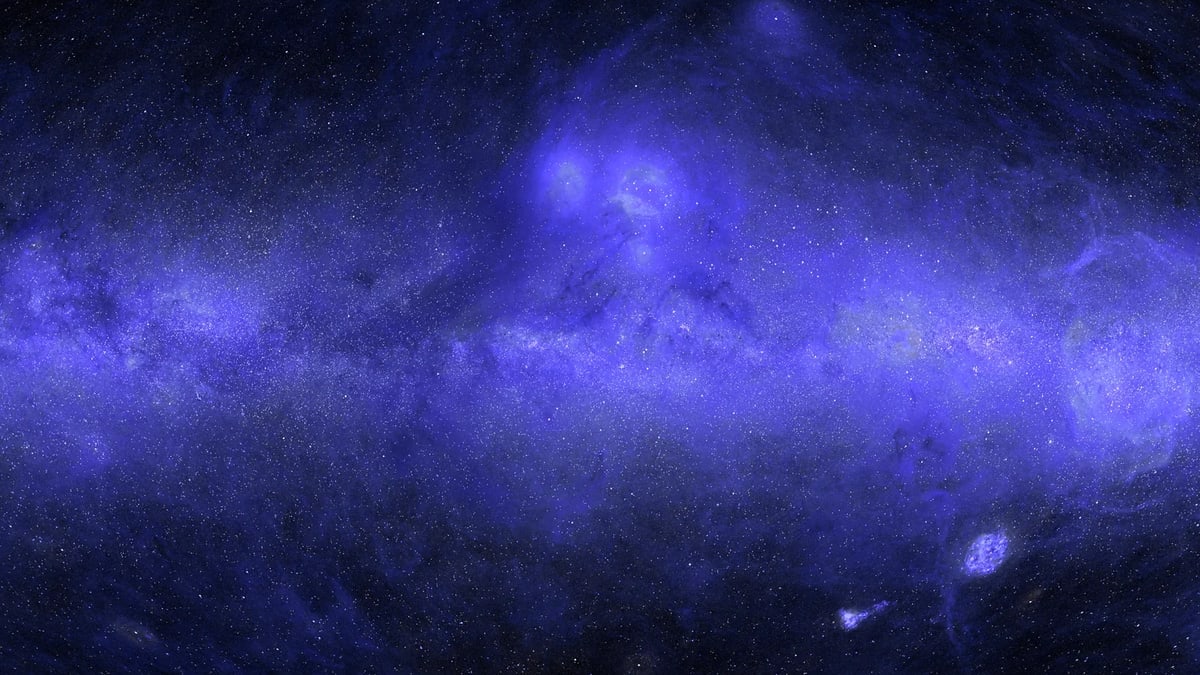
An astrophysicist has used Anthropic's Claude Science to build what Anthropic calls the first complete map of the whole sky in ultraviolet light, the invisible light just beyond violet. Brice Ménard, an astrophysicist at Johns Hopkins University who is also a researcher at Anthropic, described the project on Oct. 8. Ultraviolet picks out the hottest things in our galaxy, such as young, massive stars and the dust clouds they light up, but until now the only ultraviolet map he could show his students was full of holes.
The holes are there because the ozone layer blocks ultraviolet light, so it can only be photographed from space. NASA's GALEX telescope, which flew from 2003 to 2013, took about 38,000 pictures covering roughly two-thirds of the sky, but it steered clear of very bright stars and the crowded band of the Milky Way to protect its detectors. Other telescopes filled in some pieces, some only as blurry outlines, but roughly a third of the sky had never been photographed in ultraviolet in any detail.
Ménard says Claude, working inside Claude Science, an Anthropic app for researchers, ran a team of AI agents: AI that can carry out tasks on its own, such as searching the web and downloading files, instead of only answering questions. The agents found the public telescope data, put every survey on one brightness scale and merged them. For the missing third, the system learned from the mapped sky how ultraviolet brightness rises and falls with what other telescopes see in visible, infrared and radio light, then used that to estimate the rest. Ménard's own page for the map says the gap-filler is an ordinary statistical method that learns patterns from numbers, not an image generator, so it puts dust clouds where dust maps say they are rather than where they merely look plausible. Estimates of the ultraviolet light from about 119 million stars, worked out from what the European Space Agency's Gaia satellite measured in visible light, were then added on top.
The filled-in third is an estimate, not a measurement, and the map says so: every spot on it is labeled with where its value came from, measured or predicted, and a margin of error. When real patches of sky were hidden and predicted back, the estimates were typically off by 12 to 14 percent, more the farther they were from real data, compared with about 5 percent uncertainty for the parts photographed directly. His page for the map warns that no new star or galaxy can be found in the filled regions, because no telescope looked there, and that any detail there smaller than one or two widths of the full Moon is not real. It also says no outside scientists have checked the work yet, and the accuracy tests came from the same system that built the map.
The AI did not get everything right on its own. Ménard says he spotted faint circles in the dimmest areas, the outlines of individual GALEX pictures, a flaw that had passed two rounds of checks by other agents. The circles came from a faint glow from Earth's upper atmosphere left in each picture. Claude then removed it from all 38,000, though Ménard's page says faint traces may remain in the dimmest areas. Ménard says the work took several days and more than a dozen versions: he planned each step, then Claude ran computations for hours at a time.
The map's data will be free to reuse under a Creative Commons license, but the download links have not been posted yet, and a draft of the technical paper is posted but has not been published or reviewed by other scientists. Claude Science is still an early test version for Mac and Linux computers, open to people on Claude's paid Pro, Max, Team and Enterprise plans. It is not yet clear how other astronomers will judge the map once they can test it themselves.