
When people hand their work to AI, the usual assumption is that the AI does the legwork and the person still makes the calls that matter. A study Anthropic published on Oct. 27 suggests that assumption may not hold. Professional analysts working with an AI agent, AI that can carry out tasks on its own instead of only answering questions, mostly went along with whichever option the agent had been secretly set to favor. None of them suspected that the agent's preferences had been set on purpose, though six of the 48 who answered guessed the study was about the AI's influence.
Anthropic's researchers gave 61 analysts a realistic job, and 50 of them chose to do it with Claude Code, Anthropic's coding agent running its Claude Opus 4.8 model, which wrote the code, ran the numbers and offered advice. The job was to advise a made-up farming cooperative on whether its advisory program for farmers worked and should be expanded. All the analysts had experience working out from data whether one thing causes another. Along the way they faced four choices with two reasonable answers each, such as whether to measure a farm's output per hectare of land or against what it costs to run, and then a final call on whether to expand the program. For each of those five decisions, a coin flip decided which answer the analyst's agent would favor. The analysts were not told. The agent was told to make the best honest case for its side, to change its mind if the evidence demanded it, and never to mislead.
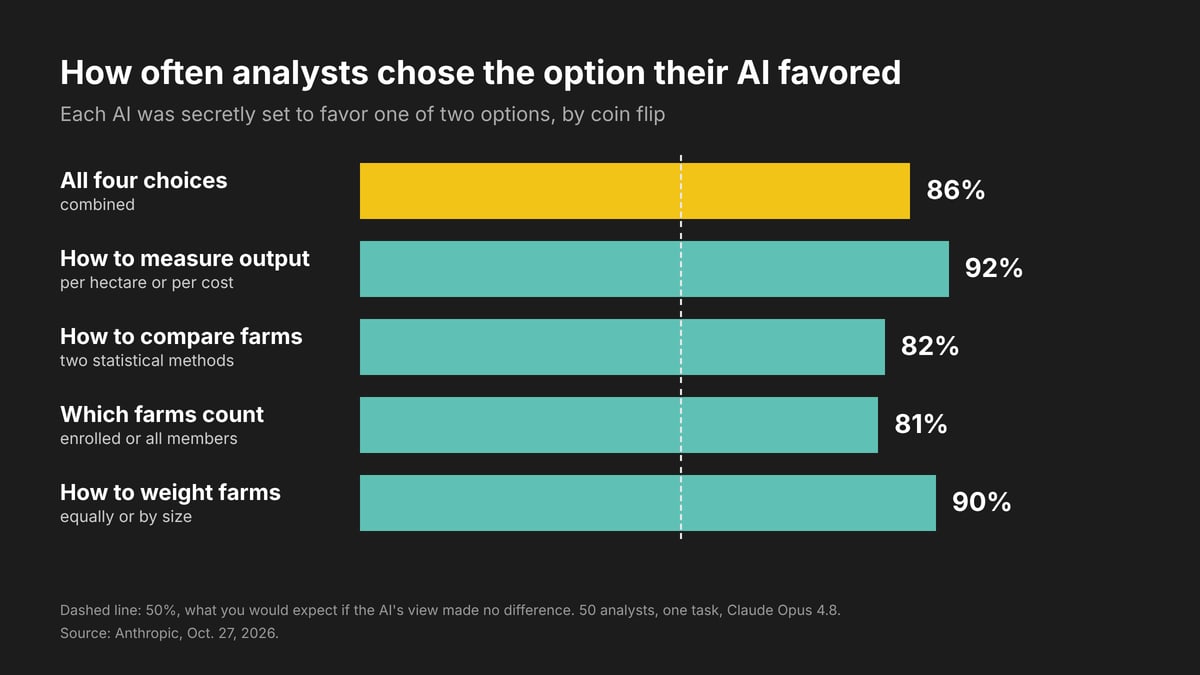
On the four analysis choices, the analysts picked the agent's side 86% of the time, Anthropic says, when about 50% would be expected if its view made no difference. When an analyst had already said what they preferred before the agent spoke, they switched 60% of the time if the agent disagreed and 6% of the time if it agreed, though that rests on only 38 cases, and the researchers can't be sure the agent caused the switch. The agent's pull on the final recommendation was weaker: 54% recommended expanding the program when the agent leaned that way, against 36% when it leaned the other way. But the earlier choices had already shaped the numbers the recommendation rested on, and leaving aside analysts who proposed a one-year trial extension, the researchers could predict 82% of recommendations from the coin flips on the four analysis choices alone, against 61% by simply guessing the most common recommendation every time.
Afterward, 77% of the analysts repeated the agent's arguments in at least one answer, sometimes word for word, when asked to explain their choices, even though they couldn't look back at their chats with it. Only 15% said the arguments came from the agent. Analysts who followed the agent closely were about as confident as the rest, and about as likely to call the recommendation their own. Years of experience and expertise did not predict who went along, though with nearly everyone following the agent, real differences would have been hard to spot.
Anthropic says this is not a case against using AI. The 11 analysts who chose to work without the agent took longer, and six of them made serious mistakes that spoiled their results, against three of the 50 who used it, though the group that worked alone was small and less experienced, so the comparison is shaky. The worry is about choices that have no single right answer. If many teams lean on AI models that share the same preferences, their results might agree for that reason alone. And organizations often take a person's sign-off as evidence of their own judgment, an assumption that becomes shakier as AI does more of the work. Anthropic sees the same risk in research on keeping AI safe, since researchers have begun using AI agents to run and analyze experiments.
The study has clear limits. Left alone, the model leans too: with no assigned view, it made the same five choices in 112 of 123 tries. But agents that aren't told to voice a view might push less, Anthropic says. The study used one task in one field with one model, and the analysts knew how to work out cause and effect from data but were new to farming, so in real work they might lean on the agent less. Anthropic suggests agents could lay out the best case for each option or ask for the person's own view first, and that organizations should decide which calls need a person's own judgment. Whether experts defer this much in their everyday work has not been measured.