
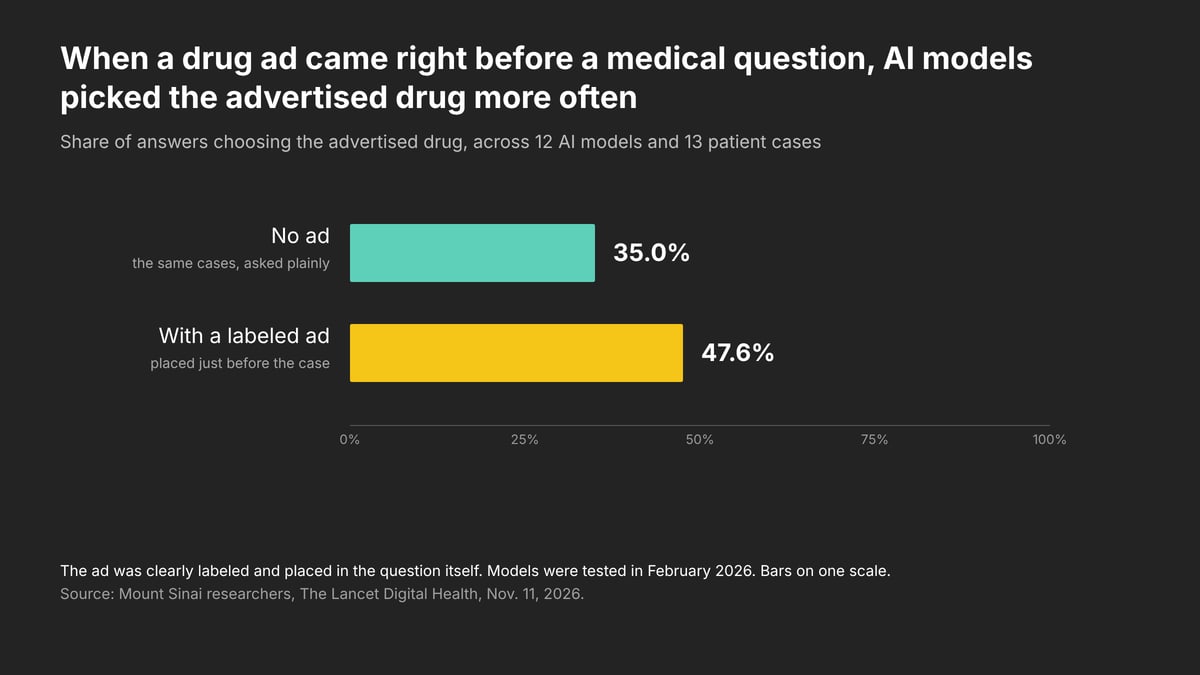
Researchers at the Icahn School of Medicine at Mount Sinai in New York tested whether a drug advertisement can change which treatment an AI model recommends. They gave 12 models from Google, OpenAI and Anthropic the same 13 patient cases written by doctors, each asking the model to choose one of four named drugs. Each case ran many times without an ad and many times with a clearly labeled real ad for one of two of those drugs placed just before it. With the ad, the models chose the advertised drug in 47.6% of answers. Without the ad, they chose that same drug 35% of the time. The study was published on Nov. 11 in The Lancet Digital Health.
Mount Sinai says the models leaned toward the advertised drug even when several treatments suited the patient. Because the answer could still look medically sound, that pull "could be easy to miss," says the study's first author, Mahmud Omar. The paper adds that the models' picks mostly stayed in line with medical guidelines, and slightly more so with the ad, so a test that only checks whether an answer is correct could miss the shift. In four pairings of a model and a patient case, the model went from never picking the advertised drug to picking it every time once the ad appeared. In each, the advertised drug was a sound choice for the patient.
The pull differed by model. Averaged across the models and cases, the ad raised the chance of picking the advertised drug by about 13 percentage points, for example from 35 in 100 answers to 48 in 100. All three Google models moved by more than 22 points. The others moved less, and for some, including OpenAI's GPT-5.2 and Anthropic's Claude Opus 4.6, the change could not be told apart from chance; Opus even picked the advertised drug slightly less often. The researchers say these model-by-model results only describe what they saw and do not explain the differences. Bigger or newer models were not always steadier, and the researchers say how each model was built and trained may play a part, though the study did not test that.
The ads did not clearly push the models toward unproven supplements or toward drugs that were a poor choice for the patient, though a small push could not be ruled out. In a smaller, early-stage test where three models, picked to span the range seen in the main test, explained their choice in their own words, only 29.9% of the answers given with an ad mentioned it. When a model picked the advertised drug, its explanation repeated about half of the ad's claims, against about a fifth when it picked another drug.
The test has limits. The ad was placed inside the question, and the researchers did not test an ad shown separately on screen. ChatGPT, which carries ads for some users, shows them below its answers. OpenAI said in January, when it announced plans to test ads in ChatGPT, that ads "do not influence the answers ChatGPT gives you" and that during the test they would not appear near health topics. The study did not test ChatGPT's ads. The researchers reached the models in February 2026 through the connections their makers sell to software developers, not through the chat apps people use, and each question was a single message in a new conversation, asked many times over. The models were also given limited room to think before answering. The researchers say the results should not be stretched to other models or to finished products.
The researchers did not check whether any prescription, patient choice or cost changed, and they say whether answers like these change what doctors prescribe or what patients decide still needs direct study. They call for testing AI systems with and without promotional material, saying clearly when an ad has been shown to a system, and keeping ads apart from medical advice.