
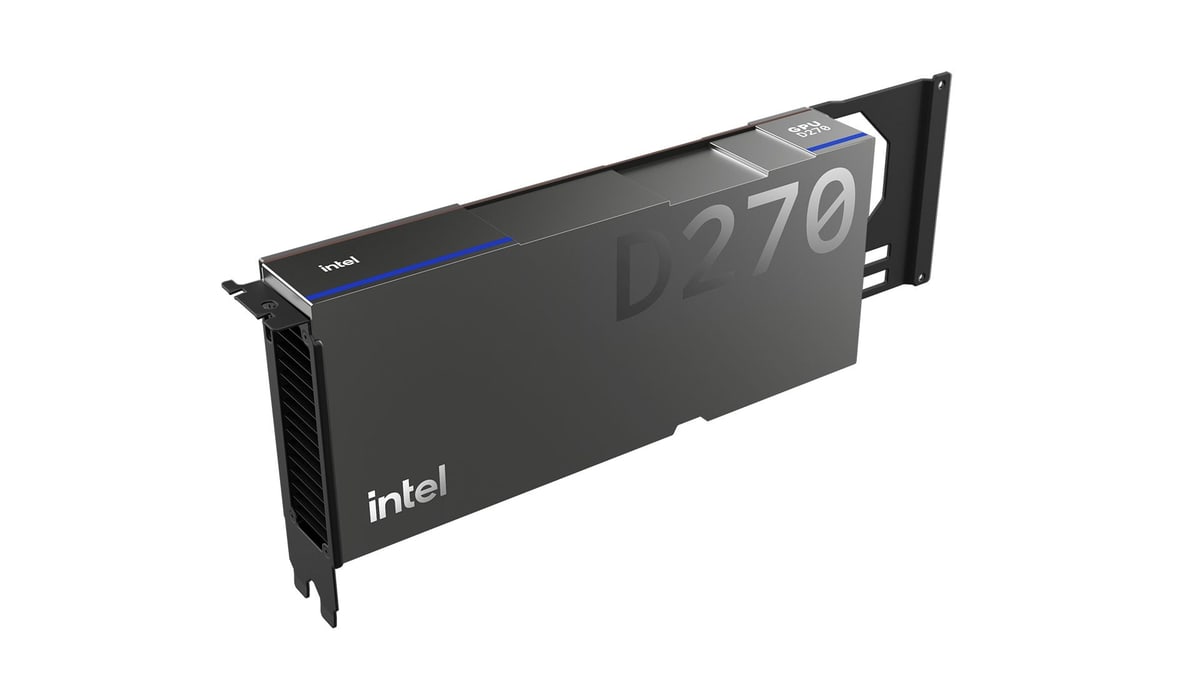
Intel on Monday, Oct. 12 gave its new AI chip for data centers a name and its main specifications at the Open Compute Project's Global Summit, a yearly data center industry conference. Code-named Crescent Island until now, the Intel GPU D-series is a GPU, an advanced AI chip, the hardware AI models are trained and run on. Intel built it for inference, running a trained model to answer requests, as opposed to training it. "Inference is becoming the defining AI workload, and enterprises need infrastructure that delivers the right performance at the right cost," said Anil Nanduri, an Intel vice president for AI products. Intel says early samples are now with customers.
Intel is pitching the chip on its memory. Intel says keeping more of a model on each card means a big model needs fewer chips. Intel's own version of the first card, the D270, carries 160 gigabytes, and Intel says other manufacturers can build versions with up to 480 gigabytes. Intel says the chip supports models with up to 300 billion parameters, the numbers a model tunes as it learns, on a single card, and more than a trillion across eight cards, though it has not said which memory version those figures assume.
Intel is also pitching it as easy to install. It says the 350-watt card plugs into the standard slot in existing servers and is cooled by air, so customers can run more AI without special racks or a switch to liquid cooling. Intel says that lets companies get more AI work out of the power and racks they already have.
According to a news report, it is not meant to match flagship chips such as NVIDIA's Blackwell Ultra or AMD's MI455X, and it is expected to be much smaller and cheaper. Its top speed on paper is about 40% below a similar AMD card that fits the same kind of server slot, though the report notes the AMD card can draw up to 600 watts against Intel's 350, and that speeds on paper rarely settle how chips compare in real use. The same report says it is Intel's first AI data center GPU for sale since 2021, after two planned successors were canceled.
Intel first announced the chip a year ago, when it said it expected customer samples in the second half of 2026. It has still not said when the D-series goes on sale or what it will cost, and the speeds it has given are figures on paper, not results from customers' own work. According to a news report, buyers may have to wait until 2027.