
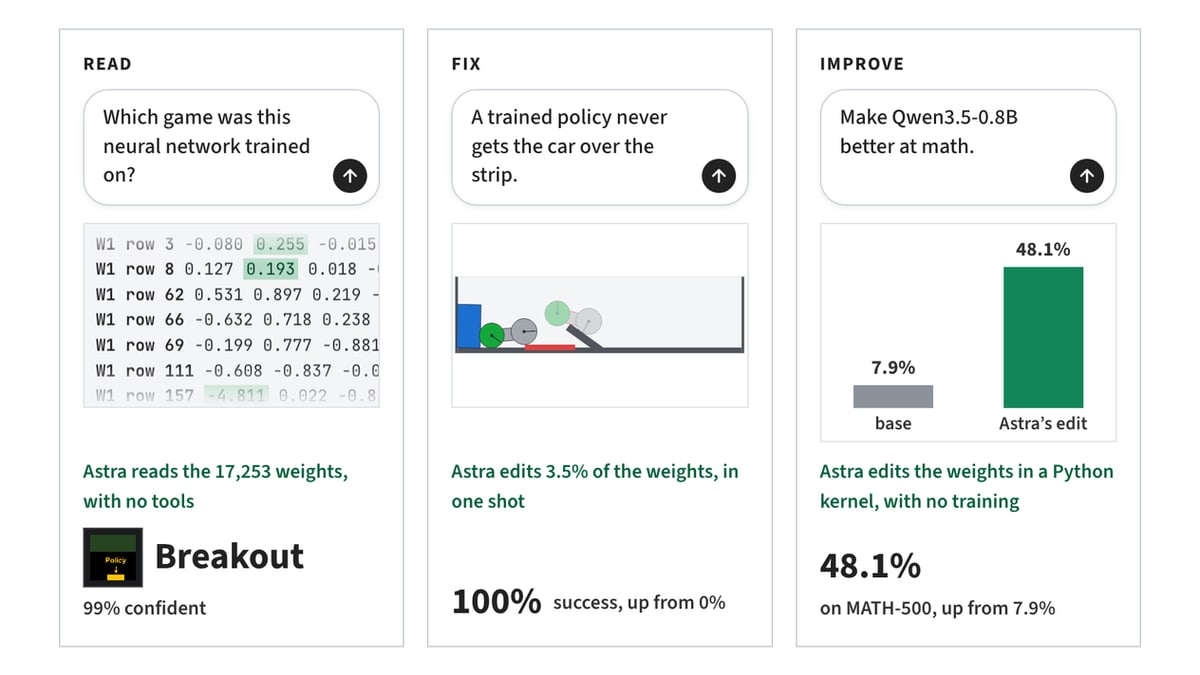
Researchers at MIT's computer science and AI lab say OpenAI's AI model GPT-6 Astra can work directly with the weights of other AI systems, the numbers a model tunes as it learns. Those numbers are hard for people to read. In a write-up posted on Nov. 2, Rikiya Takehi, Jayden Teoh, Alex Zhang and Omar Khattab report that Astra could tell what small networks were trained to do from their numbers alone, and could change the numbers to fix a fault.
In one test, the team trained four small networks, identical in size and setup, to play simple grid versions of Breakout, Pong, Pac-Man and Freeway, so only their numbers set them apart. Astra got each network's 17,253 numbers as text, with no tools and no list of games to choose from. The researchers say it named the right game all four times. Astra also worked out which shape each of three small image-making models produced. Its sketches showed only outlines, though the models made filled shapes. From the numbers alone, Astra could not tell which of two copies of a small model had been trained to agree with whatever answer the user suggested. When it could also see where each model focused while reading texts Astra wrote, it picked out that copy in all three pairs the team trained.
The team's main result involved Qwen3.5-0.8B, a small AI model. Its makers warn that it is prone to getting stuck repeating itself while it works through a problem, and 93% of its answers on a 500-question math test hit the length limit before reaching an answer. Astra worked in a Python programming session and could run the model on up to 50 batches of practice problems, but could not retrain it.
Astra traced the looping to one pattern in two parts of the model and changed 131,072 of its 0.8 billion numbers, about 0.016%. The researchers say the model's score on the math test rose from 7.9% to 48.1%, and its score on a test of following instructions rose from 21.0% to 62.3%. With 10 or 25 batches instead of 50, the math score rose only to 12.3% and 14.1%.
The researchers say the fix let the model finish answers it could already work out, rather than making it better at math. On Gemma 3 270M, a smaller model that rarely loops, Astra could not improve the math score. The team calls these very early results, and the write-up has not been formally published.
Outside engineers have questioned how much it shows. One ran the game test on a different model on a laptop, and it named three of the four games but missed Freeway. Another wrote that the math fix took the same steps a skilled human researcher would take. A third noted that it relied on code and test runs of the model, not on reading the raw numbers alone. The researchers hope the approach could one day find hidden problems in a model without running it, but so far it has only been tried on small models.