
In simulated tests, a small AI model trained by MIT researchers tuned analog chip circuits nearly as well as OpenAI's GPT-6 Astra on the kinds of circuits it had practiced on. MIT says the model is small enough for a company to run on its own computers. MIT announced the work, called SLIC, on Nov. 23; the paper was posted online on Nov. 10. Analog circuits connect devices to the physical world: they boost the wireless signal coming into a phone, for example, or process readings from a sensor that tracks a car's engine temperature. Designing them is still slow, largely manual work.
The model is small for the sake of secrecy. Most companies would be reluctant to send their designs, or the confidential data they get from the factories that make their chips, to an outside AI service, MIT says. SLIC's model has about 4 billion parameters, the numbers a model tunes as it learns. MIT says that makes it several thousand times smaller than the most advanced models, which have trillions, and cheap and efficient enough to run on a laptop. The researchers' released code runs it on a single large graphics chip of the kind used in data centers.
The model started as Qwen3.5-4B, an existing small open model, which on its own met the targets on only 2.3% of the familiar tasks. The researchers first showed it worked examples of the design process written by DeepSeek V4.1 Flash, a much larger AI model. Then they let it practice with reinforcement learning, which is learning by trial and error, with a reward for getting it right. On each task the model proposes new sizes and settings for a circuit's parts, then checks them in a circuit simulator, software that predicts how the circuit will behave. It adjusts based on the result and tries again. Each task allows up to eight rounds of changes. A task counts as solved when the circuit meets four targets at once, give or take 5%, among them how much it amplifies a signal and how much power it uses.
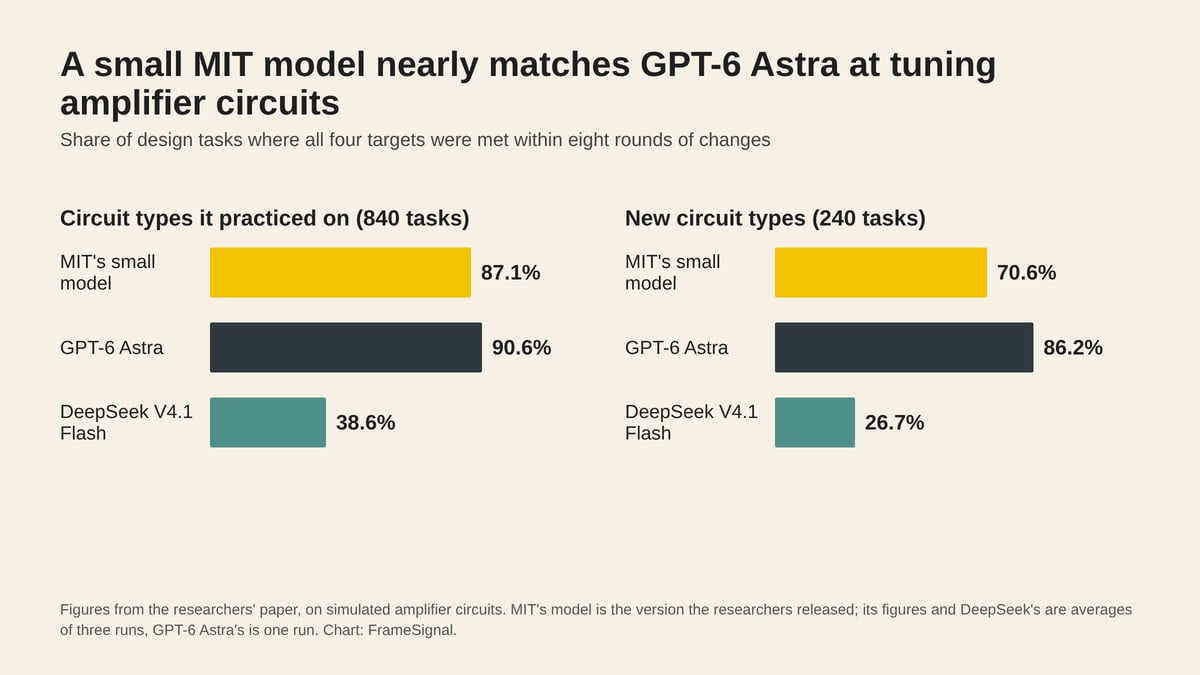
In the researchers' simulated tests on 840 new amplifier tasks, using circuit types it had trained on, the small model met all four targets within eight rounds 87.1% of the time, against 90.6% for GPT-6 Astra. With only four rounds on those familiar types, the small model did better than GPT-6 Astra, 74.9% to 67.1%. On 240 tasks with circuit types it had never seen, it succeeded 70.6% of the time, against 86.2% for GPT-6 Astra. DeepSeek V4.1 Flash, the teacher, solved only 38.6% of the familiar tasks. GPT-6 Astra was tested once, while the small model's scores are averages of three runs, so how much GPT-6 Astra's scores vary from run to run isn't known.
The model was trained on public, simplified models of how chip transistors behave, not any one factory's. With no extra training, it was also tested with TSMC's detailed models of a real manufacturing process, still in simulation. It solved 55.8% of a set of familiar-type tasks and 49.9% of new-type ones, down from 86.9% and 70.6% on the same tasks with the public models. The researchers say more training on a company's own setup could improve that. They have posted their code, data and trained model online, and will present the work at NeurIPS, a major AI research conference.
The work so far covers one step of chip design: choosing the sizes and settings of parts in an amplifier whose wiring is already fixed. The paper says other kinds of circuits, and a full design flow that also checks a design still works across manufacturing differences, temperature and voltage, are left for future work. It also says designs from such tools should still go through expert review, since real chips must meet reliability and safety requirements beyond the simulated targets. All the results come from computer simulations; no chip was built and tested. Co-authors from Analog Devices and IBM worked on the paper, and both companies helped fund it. The results so far are the researchers' own.