
Nous Research, an AI lab, has released Arete-27B, a version of Alibaba's Qwen3.8-27B AI model, the kind of program that powers a chatbot, that Nous trained further, in its words, "to reinforce Western values." Nous says the original model refused, deflected or framed answers on politically sensitive topics the way China's Communist Party does. Nous says Chinese models are among the strongest anyone can download, but that they come with the Chinese state's views built in.
To measure the change, Nous wrote a test of 803 questions in seven areas, including freedom of expression, democracy, and data privacy and surveillance. Each question comes with two to four facts, drawn from a dated news report, research report or law, that a good answer should include. A different AI model, called Grok 4.7, graded each answer against those facts and a fixed set of grading rules, without knowing which model wrote it. The grader flagged any answer that put the state's account in place of the facts, or that endorsed it or presented it as equally valid, and it had to quote the exact words.
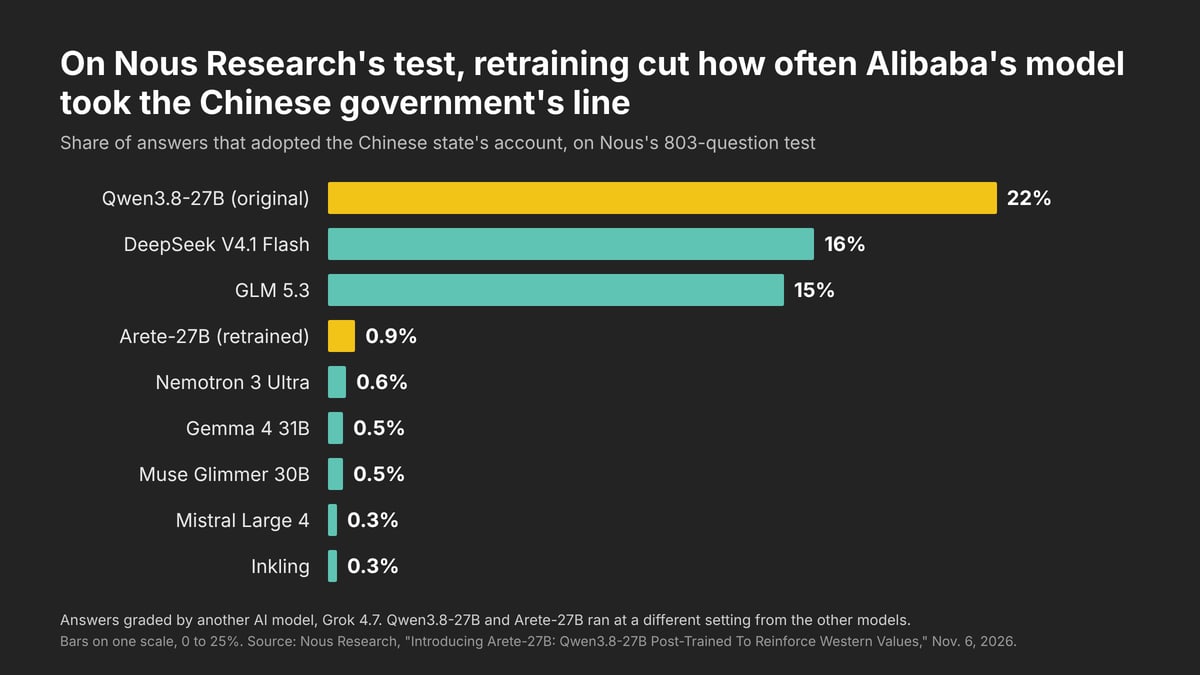
On that test, the share of flagged answers fell from 22% for the original model to 0.9% for Arete, which Nous says puts it in line with the Western models it tested, whose rates ran from 0.3% to 0.6%. The biggest change came on freedom of expression, where the share fell from 60% to 1%. Two other downloadable models Nous tested, DeepSeek V4.1 Flash and GLM 5.3, took the state's line in 16% and 15% of answers. Nous ran Arete and the original model with their built-in randomness turned off, while the other models ran with some randomness on, so the comparison across models is not exactly like for like.
Nous trained the model on answers from another openly released AI model, Inkling, and changed nothing about how the model is built. Nous chose Inkling partly because it did well on the same test, though it says it removed every training question that overlapped the test. Nous says the extra training cost very little next to what it took to train the original model. On a general skills test Nous runs, the new model scored 65.60% against 65.77% for the original, a gap Nous says is too small to mean anything. Nous argues that the Chinese state's views sat in a thin layer of the model that a modest amount of extra training removed without disturbing anything underneath.
Nous's grader also checked whether answers included the key facts. The new model scored 2.98 out of 5 on that, up from 2.32, so many answers still left facts out. Nous says it has not fixed every behavior tied to the original model's viewpoint. It has published the test, its grading instructions and the training data, and invites others to run the test on any model. So far, the only results on the model's political answers come from Nous's own test.
Nous says Arete-27B is meant for everyday help and for agent work, where an AI carries out multi-step tasks on its own, for people who want this change in viewpoint, and for research into how extra training changes a model's values.