
OpenAI said on Friday, Nov. 20, that it is fighting organized efforts to copy its AI models' skills, and described how. OpenAI calls this adversarial distillation. Distillation means training one model to imitate another by learning from its answers. OpenAI's concern is someone doing it without permission to build a model with similar skills but without the original's safety limits. It says a copy of a model's hacking skills, for example, could help with attacks the original would refuse to assist.
The company says its weekly actions against organized campaigns to copy its models have ranged from thousands to tens of thousands of accounts, and that the pace of those actions rose significantly this past summer. It says it acts against the network of accounts when it finds a violation of its rules, and shares warning signs with other AI companies so they can look for the same abuse on their own services.
OpenAI says it puts special weight on guarding what it calls protected reasoning: the working steps a model writes for itself on the way to an answer, which users don't see. OpenAI says these steps can hold information the final answer leaves out, which makes them especially useful for training a copy. In its own study, after a first round of training, a model that learned from the exact steps generally did better on cybersecurity tests than one that learned only from what users normally see, including summaries of those steps. The study used one starting model trained on coding and defensive security work, and OpenAI says it will keep studying how the results hold for other models and training methods. After further training, the model trained on the exact steps still led on both tests when allowed the most working steps OpenAI tried, while the other one led when allowed fewer. OpenAI says this suggests that keeping the steps hidden can limit how much hacking skill a copy picks up.
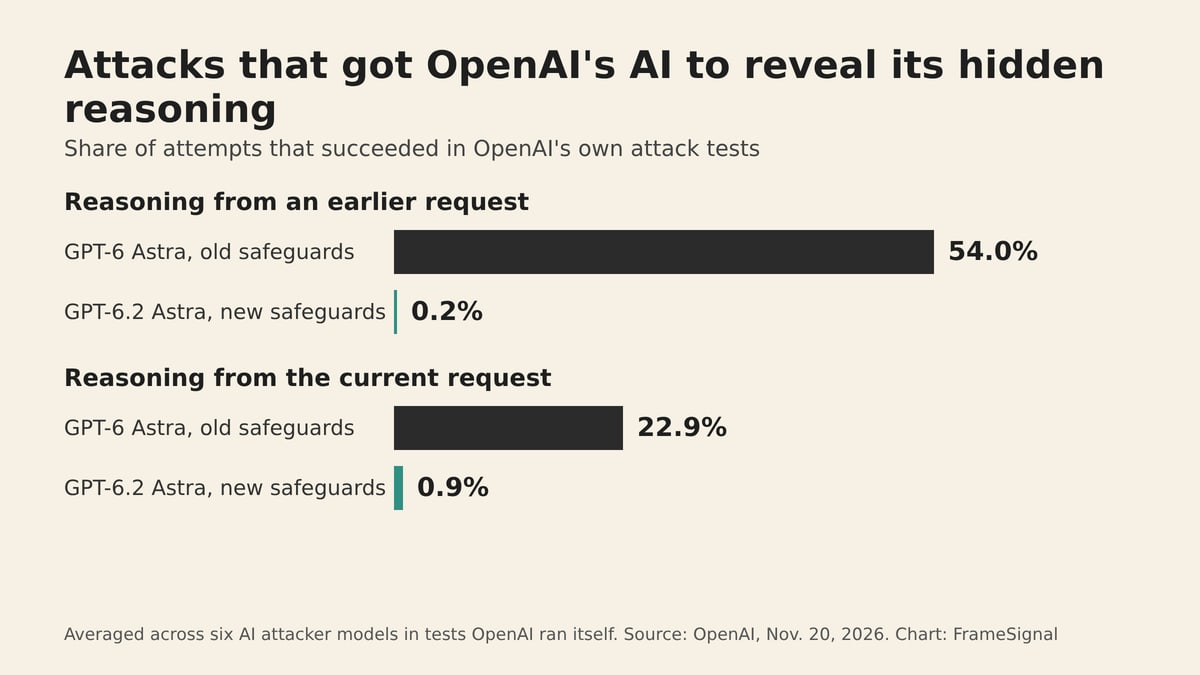
OpenAI says it has tightened its defenses in GPT-6.2 Astra and GPT-6.2 Sol. In its tests, AI attackers pulled out the hidden steps the model wrote while answering an earlier question 54.0% of the time against GPT-6 Astra with its original safeguards, and 0.2% of the time against GPT-6.2 Astra. Success at pulling out the steps behind the question it was working on fell from 22.9% to 0.9%. The results are averages across six attacker models, and the attackers had only the view an ordinary user has. These are OpenAI's own test results. The company says it is also applying some of the improvements to GPT-6 Astra.
OpenAI now blocks older model families with weaker safeguards from reading the hidden steps of GPT-6.2 Astra and Sol. In September, it said it had closed a gap that let someone who already had another user's scrambled hidden steps replay them and read them, and that the attackers it caught then had not broken its encryption or gained direct access to stored user conversations.
OpenAI casts this as a national security risk: a foreign group that copies a U.S. model's skills can use them without the safeguards its maker built in. It says it plans to share more soon about recent campaigns it has disrupted, but has not said who is behind them. In February it briefed Congress on activity it said showed DeepSeek trying to copy U.S. models this way, and in September it tied a core part of one campaign to people associated with Moonshot AI, the maker of Kimi. OpenAI says it backs laws that would give the U.S. government more tools to identify and sanction foreign actors who illicitly extract abilities from American AI models. It has also told Congress it supports the Chip Security Act, the AI OVERWATCH Act and the MATCH Act, and says stronger export controls can limit rivals' access to the chips needed to train top models.