
On Nov. 16, OpenAI made its AI agents available in its healthcare versions of ChatGPT. AI agents are AI that can carry out tasks on its own, such as using apps and websites, instead of only answering questions. In ChatGPT's healthcare versions, they can work in the software health workers already use, including insurers' websites. The agent reads the screen, clicks, types and moves between programs, much as a person at a computer would. The same ability is also available to developers and in OpenAI's ChatGPT Work and Codex tools; what is new is access through its healthcare products, test results in medical work and examples from health companies.
OpenAI says healthcare work is full of hand-offs between programs, because records sit in one system and forms in another. Its example is an MRI scan: the details an insurer needs to approve it are in the patient's medical record, but someone still has to copy them into the insurer's website. In OpenAI's demo, which uses made-up patient data, the agent drafts the scan order and a reply to the patient for the clinician to review. It then fills in the insurer's approval request for the staff member who handles insurance approvals to check.
The agents can be reached in three ways. Healthcare organizations get them through ChatGPT for Healthcare, which they buy through OpenAI's sales team; organizations that already use it need their administrator to switch the agents on. Developers can build them into their own software through OpenAI's API, a connection that lets developers plug a service into their own apps. U.S. clinicians who verify their license can try them with a free ChatGPT for Clinicians account, though OpenAI's help page says use can run out of credits.
OpenAI says organizations choose which programs the agent may open and which steps need a person's approval, and they can keep a log of what it does. To use it with patient records under the U.S. health privacy law, HIPAA, an organization needs a signed privacy agreement with OpenAI covering the service, plus OpenAI's required security and data-retention settings. A clinician on the free account gets that protection only if they are allowed to sign such an agreement and have signed one. OpenAI says ChatGPT for Clinicians is meant to support clinicians' professional judgment, not replace it, that clinicians stay responsible for every care decision, and that they should check its information themselves.
OpenAI says some large health companies already use the agents. Over a weekend, one CVS Health agent cleared a months-long backlog of documents waiting to be sent. Another handles the computer steps for tens of thousands of requests each day for a specialist's opinion on a patient, and CVS uses checks and staff oversight to confirm what the agents do. Cigna Healthcare, a health insurer, uses them to pull a customer's details from more than 10 separate systems in seconds for its case managers, the staff who help customers follow their care. Two health software makers are working with the agents too: Abridge is developing its own, and Ambience showed one that stops to ask the clinician when a record is unclear and waits for approval before submitting the request.
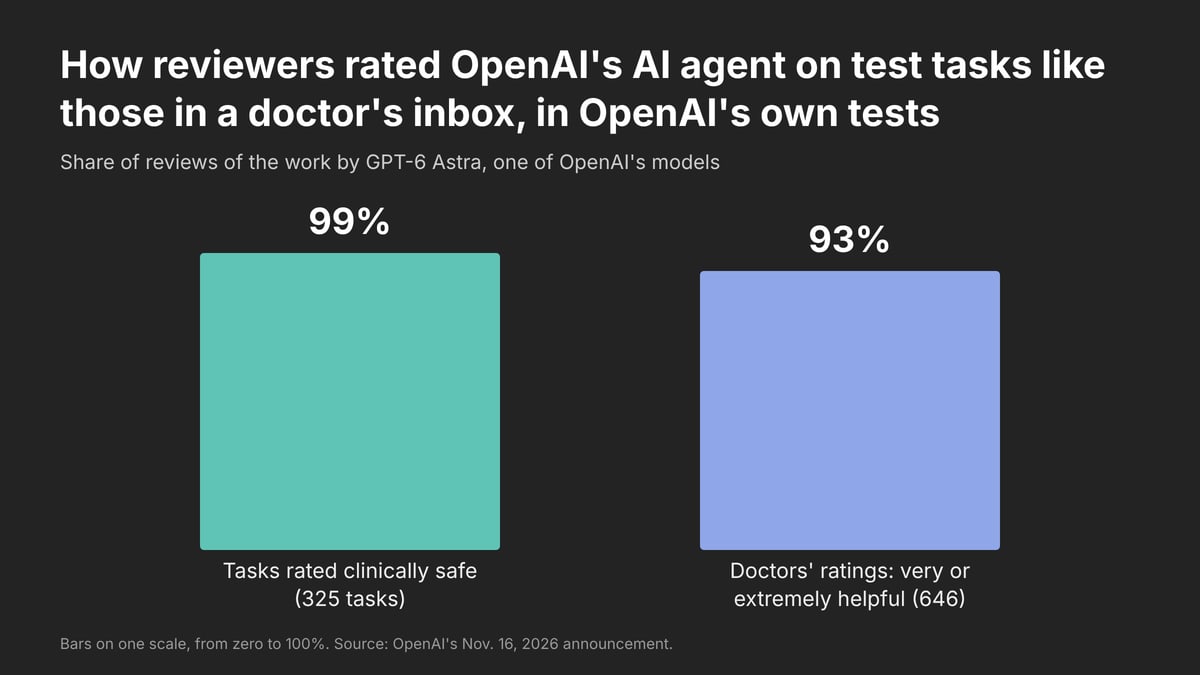
In tests OpenAI ran itself, GPT-6 Astra, one of OpenAI's models, worked through test tasks like those that land in a doctor's inbox in the electronic health record, the computer system that holds patients' charts. One was a caregiver asking how much children's ibuprofen to give a girl with a broken arm. Reviewers rated 99% of 325 tasks clinically safe, meaning nothing in the work could plausibly harm a patient, and doctors called the work very or extremely helpful in 93% of 646 ratings. Karan Singhal, who leads OpenAI's health AI work, said in an interview, according to a news report, that in some of the roughly 1% of tasks rated unsafe the model might overstep and take a step without the proper sign-off. He said the researchers found no case that created a specific, plausible risk of harm to a patient.
On a test of office work such as insurance approvals, appeals and medical equipment orders, made by Stanford researchers, OpenAI says GPT-6 Astra earned 94.3% of the available points. A cheaper OpenAI model, GPT-6 Luna, earned 91.8% at 8.5 cents a task, 98% less than Astra. It is not yet clear how often the agents make mistakes in busy hospitals using real patient records, or what organizations pay for ChatGPT for Healthcare.
Correction (Nov. 18): an earlier version of the headline said OpenAI brought the agents to hospitals. OpenAI sells them to healthcare organizations, and the companies it names as users are CVS Health and the insurer Cigna.