
OpenAI on Friday, Nov. 6, published BioBasicsBench, a test of how well AI agents handle the everyday analysis in a wet lab, where scientists run experiments on biological samples. AI agents are AI that can carry out tasks on their own instead of only answering questions. OpenAI built the test with Ligo, a biotech company focused on designing enzymes. OpenAI says everyday lab work involves failed experiments, ambiguous images and conflicting observations, and that tests built on the charts and images chosen for scientific papers may miss that.
The test has 100 tasks across five areas of routine lab work. Some are simple, such as reading the size of a DNA sample on a gel, a slab that sorts pieces of DNA by size because smaller pieces move through it faster. The pieces show up on the gel as bands. Others call for detailed analysis of lab tests. Scientists wrote the tasks from their own experiments' data: gel images, photos of plates of bacteria, microscope images, DNA readouts, instrument screens and videos of bench work. Each task was reviewed three times, once by an outside PhD-level scientist who works in a wet lab. Answers earn credit against expert-written grading criteria, including for recognizing when the evidence can't support a conclusion.
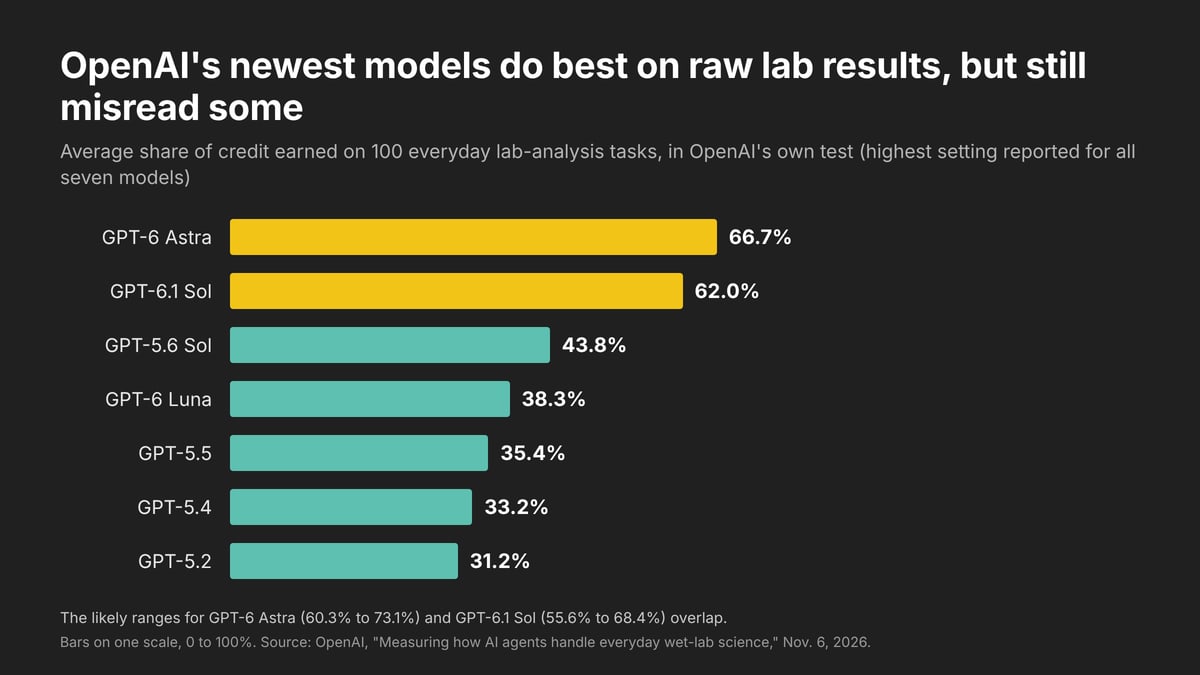
OpenAI tested seven of its own models. At the highest effort setting reported for all seven, which lets a model spend more effort on each task, GPT-6 Astra earned 66.7% of the available credit on average. GPT-6.1 Sol was close behind at 62.0%, and OpenAI's margins of error for the two scores overlap. Among the rest, the older GPT-5.6 Sol earned 43.8%, GPT-6 Luna, another GPT-6 model, 38.3%, and GPT-5.2 31.2%. Astra also produced about half as much text as GPT-5.6 Sol per task to get there. OpenAI says stronger handling of images, video and other kinds of data beyond text may be key to the gain.
OpenAI gives examples. In one, GPT-5.6 Sol saw no bacteria growing on a control plate, one of the checks scientists use to test an experiment's results, and based its conclusion on that. Astra noticed the plate's label named kanamycin, a different antibiotic from the ampicillin the experiment used, and rejected the plate as a reliable check. In another, cells drifted in and out of focus in a series of microscope images. GPT-5.6 Sol looked for a biological reason the cells seemed to vanish, while Astra recognized images taken at different depths, which bring cells in and out of focus.
OpenAI says higher scores on the test do not yet mean models can make reliable judgments in a lab. On a gel used to check which colonies of bacteria carried newly built DNA, Astra sorted the bands into the right two groups, then assumed the bigger piece of DNA marked success. It picked colonies that still carried the original DNA, which would lead a scientist to purify the wrong DNA. On a plate of bacteria, Astra's count of colonies came out about 12% too high. In another task, it looked at parts of a microscope image that contradicted its preferred answer, then left them out of its conclusion.
No other company's AI was tested. OpenAI's post does not say whether the tasks will be released for others to run. OpenAI says tracking these skills will also help it understand what they mean for biosafety and biosecurity.