
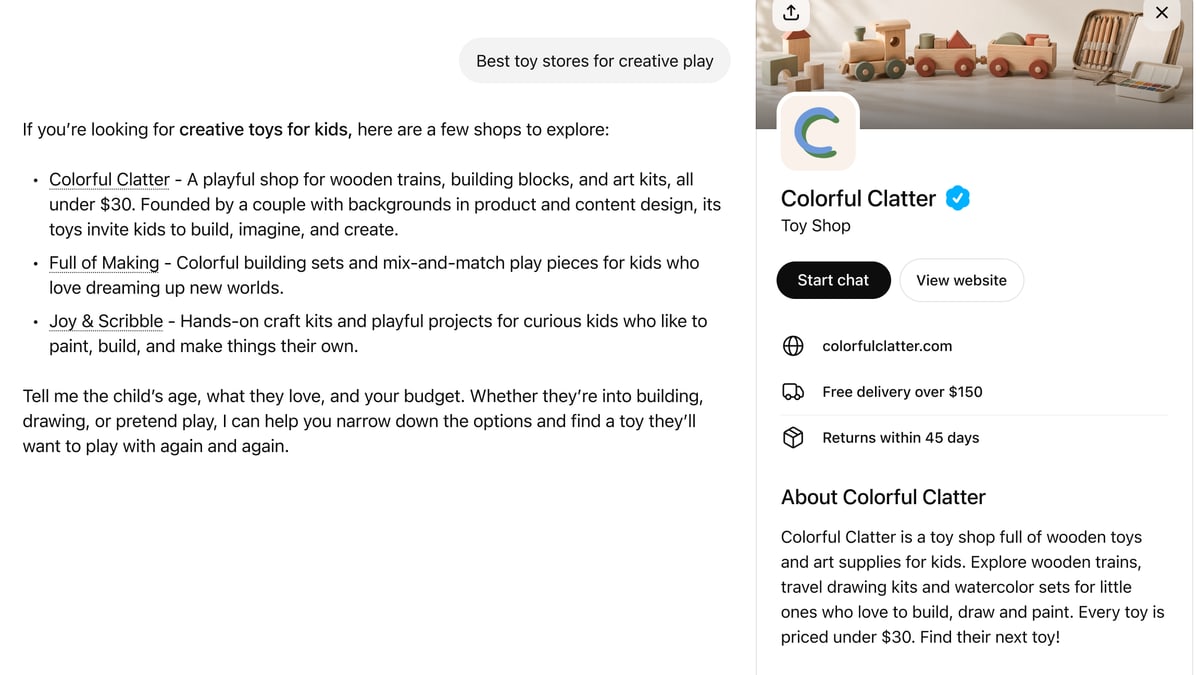
OpenAI has opened a way for businesses to update how they are described inside ChatGPT, which the company says 1.2 billion people use each week. A profile is the page ChatGPT opens when someone clicks on a business named in one of its answers. In a test version announced on Tuesday, Nov. 10, a business can claim its profile through a new tool called Business Hub. Once the owner is verified, the business can update its details and, if it sells products, add a list of its products with prices and whether they are in stock. Eligible products from Shopify stores were already showing in ChatGPT through Shopify's own catalog.
As with taking over a business's listing on an online map or review site, the owner first proves the link to the business. That can be a code sent to its phone or business email, a line added to its web address's settings, or a link to its Shopify store. To publish changes, see figures or build an assistant, the owner must also pass an identity check through a service called Persona, which may ask for a government ID, business registration details and proof that the person may act for the business. A blue check then appears on the profile. OpenAI says eligible businesses located where ChatGPT is offered can claim their profile, though it depends on the type of business and at first needs a website. Local stores and restaurants can for now claim a profile only if ChatGPT already lists them in the U.S.
Business Hub also shows how often ChatGPT points to a business's website or shows its location, and how many times people click through to its website, over the past 28 days. It also lists the common themes of the ChatGPT answers that mention the business. OpenAI says it does not share people's conversations with businesses, including their chats with a business's assistant, though OpenAI may pass on details a customer agrees to share through the assistant. The figures appear only once there are enough conversations or interactions to add up. It warns that the counts may be incomplete.
The second part, which OpenAI calls Business Agents, is for U.S. online stores and online service businesses that have a website and work in industries OpenAI allows. A business, or OpenAI on its behalf, sets up a chat assistant that answers customers' questions using the product and policy details the business supplies, and it goes live only when the business publishes it. A customer can open a chat with it from the business's profile. OpenAI says that chat is labeled and kept apart from ChatGPT's own answers. For now the assistant can explain products and policies and link to the business's website, but it cannot complete a purchase, make a booking or check an order. OpenAI's terms warn that the assistants may give wrong answers, and make the business responsible for what its assistant says. Businesses can also pay to promote their assistant through ChatGPT's ads, and OpenAI says those spots are labeled.
OpenAI says claiming alone does not change how visible a business is in ChatGPT, and that advertising does not change what ChatGPT recommends on its own. Its terms say it may create and show a listing for a business whether or not the business claims it. Claiming does not give the owner sole control, since OpenAI may add to, edit or replace what the owner submits, or not show it. By using Business Hub, a business also agrees that OpenAI's AI assistant may phone it on behalf of ChatGPT users, though it can opt out. A business that sends a product list must let OpenAI's crawlers, the programs that visit web pages automatically, and its other automated agents reach and use its websites. It must also agree that any opt-out it has declared against having its content mined by automated tools has no effect on OpenAI.
OpenAI says it plans to bring Businesses in ChatGPT and the assistants to more places and kinds of business over time, but it has not given dates. It is not yet clear how many businesses will claim profiles, or how much the details and product lists they add will change which shops ChatGPT suggests.