
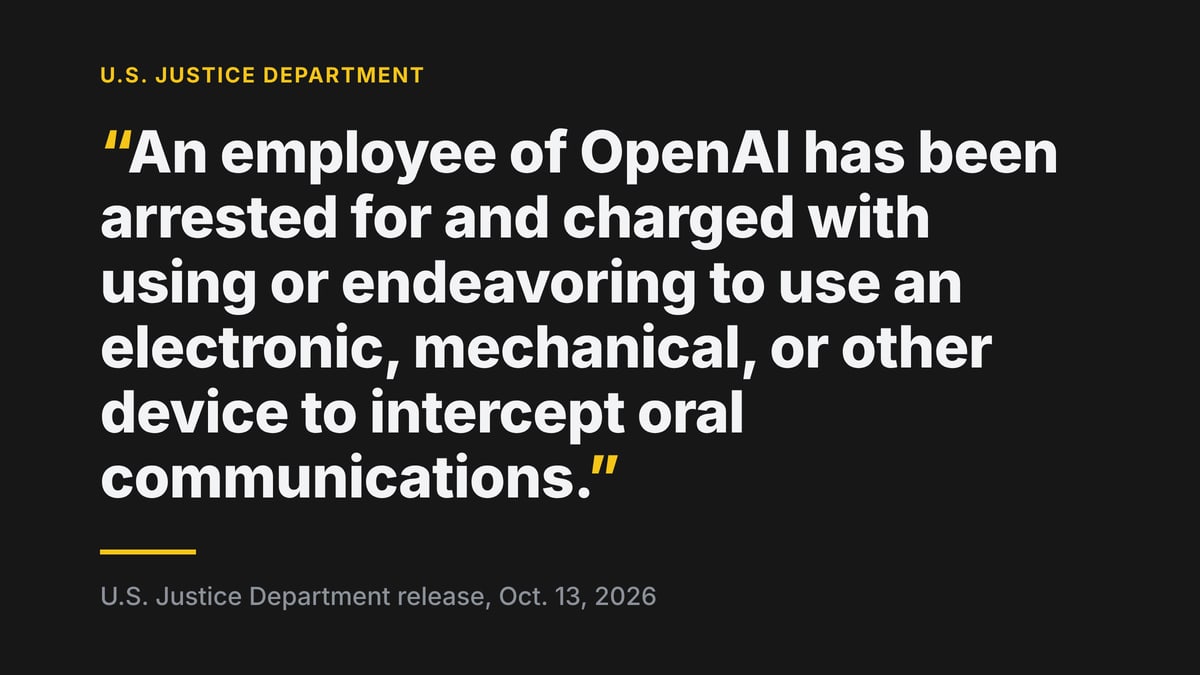
An OpenAI engineer has been arrested and charged after prosecutors say he secretly planted a recording device in an executive conference room at one of the company's San Francisco buildings, the U.S. Justice Department said on Tuesday, Oct. 13. Abdulrahman Alfozan, 35, a Saudi national who had worked at OpenAI as an engineer since July 2025, was arrested on Oct. 9 and made his first appearance in federal court on Tuesday. He is charged with using, or trying to use, a device to secretly capture spoken conversations. The charge has not been proven in court.
According to the criminal complaint, OpenAI staff found the device on or about Sept. 30, plugged into a USB port on the back of a television in the room and hidden in toilet paper. OpenAI worked out that it had been put there on or about Sept. 28 and that its contents were encrypted. Prosecutors say meetings in that room often covered highly confidential research, product plans and possible business deals, and that security cameras showed Alfozan near the room on several days before the device was found, though he had no authority to enter the room or join its meetings.
Prosecutors say that before the device went in, Alfozan used a workplace tool to look up OpenAI's building addresses, meeting rooms, room calendars and where "leadership and exec" were. Between Sept. 24 and Sept. 30, they say, a chatbot account tied to his spouse, which prosecutors say shared several identifying details with his own account, asked how to build "a continuous audio recorder" and how to encrypt its memory card. The same account asked about the planted device itself, including its unique network address, on Sept. 27 and 28, prosecutors say. On Oct. 5 he went into the room and appeared to look behind the television, the complaint says. On or about the same day, it says, OpenAI security staff found a second, similar device in a bag he had left in another room.
OpenAI says it used its own AI models to work out what the device was and where it had come from, which led to the employee, and then referred the case to the FBI. The Justice Department's account does not mention this. The company says it has fired him and has no sign so far that he improperly accessed or took its source code, customer data or model weights (the files that hold what its AI has learned). U.S. officials cast the case as a national security matter: Director of National Intelligence Jay Clayton said it shows why winning the global race to superintelligence, AI much smarter than people, is a national security prerogative.
FBI Director Kash Patel says Alfozan allegedly hid the device to secretly capture talks about the company's technology, according to the complaint, but prosecutors have not said what Alfozan allegedly planned to do with any recordings, whether anyone else was involved, or whether it captured any conversations. If convicted, he faces up to five years in prison and a fine of up to $250,000, followed by three years of supervised release. A hearing on whether he stays in custody is set for Oct. 19, according to a news report, and the FBI is still investigating, the Justice Department and OpenAI say.