
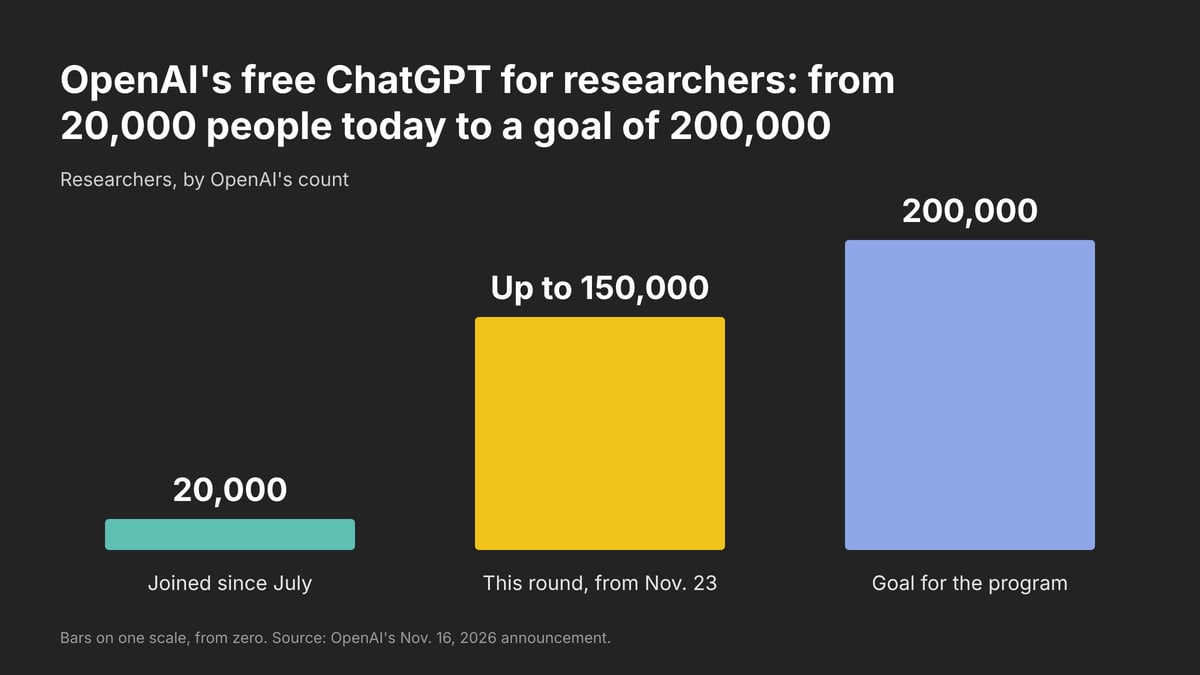
OpenAI said on Monday, Nov. 16, that it is expanding ChatGPT for Academic Researchers, a program that gives scientists free use of its chatbot. Applications for the next round open on Monday, Nov. 23. OpenAI will award 50,000 grants to the first eligible applicants, rather than drawing names by lottery as it did in the pilot. Each grant gives the researcher and up to two collaborators free ChatGPT Plus, a plan OpenAI lists at $20 a month, so the round could reach up to 150,000 researchers.
The program began as a pilot in July, and OpenAI says 20,000 researchers in 33 countries have joined since. OpenAI's goal for the whole program is to reach 200,000 researchers, double the goal it set in July. Pilot members got ChatGPT Pro, which OpenAI lists from $100 a month, at least five times the price of Plus. OpenAI says most of them would have stayed within the usage limits of Plus, so it is offering Plus this time so it can reach more research teams.
OpenAI's page comparing its research plans says the grants are for research faculty and postdoctoral researchers in every region except China and Hong Kong, free for 12 months. The grants cover ChatGPT, not credits for using OpenAI's models in researchers' own software. Papers that count include ones posted in the past three years on arXiv, a research-sharing site open to anyone, or on bioRxiv or ChemRxiv. Applicants must also have their identity and academic standing verified. OpenAI says the final rules on who qualifies and on collaborators for this round are still to be confirmed. Researchers already on the waitlist who qualify will get an email before applications open, and OpenAI says grants for people already on the waitlist come with separate terms. OpenAI says that by default it does not use what researchers share through the program to train its models.
Alongside the expansion, OpenAI published its own study of how 1,819 scientists in the pilot used ChatGPT, based on 580,186 science-related messages sent between Aug. 20 and Sept. 22. The two biggest uses were reading and learning, at about 28% of a typical scientist's messages, and writing and communicating, at about 27%. OpenAI says its researchers saw only the kind of task each message was about, sorted automatically, not the messages themselves. In a survey of 251 participants, scientists estimated that the same work, done as well, would have taken 1.9 times as long without AI. Those are the scientists' own estimates, not measured results, and OpenAI says the study does not show that ChatGPT caused the time savings.
Of the surveyed scientists who answered a question about the future, 98% expected AI to speed up discovery in their field. OpenAI says it will take more research to learn whether that happens, and that progress also depends on the funding, staff and lab capacity scientists need to test their ideas.