
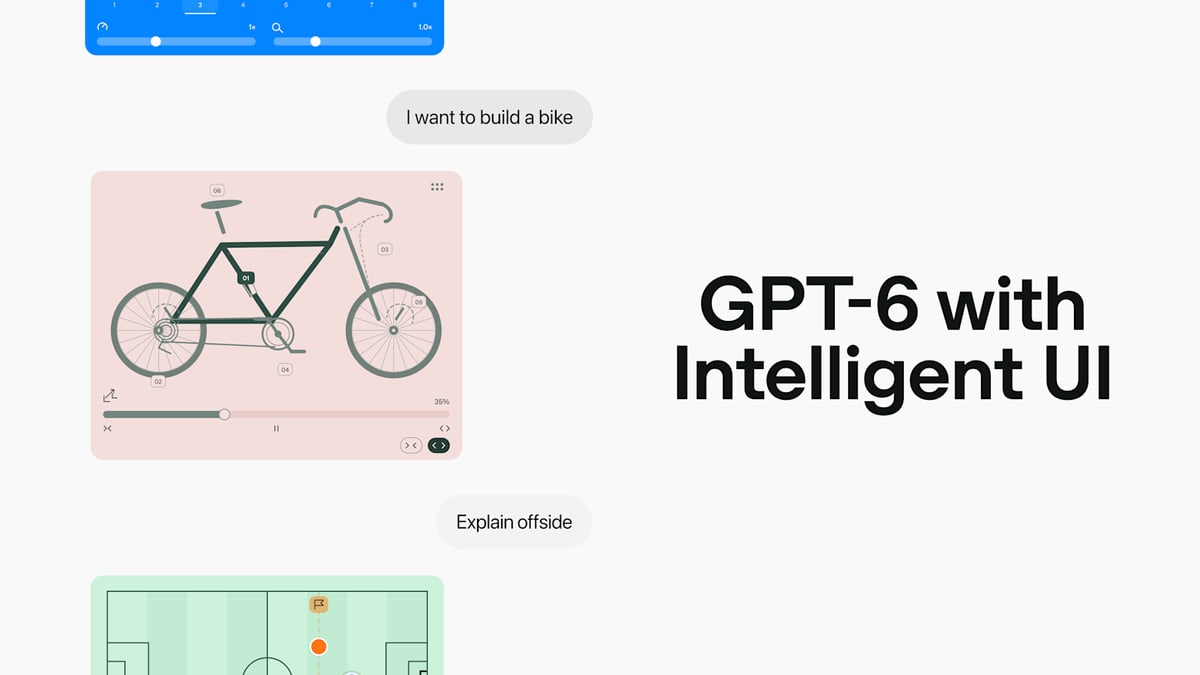
OpenAI on Wednesday, Oct. 7, began bringing GPT-6, the family of AI models it introduced last month, to the everyday Chat tab of ChatGPT, which the company says more than 1.2 billion people use each week. Until now those models had gone only to paying customers. The most visible change is a feature OpenAI calls Intelligent UI, short for user interface, the parts of a screen you look at and tap. With it, ChatGPT can build part of an answer as something you can look at and use: a diagram, a chart, a map, a form or buttons you can tap.
OpenAI says it trained GPT-6 to decide which format suits each question, and that ChatGPT still answers in plain text when that is most useful. Its examples include a 7-speed bike broken into its main systems, such as the frame, wheels and brakes, which you can select one at a time, road trip stops placed on a map, and a Sunday roast plan whose shopping list changes as you change the number of guests. People can also ask for a small tool for the job at hand, such as a calculator showing how savings could grow, a bill splitter for dinner with friends, or a game played inside the chat. OpenAI says it built a set of ready-made screen pieces for the model to arrange, along with software that shows the answer on screen bit by bit as it is written.
OpenAI says ChatGPT can now start answering a harder question while it is still working on it, adding to the answer in parts, where before people had to wait until it finished. It says that for questions that need a web search, GPT-6 Instant, its quickest answer setting, starts answering 44% sooner on average than the version before it, GPT-5.6 Instant. It also says GPT-6 is better at deciding when to look something up, better at saying when it lacks the information to answer, and harder to trick into getting around its safety rules. All of those results come from OpenAI's own tests.
The rollout starts worldwide on Oct. 7 for the Plus, Pro, Business and Enterprise plans and widens to the Free and Go plans from Oct. 8, so some accounts may not see it right away. OpenAI says Plus, Pro, Business and Enterprise run on a model called GPT-6 Sol, and Free and Go on GPT-6 Luna, both tuned for everyday conversation, though OpenAI's help page for the change still lists the older GPT-5.6 Luna for those plans. At companies on the Enterprise plan, access depends on settings chosen by the company. The new answers don't come with a usage cap of their own; each plan's usual limits still apply, and older models people can already pick in the menu stay available. On the web, turning off a setting called Layout and visuals cuts back the visual pieces, though it does not switch ChatGPT back to text only. The new answers don't appear when Pro subscribers choose the top Pro setting, phone users need the latest app, and the older ChatGPT desktop apps for Mac and Windows don't support them; OpenAI points those users to the web version. The models behind ChatGPT's separate Work and Codex sections are not changing.
OpenAI says there is still work to do on the model's sense of design. It has not said how often the new visual answers or the tools ChatGPT builds get things wrong, so there is no outside measure yet of how far to trust the numbers inside a chart or calculator it makes.