
OpenAI said on Nov. 24, 2026 that its GPT-6 models can come up with new protein shapes, and the order of the building blocks that make them, using reasoning and ordinary coding tools, without calling the biology software usually used to generate such designs. Proteins do much of the work in living cells. Designing one means working out a three-dimensional shape that would do the job, then working out which order of chemical building blocks, called amino acids, would fold into that shape. OpenAI posted the work as a paper that has not been through review by other scientists.
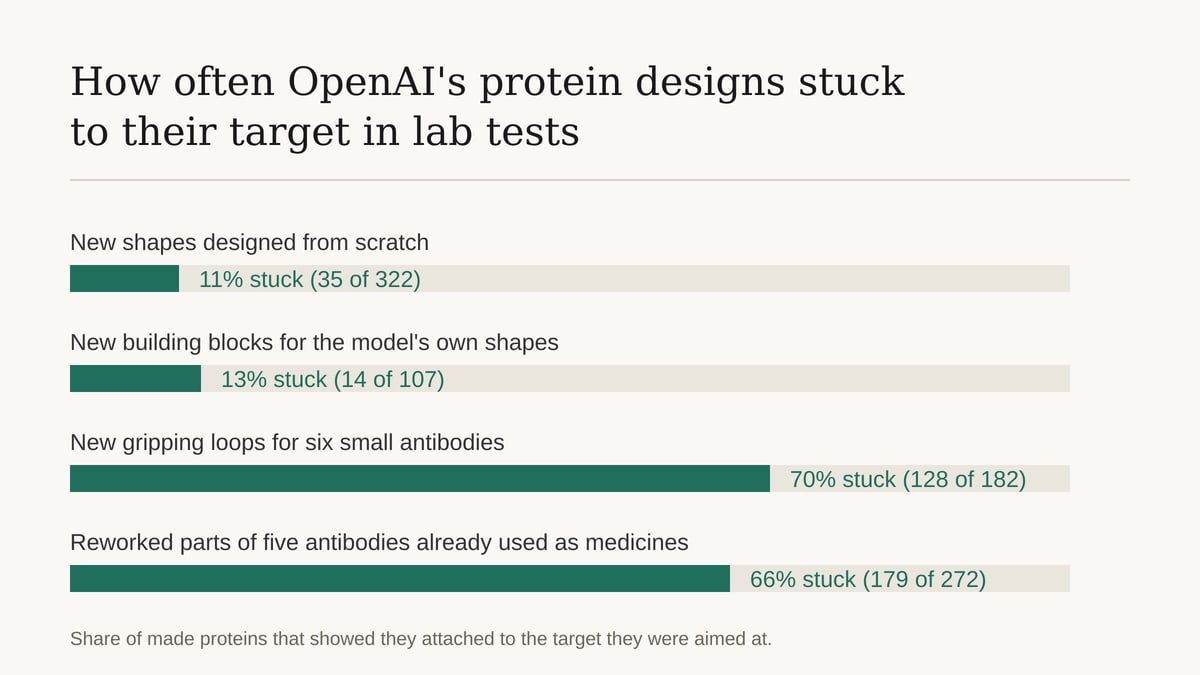
The first lab test was run with Onava, a company OpenAI calls its research partner. A pre-release version of GPT-6.2 was given the shapes of five target proteins with the places marked where a new protein should attach, and it wrote code to design shapes that would fit. Specialized biology software then proposed an order of building blocks for each shape and helped choose which designs were worth making. Onava made and tested 322 of them, small proteins meant to attach to one specific target, the way antibodies do in the body. Of those, 35, about one in nine, tested positive for sticking to the target they were aimed at, and at least one stuck for each of the five targets, among them PD-L1, a protein some cancers use to evade the immune system. The rate varied sharply by target, from a single hit on one of them to 18 on another. OpenAI says GPT-6.2's shapes scored slightly lower than a specialized design tool on its own computer checks, and that only an internal model it has not released scored higher. OpenAI also says an earlier study of that specialized tool reported a higher share of hits, and that the share depends heavily on how strictly researchers screen designs before lab tests and on what they count as sticking.
OpenAI says researchers could steer the designs by describing what they wanted in plain language, such as where a protein should attach and how many coiled sections it should have, and that in computer checks an internal model followed those instructions almost exactly. In one run the model was given three shapes it had designed itself and never published, shapes a specialized program had already turned into proteins that stuck, and was asked to write the building blocks from scratch. Of 107 proteins made that way, after the same software screen picked which to make, 14, about one in eight, stuck. OpenAI says the shapes were ones no one had published. In one example it gives, the building-block orders the model wrote differed from the original at 52 and 58 of 90 positions. OpenAI takes that as strong evidence that the models are doing more than repeating what they were trained on.
In other experiments GPT-6.2 was given a protein's shape and most of its building blocks, with the gripping loops left out, and asked to write new ones. Of 182 loop designs for six small antibodies that all attach to the same target, chosen by the same software screen before anything was made, 128, about seven in ten, showed signs of holding on. In a second run on five antibodies already used as medicines, the model changed about half the building blocks in each of three gripping loops: of 272 pieces tested, again the ones the screen picked, 179, about two in three, still held on to the original target.
The work still leans on software built for biology. OpenAI says the design run used programs such as Boltz-2, OpenDDE and ESMFold2 to help pick which designs were worth making, and that in the first run other specialized programs wrote the order of building blocks the proteins were built from. It says the results do not yet show that its models can produce new small proteins of this kind from start to finish without that help. OpenAI says predicting a whole protein's shape from its building blocks alone is still much harder for its models than several of the other tasks it tested, and that even its best internal models stayed well behind software built for that job.
OpenAI also says some of its test results need care. When models were asked to work out the order of a protein's building blocks from its shape, they scored unusually well, and OpenAI says that may partly reflect proteins they were trained on, or patterns left by the way those shapes were made. Those results on their own, it says, do not show that the models work reliably on proteins they have not seen. The model behind the lab designs, a pre-release version of GPT-6.2, is not one the public can use, and in the computer tests an internal research model OpenAI has not released matched or beat the specialized software on many tasks.
Sticking to a target is only an early signal. OpenAI says further work would have to show that a designed protein attaches only where it should, stays stable and does something useful in a living body. Safety and effectiveness would have to be shown too before it could be a medicine. The lab work was done by OpenAI's own research partner. The company says the same abilities that help design medicines could be misused, and that it assesses those risks under its own safety framework.
Correction (Nov. 25): an earlier version said the building-block orders the model wrote differed from the originals at more than half their positions. OpenAI gives that figure for one example, two sequences differing at 52 and 58 of 90 positions.