
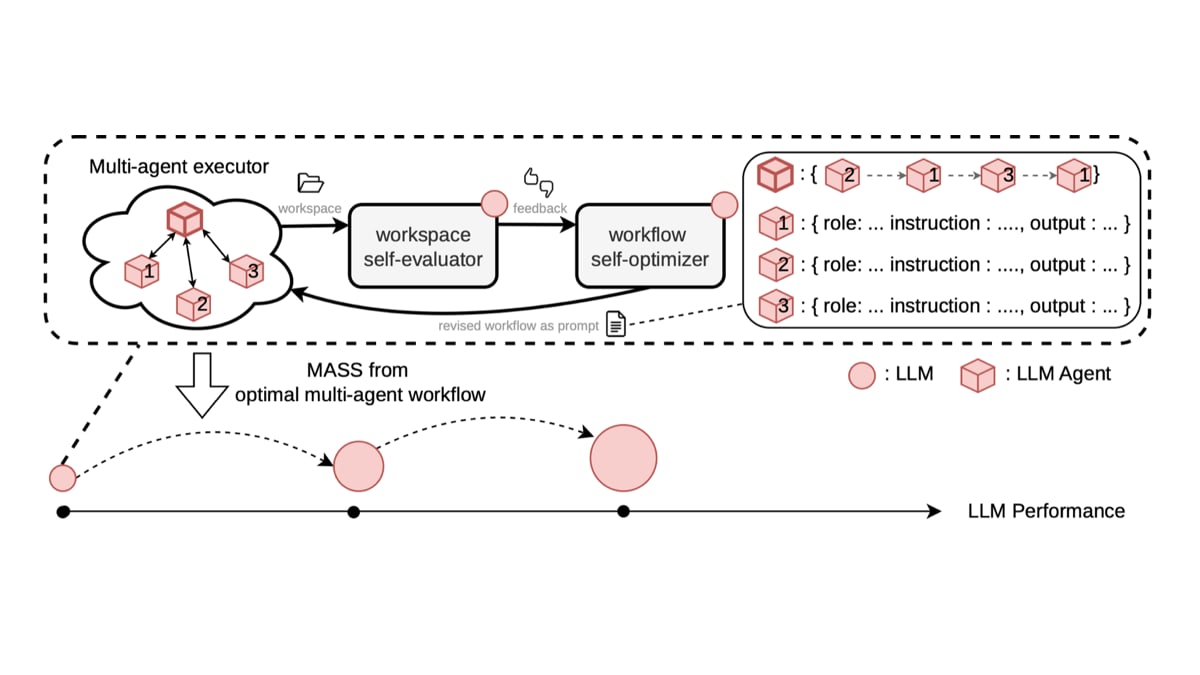
Researchers at Sakana AI, a Japanese AI lab, and UC Berkeley say they have found a way for an AI model to get better at long research projects while acting as its own teacher and judge. Their method, which they call MASS, is described in a paper first posted online on Oct. 8 and in a post on Sakana's website. It is an attempt at what AI researchers call recursive self-improvement: an AI improving itself, then using the improved version to improve itself again, round after round.
The researchers argue that as AI takes on work at the edge of what people know, even experts may struggle to judge the results, so the model itself may end up as the best supervisor available. The trouble, the paper says, is that a model grading its own work risks reinforcing its own errors rather than correcting them. The researchers' answer is to have the model work as a team of copies of itself and learn from what that team gets right.
In MASS, one model plays every part. Copies of it work as a team. One copy hands out assignments to helpers and pulls their results together. It follows a written plan that sets each helper's role and instructions, what it must hand back, including any checks, and the order of the work. The same model also acts as a judge, comparing two finished projects and picking the better one, and as a planner, rewriting the team's plan based on the judge's feedback. Once the model has picked its best plan for a task, the team runs it 18 times, the model ranks the results, and up to 15 of the best runs per task become extra training for the model. The plan itself is left out of that training, to push the model to learn to organize the work on its own.
The researchers started from an existing AI model, Qwen3.6-27B, and ran two full rounds. They used 12 research tasks in finance, robotics and pharmacy, written by OpenAI's GPT-5.5, each calling for working code, results and a written report. Three were held back for testing, and eight of the rest in the end supplied training material. To measure progress, GPT-5.5 and Anthropic's Claude Opus 4.8 compared the work, and their verdicts were kept out of the process. On the three held-back tasks, in comparisons that had a winner, they preferred the twice-improved model's work to the original's 69.9 percent of the time, up from 53.9 percent after one round. The researchers also say the model became a better judge and planner even though it was trained only on doing tasks: its verdicts agreed with the outside judges 93 percent of the time by the end, up from 73 percent.
On four public tests of research work, the researchers report their gains mostly as how much the model achieved for the amount of text it wrote: 1.2 to 1.6 times as much as the original. Plain scores rose on all four, by very different amounts: on a test of machine-learning research projects the average grade rose by about half, while on a data-science test it barely moved. On a test of data-driven science tasks, the share solved rose from 28.8 percent to 31.7 percent. On two tests of software and computer tasks, the improved model did slightly worse, passing 35.2 percent of tasks instead of 37.5 percent on one and 61.1 percent instead of 62.6 percent on the other. The researchers suspect adding software tasks to the training would fix that, though they have not shown it. The search for better plans was also unsteady, with strong attempts sometimes followed by sharp drops.
The experiment was small: one model, two rounds and a dozen practice tasks written by another AI, so it is not yet clear whether the gains keep coming. The researchers note that nothing in the method guarantees each new round will improve, and that speeding up the gains in each round is still work for the future. They also warn of a risk built into the idea: when one model does the work and grades it, a blind spot in that model could let a flawed result pass as an improvement and be carried into the next version, and if people cannot spot the flaw either, each round may make it worse. The researchers have published their code.