
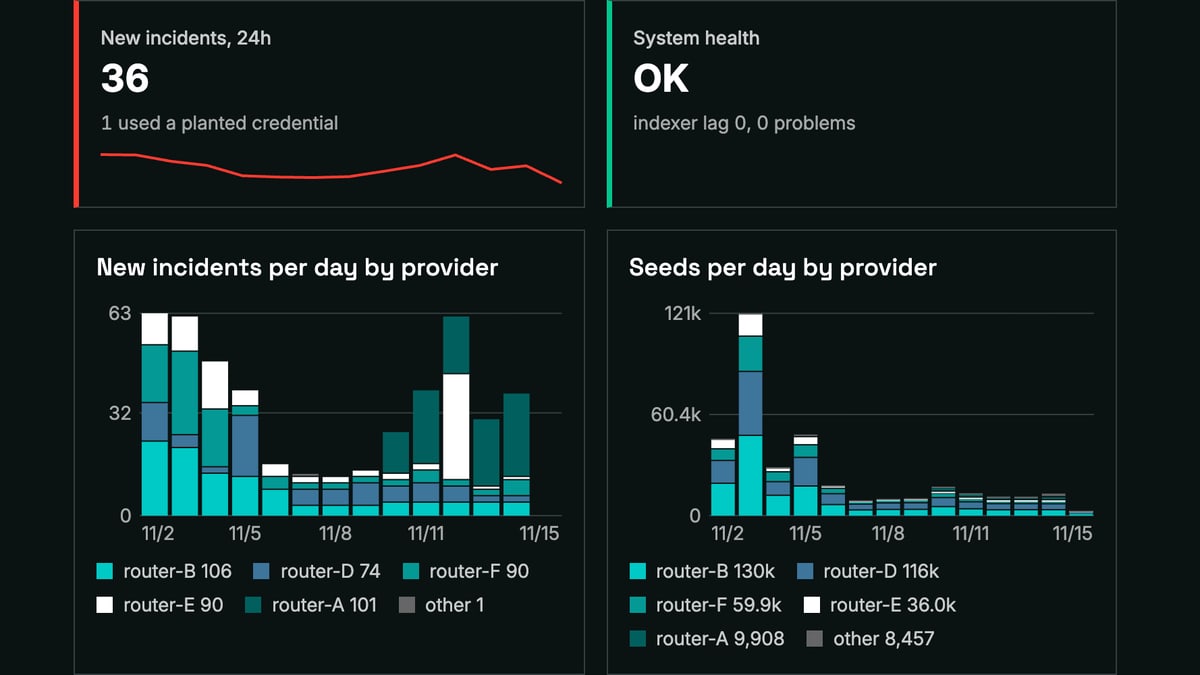
Dragos, a security company, says attackers stole requests sent to at least three companies that run AI models for others. A request is whatever a customer sends an AI model to work on, from a question to a file of code. From July through November, Dragos sent about two million requests to AI services, each carrying a unique password, web address or cloud key that no real system would ever use. Anyone who later tried one had to have seen the request.
In a Nov. 19 post, Dragos's chief research officer, HD Moore, wrote that none of the three companies knew it had been broken into until Dragos told them, and that the earliest break-in dates back to mid-July. He wrote that the requests caught were bait, but they were handled alongside real customers' requests, which were almost certainly copied too. Some of the stolen requests had been marked not to be stored, a setting that does nothing once an attacker is inside. Dragos does not name the three companies. It says the thieves tried its planted keys to cloud computing accounts, sometimes within hours, then searched those accounts, which Dragos had left empty, for data and tried to set up logins of their own.
Two companies have described break-ins. Together AI said on Nov. 21 that an outsider downloaded samples of customer requests that it had stored for testing its software, taken from requests to three AI models, mostly on four days in June and July. It says an AI agent, AI that can carry out tasks on its own instead of only answering questions, was writing code for one of its public projects and put in a password to the private store of those samples. Together's scanning caught it and the change was undone, but the outsider got the password first. The outsider then searched the samples for passwords to other services and tried them, and Together says five of those were planted by Dragos.
Phala, which runs AI models on its own servers, said in a Nov. 10 report that an attacker took over the computer running one model. It says only requests sent on Oct. 21 and 22 are known to have been taken. As a precaution, it says anything sent to that model through OpenRouter from Oct. 21 to Nov. 8 should be considered exposed. Phala credits an outside security researcher, whom it does not name. Phala tells those customers to change any passwords or keys they put in their requests.
Dragos also found people reselling cheap access to AI models who kept and read the requests that passed through them without breaking into anything, then tried the planted logins. It says some companies kept or passed on requests that customers had marked not to be stored. Dragos says requests sent to some U.S. companies were passed back to a Chinese AI lab, which it does not name, whose systems opened the secret web addresses in them. Novita, another company that runs AI models for others, says a researcher's report led it to find a setup mistake. Between May 28 and Nov. 11, some customers' requests for models made by MiniMax were passed to MiniMax's own service instead of being handled by Novita. Novita says those requests may have been read or kept by someone else, and advises customers to change any passwords or keys they included.
OpenRouter, which passes developers' requests on to many of these companies, said on Nov. 22 that it dropped three companies, which it did not name. It also stopped offering 125 of its listings, each one company's version of a model, to customers who ask that their requests not be stored, some of them as a precaution. It says the findings showed no break-in at OpenRouter itself, and that it has told all customers who may be affected.
Together says it is still checking whether personal information or other customer data was exposed, and has not said how many customers are affected. OpenRouter says not every affected company has posted about it. Dragos wrote on Nov. 19 that the company it found broken into in mid-July had not yet told the public, and it is not clear whether that company has spoken since. Phala says its investigation is still going on. Dragos advises turning on settings, where a company offers them, that strip passwords and keys out of requests, and warns that AI agents will send whatever they can read, passwords included.