
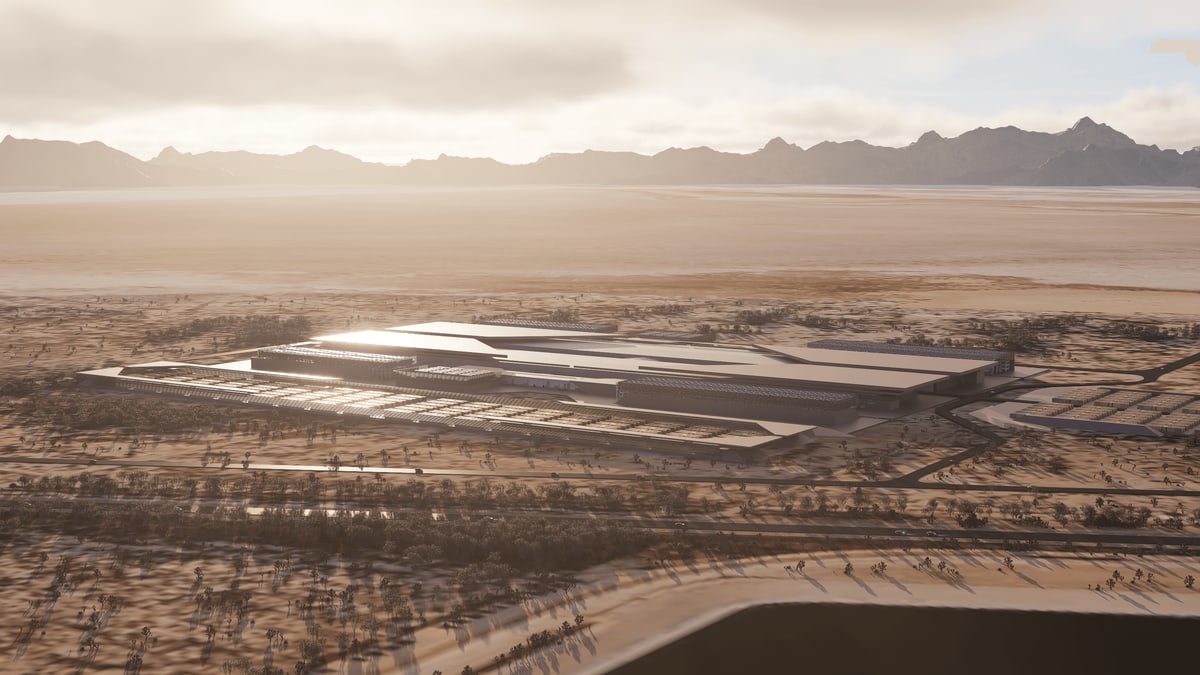
SpaceX says it plans to invest more than $74 billion in two new supercomputing campuses, huge data centers built to train AI. One is at Starbase, the Texas site where SpaceX builds and launches its Starship rocket, and the other is in Cochise County in southeast Arizona. SpaceX makes the Grok AI models, and it says the Arizona campus will train what it calls its "super intelligence models," without saying which models those are. Superintelligence means AI much smarter than people. It is a goal, and no one has built it.
The Arizona campus is the bigger of the two, at roughly $50 billion. SpaceX's page for it describes nine supercomputing buildings using up to six gigawatts of power. A gigawatt is a measure of electric power, and a typical U.S. nuclear reactor produces about one, according to the U.S. Energy Department. The plans also include a battery bank that stores up to 24 gigawatt-hours, enough to run the whole campus at full power for about four hours. For a rough sense of scale, SpaceX said in its third-quarter results that its AI data centers had a rated size of 1.7 gigawatts in all as of Sept. 30. SpaceX expects about 5,500 construction jobs and 1,000 permanent ones in Arizona.
SpaceX says it plans no industrial use of groundwater and no new wells at the Arizona site, cooling its machines with water that circulates in a closed loop instead of evaporating. Unlike the Texas site, the Arizona campus would get its power through local electric cooperatives, and SpaceX says it will have no power plant of its own, only backup generators that burn natural gas from an existing pipeline during outages and tests. SpaceX says working with local electric cooperatives could cut members' power bills by up to 20%. Its project page gives a different figure, cuts of 10 to 40% for members of the Sulphur Springs Valley Electric Cooperative.
The campus is not approved yet, and SpaceX says it is seeking approval. Cochise County says it received an application on Oct. 30 for nine data center buildings and a battery system near the Apache Generating Station, a power plant. The applicant is a company called Tombstone Resources L.L.C. The county says SpaceX hosted the Nov. 4 public meeting on the project. The county's planning and zoning commission will hold a public hearing on Dec. 9 and can approve the plan, add conditions or deny it. Its decision can be appealed to the county's Board of Supervisors. A petition with 2,400 signatures asks officials to deny the permit, according to a news report.
In Texas, SpaceX says it will spend about $24 billion on a supercomputing site on land it owns near the Port of Brownsville, on top of more than $15 billion already spent on Starship and Starbase. It says the work has already brought more than 3,000 construction jobs and will support more than 500 permanent ones. The site will make its own electricity rather than draw from the public grid, SpaceX says, with emissions controls but without naming the fuel. A city notice published earlier that week showed plans for a gas-fired power plant there, according to a news report.
As part of the Texas project, SpaceX says it has committed $220 million to help pay for planned water projects that would add about 20 million gallons a day for Brownsville and Cameron County. It says the city keeps ownership of them and SpaceX gets no special access to the water. SpaceX is also negotiating tax deals with local governments and argues for a property tax break paired with negotiated payments to those governments. Its reason is that the computers lose value fast, so the tax they owe would jump at first and then fall. Starbase, which is also a city, has a commission due to consider a property tax break for the Texas project on Dec. 9, according to a news report.