
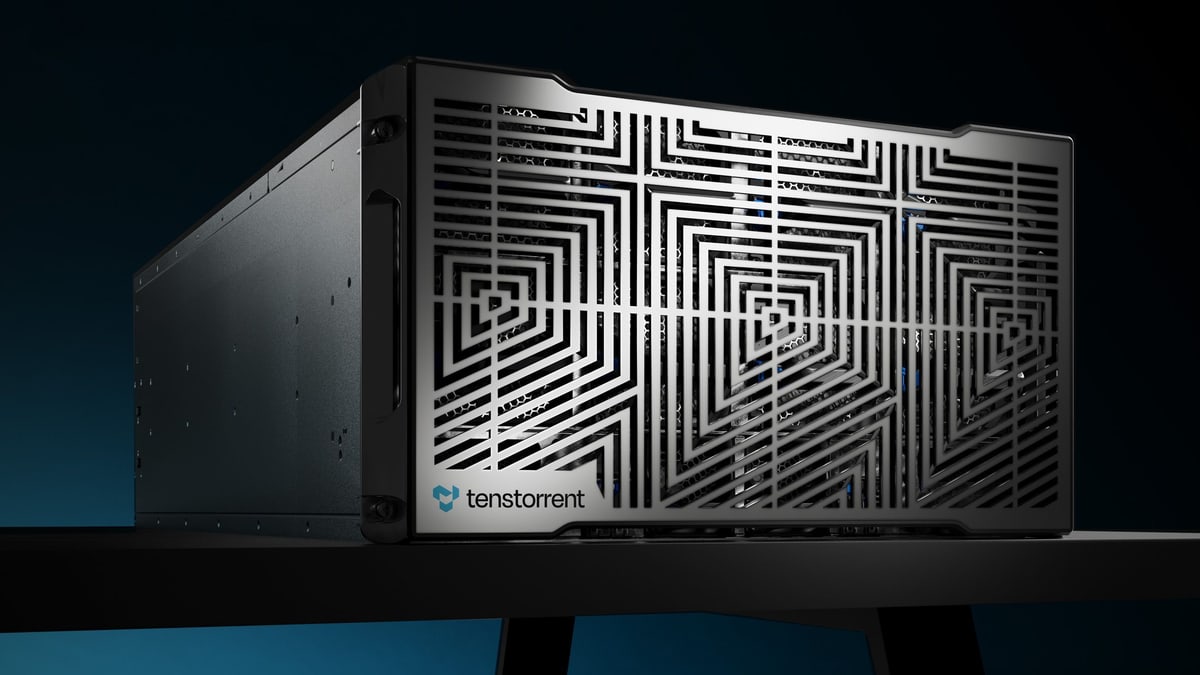
Tenstorrent, a company in Santa Clara, California, that designs chips and computers for AI, said on Monday, Oct. 19, that it has closed a $1.5 billion funding round that values it at $6.2 billion including the new money. Trace Capital and Innovation X led the round, joined by investors including ARK Invest, Fidelity, Morgan Stanley, Sandisk, T. Rowe Price and Tether Investments. In its last round, in December 2024, Tenstorrent raised more than $693 million at a $2 billion valuation before that money came in. Counting the new money in both rounds, its value has more than doubled in under two years.
Tenstorrent sells AI hardware from a single card or workstation up to racks of servers and large clusters, and it licenses its chip designs to companies that make their own chips, including Samsung and LG, the company says. Its processors are built on RISC-V, an open standard for the basic instructions a processor understands, which any company may use without paying fees. Tenstorrent's software for running AI on its chips is open source, free for anyone to use, study, change and share.
The company says it will use the money to deploy its Galaxy servers at scale, keep running freely downloadable AI models for text and video on them, and improve the chip designs it licenses. Its website lists a Galaxy server with 32 of its Blackhole chips from $160,000, and a cluster of four such servers from $640,000. "We built one architecture and sell it at every size," said Jim Keller, Tenstorrent's chief executive, who earlier designed chips at Apple and AMD and led the design of Tesla's self-driving car chip.
The speed claims come from the company and its investors. Tenstorrent's website says Galaxy leads the industry on standard tests of how fast it makes video, and George Bousis of Protagonist, an investor, said Tenstorrent's "video generation results beat industry benchmarks ahead of our expectations." Neither gave outside test results with the announcement.
Tenstorrent did not say how much revenue it makes, how many Galaxy servers it has sold or who its largest customers are. When it raised money in December 2024, its chief operating officer pointed to about $150 million in deals closed; the company gave no new figure this time, and it has not said how much each investor put in.