
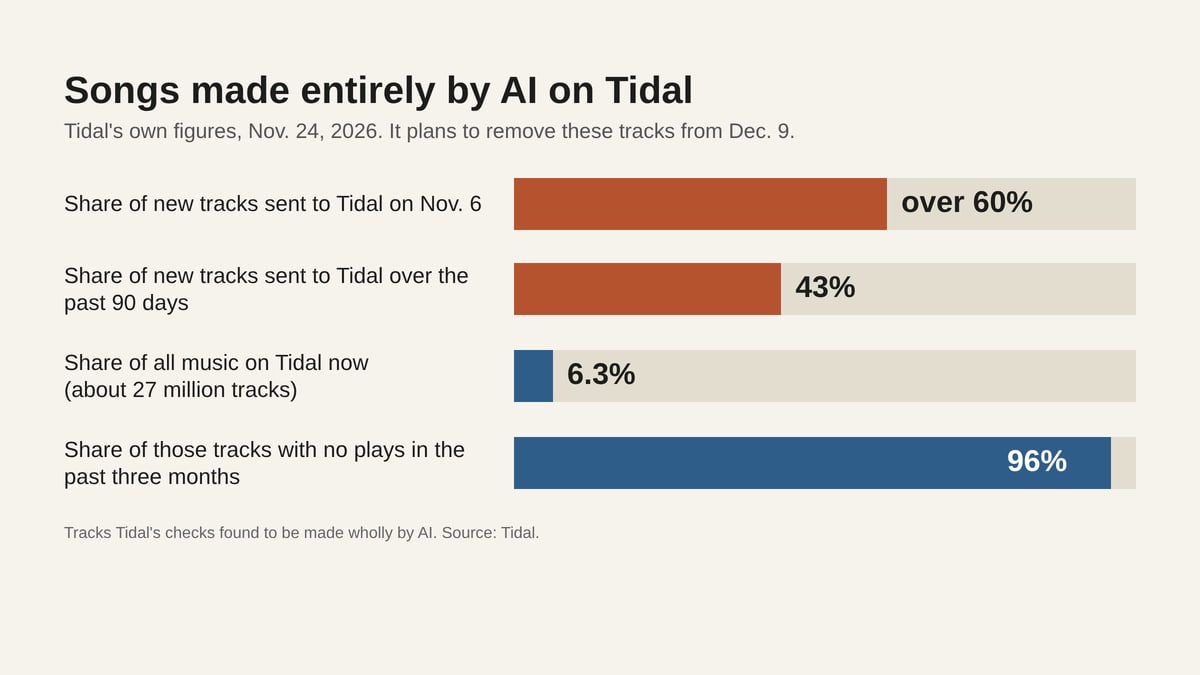
Tidal, the music streaming service owned by Block, said on Nov. 24 that it will remove every song it finds was made entirely by AI and refuse new ones, starting Dec. 9. Tidal says these include tracks from tools such as Suno and Lyria, which turn a typed request into a finished recording. Tidal says about 27 million tracks on the service are tagged as made entirely by AI, about one in 16 of all its songs.
Tidal will also bar the distributors that deliver artists' music to streaming services from sending such tracks, and will reject any delivery whose details say it was made only with AI tools. Songs that people made with help from AI tools are still allowed, and the rules also cover music artists upload to Tidal themselves. Robert Andersen, who leads Tidal at Block, says removal starts Dec. 9 and the songs will be gone by the beginning of 2027. He puts the number to be deleted at 29 million, more than the 27 million Tidal's own announcement gives, and says Tidal expects to turn away an estimated 80,000 to 85,000 songs a day.
The ban goes further than the rules Tidal brought in on June 29. Under them, songs made entirely by AI could stay on the service with a label but earned no royalties, the money paid to rights holders when a song is played. AI songs were taken down only when they broke its rules, such as fakes of real artists or floods of uploads tied to fraud. Tidal says that over the past 90 days, its checks found 43% of all tracks sent to it were made entirely by AI, and over 60% on Nov. 6 alone. It says 96% of those 27 million tracks got no plays at all in the past three months, and that at this scale the real artists its listeners want to find get buried.
Tidal says it has already taken down over 65,000 tracks flagged as suspected fakes using real artists' names, which it says take plays and royalties from those artists and confuse fans. Andersen says Tidal is the first streaming service to ban such songs, and urges others to follow. According to a news report, Spotify, YouTube Music, Deezer and Apple Music still allow AI music with a label, though Spotify has removed millions of AI tracks that listeners reported.
The rule depends on Tidal telling AI-made songs apart from songs people made. Tidal says it relies on technology from Ircam Amplify, a company it calls its AI detection partner, but has not said how well the checks work. It says it acts only on songs made entirely by AI because detection tools are still limited and it wants to avoid flagging real artists by mistake, so songs partly made by AI may go unlabeled. Its current rules say it will widen that to songs largely made by AI as detection becomes more reliable, and that it takes no action against songs whose music or lyrics were written with AI. For now, artists who say they did not use AI on a flagged track can appeal through Tidal's support form.