
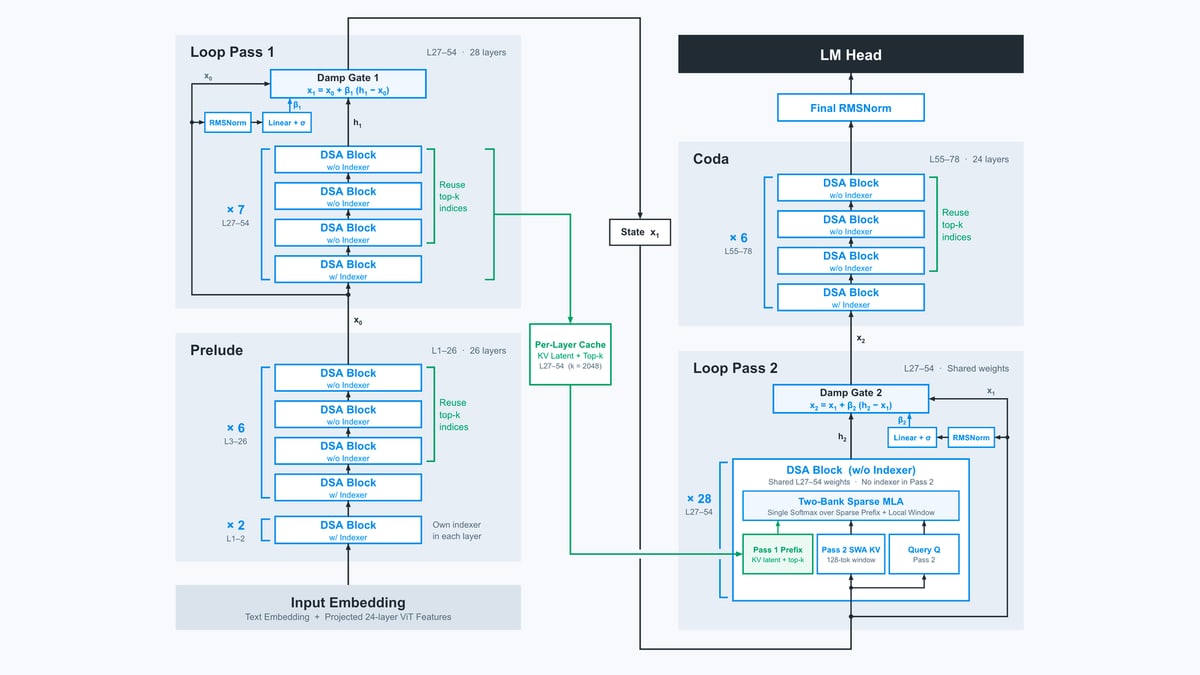
Z.ai, a Chinese AI company that grew out of research at Tsinghua University, released GLM-5.4 on Monday, Nov. 23. Z.ai says it is its new top model for writing code, and the first of its top models built on a design it calls the Loop Transformer. Z.ai puts the model at about 750 billion parameters, the numbers a model tunes as it learns. It says GLM-5.4 performs at the level of models with 2 trillion to 3 trillion parameters, though it has published no test scores to show it.
Most AI models of this kind handle text by passing it through a stack of layers, processing steps that each rework the text a little and hand it on, and each layer runs once. GLM-5.4 instead runs a block of 28 middle layers twice, and the second pass refines what the first one produced. That gives the model more steps to work through a hard problem without adding parameters. Z.ai says the idea dates back to 2018, but models built this way from the start have lagged behind ordinary ones given the same amount of training. So Z.ai took its existing GLM-5 model and trained it further into the new shape.
Z.ai tested the design on smaller models first. On a test model of 30 billion parameters, it says the version with the loop did clearly better than the same model without it, while using about 10% more computing power in training. Z.ai says the biggest gains came in math, science questions and tasks with long documents to keep track of, and that the looped version's output, mostly its step-by-step working, was 10% to 14% shorter on most tests. Those results come from the smaller test model, not from GLM-5.4 itself.
GLM-5.4 is available now in Z.ai's chat app, its ZCode coding tool and its GLM Coding Plan. The plan, from $18 a month or $12.60 a month paid yearly, lets subscribers use Z.ai's models inside the coding tools it supports, such as Claude Code. It measures use in credits, with caps every five hours and every week, and GLM-5.4 costs about a third fewer credits than the older GLM-5.3 for the same amount of text, so the weekly allowance goes further. Z.ai lists access for developers' own apps as coming soon, and says it plans to let anyone download the model after more safety work.
Z.ai shows the model writing code to make a music video, design a robot arm in the FreeCAD design program and build a game. Z.ai also says GLM-5.4 has a weakness: the model can get caught in very long stretches of working through a problem, though the company says that extra checking of its own work makes its answers more accurate.
Z.ai has not published test scores for GLM-5.4 itself, including against models from OpenAI, Anthropic or Google, so how it measures up against them is not yet known. It has given no dates for developer access or the download.