
Google DeepMind and Singapore's Government Technology Agency have trained an AI model meant to run on a person's phone and warn them when a chat looks like a scam. Google DeepMind announced the work on Wednesday, Oct. 14, and Singapore's minister for digital development and information, Josephine Teo, described it the same day at Singapore International Cyber Week. Google DeepMind says scams make up more than half of Singapore's reported crimes and have cost people there more than S$4 billion since 2019.
Google DeepMind says scammers have moved from simple phishing to convincing conversations that win a victim over before asking for money, and that these now account for up to 80% of losses. Traditional scam filters check messages on a company's servers, but many messaging apps scramble chats so that only the people in them can read them, which leaves those filters unable to see the conversation.
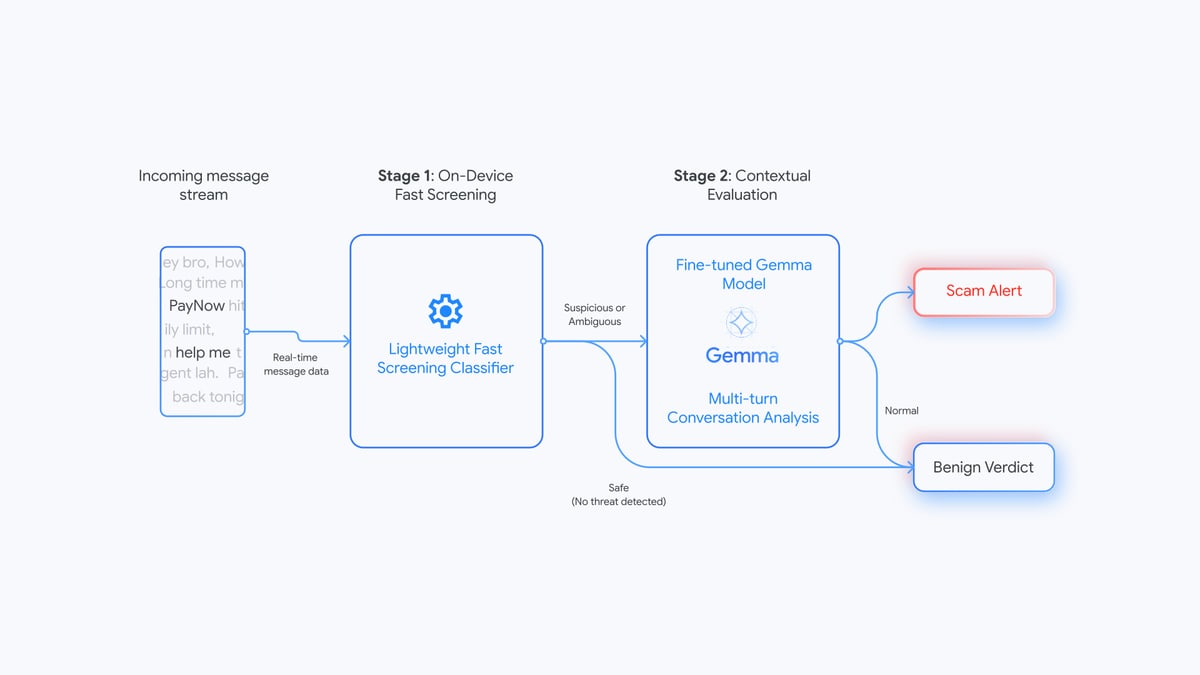
The new model is designed to do its checking on the phone itself, and Google says it is meant for Android devices. A small, fast program first screens incoming messages and passes on the suspicious or unclear ones. A version of Google's lightweight Gemma AI model then reads a longer stretch of the conversation to confirm the threat or dismiss a false alarm. If it finds signs of manipulation, a warning would appear on screen telling the person to pause before sending money or sensitive details. Google DeepMind says it split the work into two steps because running such a model on a phone is hard on the battery.
The two teams fine-tuned the Gemma model on local scam conversations, giving it extra training that adapts an already trained model to a specific job. The examples ranged from people pretending to be public agencies, banks or local figures to schemes spreading in the region. Google DeepMind says the training left out private and identifying information, used scam reports and intelligence feeds with personal details removed, and took place in a Google Cloud setup that the agency runs.
Google DeepMind says that because the model runs entirely on the phone, neither the Singapore government nor Google will be able to read people's conversations through it, and that the model will see chats only if the user agrees, under the terms of the app it comes in. "If our devices can recognise signs of manipulation early, we can help potential victims avoid financial or credential loss, while keeping their personal messages on their devices," Teo said.
No one can use it yet. Google DeepMind says the model will reach apps in careful phases, worked out with the Singapore government, and the company has not said which apps will carry it or when. It says the model was tested on made-up conversations and local scam data, but it has published no figures on how often it catches scams or wrongly flags ordinary chats. The company says it is exploring similar technology for other countries.