
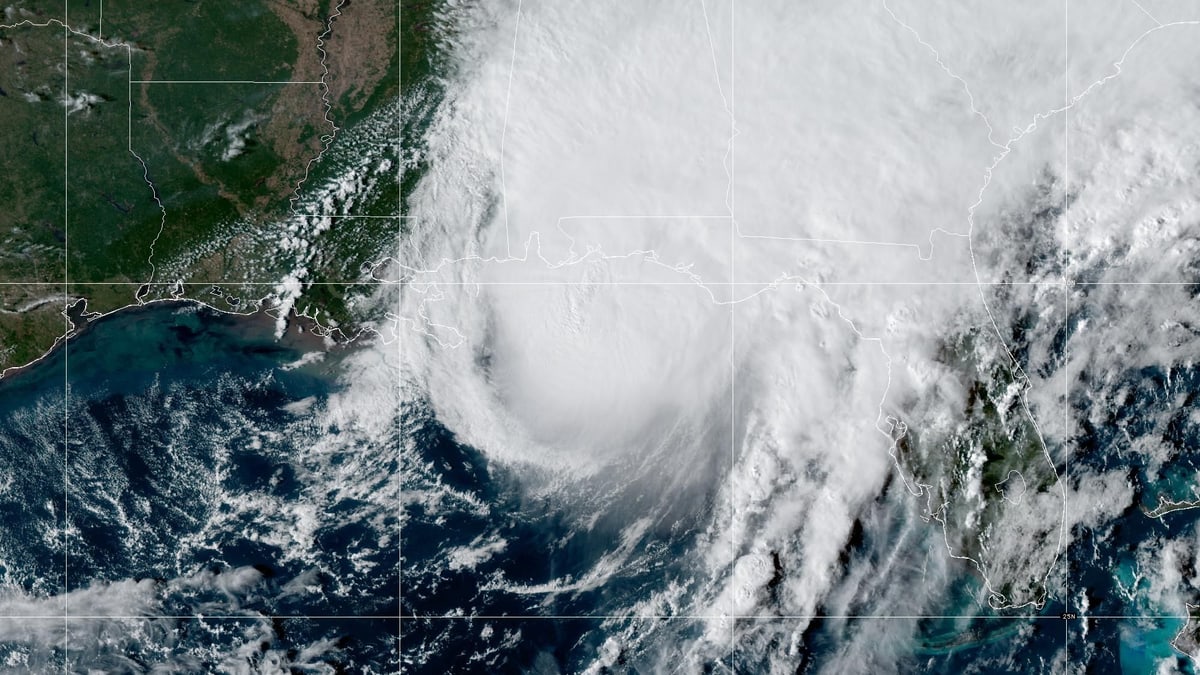
Forecasters at the U.S. National Hurricane Center leaned heavily on an AI model from Google DeepMind to forecast Hurricane Isaias this week. In the notes they publish with every update, they said several times that they were leaning on two guides more than the rest: the average of the Google model's many possible forecasts, and the corrected consensus, a combined forecast that averages several models. On Friday morning, hours before landfall, they wrote that the Google DeepMind guidance on the storm's path "has been very accurate for Isaias." The storm came ashore near Destin, Florida, at about 8:30 p.m. Central time on Friday, Oct. 9, as a Category 2 hurricane, the second step on the center's 1-to-5 scale, which rates a hurricane only by its top sustained wind speed.
Most weather forecasts come from physics: supercomputers solve equations that describe how the atmosphere works and run them forward in time. AI weather models learn from records of past weather instead, and Google says its model can produce a 15-day forecast in less than a minute. Google says that this year the model runs 1,000 slightly different versions of each storm's future, up from 50 last year, to help forecasters spot rare but dangerous outcomes, such as a storm that strengthens very quickly. The forecasters' average is the middle of those many versions.
The center's first forecast came on Tuesday, Oct. 6, when Isaias was still an unnamed tropical depression in the Gulf. It called for a hurricane by Thursday and winds of 100 miles an hour, Category 2 strength, as the storm neared the coast on Friday. That first forecast of the storm's path sat closest to two AI models, Google's among them. Through Thursday, the AI models placed the storm farther east and moving faster than the physics models did, and on Wednesday the center shifted its forecast path east, toward the AI models. It called the Google average and the corrected consensus "our best performing track guidance this year," meaning the guides that had best predicted storms' paths. On Thursday night, when most of the Google model's versions, and some other hurricane models, showed Isaias briefly becoming a major hurricane, Category 3 or higher, the center added that to its forecast.
Isaias became a major hurricane on Friday morning, and at 4 p.m. it still had winds of 115 miles an hour, a Category 3. It weakened to a Category 2 by the time it came ashore that evening, a little weaker than the center's last forecasts had expected. The center's director, Michael Brennan, said in a news interview this week that the AI models "have shown more consistency" from one run to the next than the physics models, and that his team has worked with Google to train the model on the center's own detailed records of past storms' paths and strength. Google says its model also helped the center forecast Hurricane Melissa's rapid strengthening before it struck Jamaica last year.
The AI model was one input, not the forecast. Forecasters still measured the storm with Hurricane Hunter aircraft and satellites, and checked the AI against physics-based models; on Thursday night their path forecast sat closest to the corrected consensus rather than to Google's model alone. Brennan called the AI models "another tool in the toolbox."
It is not yet clear how Google's model did against the physics models over the storm's whole life, or why Isaias came ashore weaker than forecast. Isaias was the season's first Atlantic hurricane, and NOAA says no season since at least 1905 had waited so long for one. It is expected to bring damaging wind gusts and heavy, flooding rain inland across the Southeast through the weekend.