
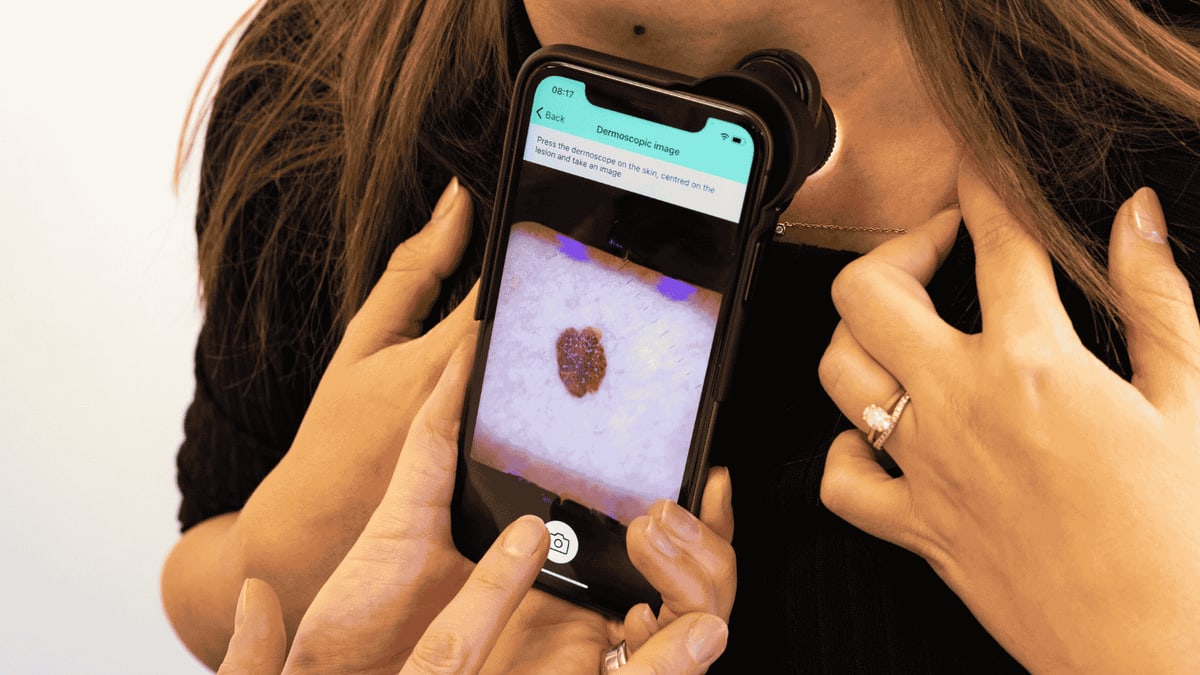
The NHS in England's South East is rolling out an AI system that looks at close-up photos of worrying moles and other skin spots and, once a hospital is confident in it, can tell a patient a spot is harmless and take them off the urgent cancer list without a doctor checking. The system, called DERM and made by the British company Skin Analytics, will go live in all 18 NHS hospital trusts in the region from this autumn, the company announced on Oct. 6. It says the rollout reaches 9 million more people and is the largest use of medical AI working on its own in NHS history.
NHS England describes the process. A smartphone fitted with a magnifying lens photographs the spot, and the images are uploaded. DERM gives its assessment. If it judges the spot harmless, the person can be taken off the urgent cancer list, with advice to keep an eye on it and come back if it changes. If it sees signs of cancer or pre-cancer, an NHS dermatologist reviews the case.
The NHS needs the help. In 2023/24, more than 650,000 people in England were referred urgently for suspected skin cancer, and 120,000 of them did not have cancer confirmed or ruled out within the 28-day target, NHS England says. Skin Analytics says that, based on its own monitoring of the system in use, DERM correctly rules out skin cancer 99.5% of the time, and that it has assessed more than 250,000 patients over six years, finding more than 25,000 cancers. It is already used by 25 NHS partners in England. Modelling quoted in the company's announcement suggests up to a third of the region's urgent referrals could be discharged before a first hospital appointment, freeing about 13,500 specialist hours a year, around 27,000 extra appointments. NHS England puts the share DERM could discharge at around 30%.
NICE's backing comes with conditions. The National Institute for Health and Care Excellence, which assesses health technology for the NHS in England, in guidance first issued in May 2025, allows DERM only during a three-year period while more evidence is collected, then will decide whether it can be used routinely. It says DERM may spot cancer about as accurately as a dermatologist, but that it is still unclear whether it frees specialists to see other patients. Both NICE and NHS England say a health professional should still review the images of people with black or brown skin, because there are fewer of those cases in the data so far, though NHS England says results in these groups look similar so far. NHS England also says patients should be told about DERM and agree to its use.
"Using AI safely alongside clinical expertise means many people can receive reassurance sooner," said Daghni Rajasingam, NHS England's regional chief medical officer for the South East. The rollout follows Northern Ireland's approval of DERM to assess skin spots on its own for its 1.9 million people.
It is not yet clear what the region is paying, how many trusts will let the AI work alone from the start rather than first having a person double-check it, as NHS England advises, or whether the savings the company projects will hold up in practice.