
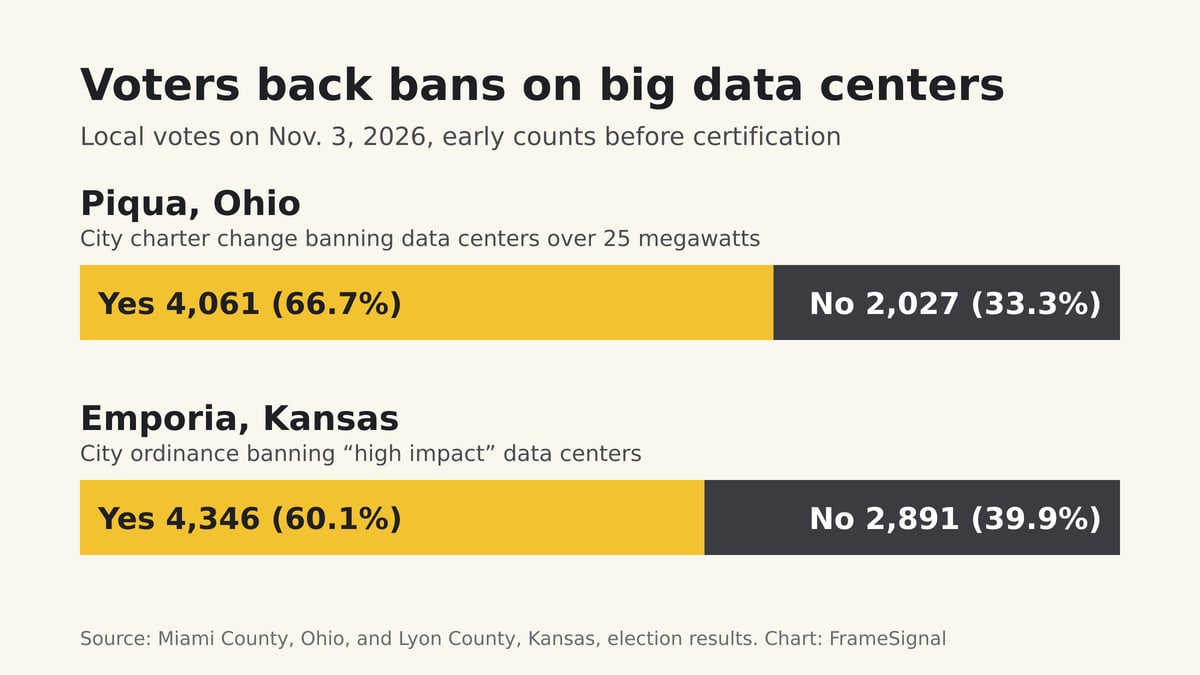
Voters in Piqua, Ohio, where Meta had proposed a data center, approved a ban on building large data centers on Tuesday, Nov. 3. The change to the city's charter passed 4,061 to 2,027, about two votes in three, in Miami County's unofficial count. It forbids building any new data center whose monthly demand or peak load tops 25 megawatts of power.
Data centers are buildings packed with computers that store, process and send out data. According to a news report, tech companies are pushing hard to build them to run their AI. In August, Meta said that if its Piqua project went ahead, it would "back the region with a $1 billion direct investment," according to the city. The city said Piqua would then also join a $1 billion Meta fund for U.S. communities where Meta runs data centers. In a letter to city commissioners, Meta also pledged $8 million for equipment and staff for the city's police, fire and ambulance services, the city said at the time.
Data centers were on the ballot in many other places. According to a news report, 33 measures to restrict data centers had passed or were leading in the count late Tuesday, and about a dozen more were still waiting for results. They ranged from outright bans and temporary pauses to limits on energy use, rules requiring a public vote before construction, and advisory votes urging officials to restrict data centers. So far only one vote, in North Dakota, went the way of people who backed building data centers, the report says.
In Emporia, Kansas, voters approved an ordinance banning "high impact" data centers, 4,346 to 2,891 in Lyon County's count. The ordinance defines those as sites that need more than 10 megawatts of power at peak or draw more than 100,000 gallons of water a day, and the city's ballot notice names "AI training facilities" among them. The ban will not take effect right away. The Lyon County District Court has ordered that it cannot be published or take effect until the court rules on whether it is valid, or orders otherwise. The ban began as a petition from residents, and the city government argues in that case that Kansas law does not let voters decide this kind of question.
Activists have raised worries about energy costs, pollution, water use, noise and the loss of farmland, according to the news report. It also cites an exit poll in which 56% of voters said AI and data centers were a crucial or major factor in their vote for Congress.
The results are not final until they are certified. Some of the other measures were advisory, so they do not bind local officials, according to another news report. It is not yet clear whether Meta still plans to build in Piqua.